Loading...
Done
Piper Hoppe, 10, from Minnetonka, Minnesota, holds a sign at the doorway of River Bluff Dental clinic in protest against the killing of a famous lion in Zimbabwe, in Bloomington, Minnesota July 29, 2015. (Photo by Eric Miller/Reuters)

Piper Hoppe, 10, from Minnetonka, Minnesota, holds a sign at the doorway of River Bluff Dental clinic in protest against the killing of a famous lion in Zimbabwe, in Bloomington, Minnesota July 29, 2015. A Zimbabwean court on Wednesday charged a professional local hunter Theo Bronkhorst with failing to prevent an American from unlawfully killing “Cecil”, the southern African country's best-known lion. The American, Walter James Palmer, a Minnesota dentist who paid $50,000 to kill the lion, has left Zimbabwe. He says he did kill the animal but believed the hunt was legal and that the necessary permits had been issued. (Photo by Eric Miller/Reuters)
Details
30 Jul 2015 12:01:00
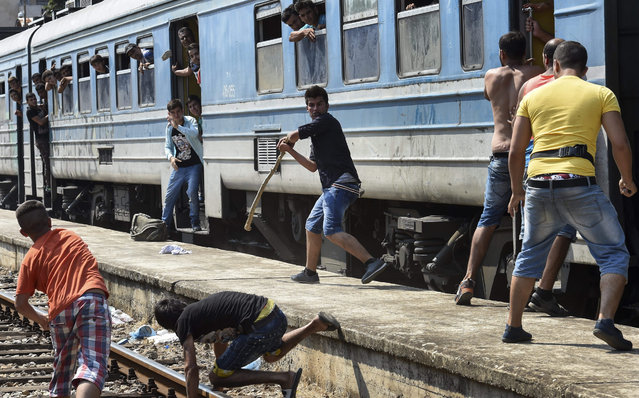
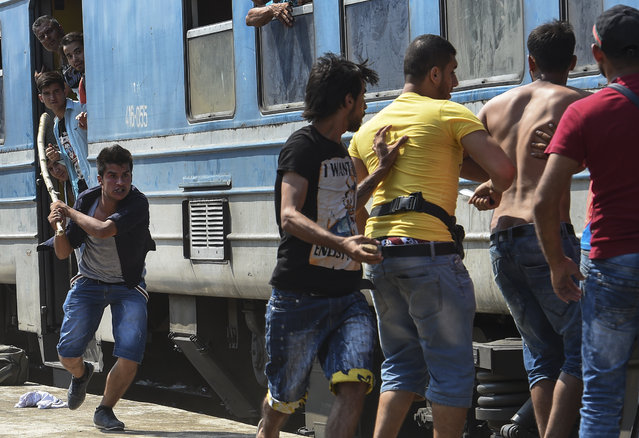
Migrants with a stick, stones and knife fight with each other after a brawl erupted over a place in an overcrowded train heading to the Serbian border at the train station in Gevgelija, The Former Yugoslav Republic of Macedonia, 14 August 2015. (Photo by Georgi Licovski/EPA)

Migrants with a stick, stones and knife fight with each other after a brawl erupted over a place in an overcrowded train heading to the Serbian border at the train station in Gevgelija, The Former Yugoslav Republic of Macedonia, 14 August 2015. The number of migrants passing through Macedonia increases day by day, local sources said. From the beginning of the year to mid-June 2015, nearly 160,000 migrants landed in the southern European countries, mainly Greece and Italy, on their way to wealthier countries in Western and Northern Europe, according to estimates by the International Organization for Migration (IOM). (Photo by Georgi Licovski/EPA)
Details
15 Aug 2015 11:10:00
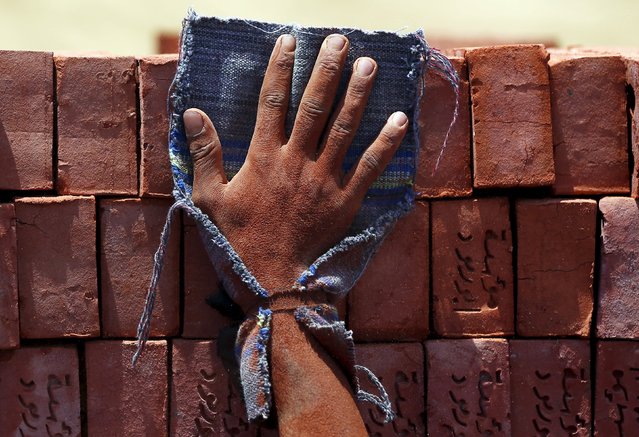
A hand of a labourer pushes bricks at a traditional brick factory in Arab Mesad district of Helwan, northeast of Cairo, May 14, 2015. (Photo by Amr Abdallah Dalsh/Reuters)

A hand of a labourer pushes bricks at a traditional brick factory in Arab Mesad district of Helwan, northeast of Cairo, May 14, 2015. About 45 labourers are employed at the brick factory and most work 10 hours a day. Adult workers earn a daily wage of 70 Egyptian pounds ($9) and child workers earn 40 Egyptian pounds ($5). The labourers, who are usually temporary or seasonally employed in Egypt's brick-making industry, experience unsafe work conditions, according to local media. (Photo by Amr Abdallah Dalsh/Reuters)
Details
19 May 2015 11:37:00
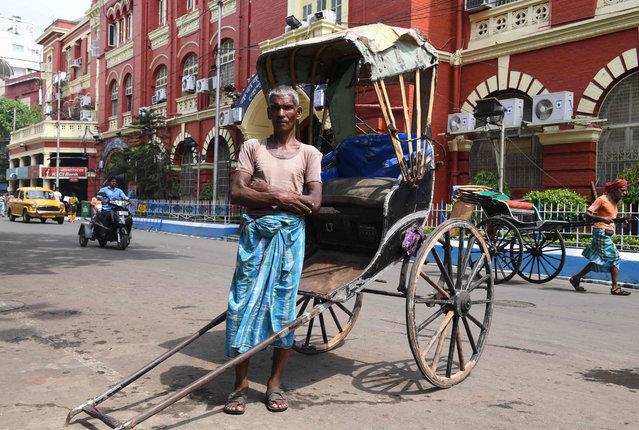
Mohammad Ashgar, 65, an Indian rickshaw puller, poses for a photograph next to his rickshaw in Kolkata on April 21, 2018. A mainstay of 19 th century transportation options, the hand- pulled rickshaw survives in India only in Kolkata after being outlawed elsewhere. The local puller's union puts the number of pullers in the city at 3,000. The union has resisted all previous attempts to ban their livelihood, previously organising mass protests of their members against moves to stamp out the practice. (Photo by Dibyangshu Sarkar/AFP Photo)

Ahead of May Day, AFP' s video and photo teams spoke to men and women around the globe whose jobs are becoming increasingly rare, particularly as technology transforms societies. Here: Mohammad Ashgar, 65, an Indian rickshaw puller, poses for a photograph next to his rickshaw in Kolkata on April 21, 2018. (Photo by Dibyangshu Sarkar/AFP Photo)
Details
02 May 2018 00:01:00
Migrants with a stick, stones and knife fight with each other after a brawl erupted over a place in an overcrowded train heading to the Serbian border at the train station in Gevgelija, The Former Yugoslav Republic of Macedonia, 14 August 2015. The number of migrants passing through Macedonia increases day by day, local sources said. From the beginning of the year to mid-June 2015, nearly 160,000 migrants landed in the southern European countries, mainly Greece and Italy, on their way to wealthier countries in Western and Northern Europe, according to estimates by the International Organization for Migration (IOM). (Photo by Georgi Licovski/EPA/EFE)

Migrants with a stick, stones and knife fight with each other after a brawl erupted over a place in an overcrowded train heading to the Serbian border at the train station in Gevgelija, The Former Yugoslav Republic of Macedonia, 14 August 2015. (Photo by Georgi Licovski/EPA/EFE)
Details
15 Jul 2018 00:05:00
A woman wears a plastic water bottle with a cutout to cover her face, as she walks on a footbridge in Hong Kong on January 31, 2020, as a preventative measure following a virus outbreak which began in the Chinese city of Wuhan. The World Health Organization, which initially downplayed the severity of a disease that has now killed 170 nationwide, warned all governments to be “on alert” as it weighed whether to declare a global health emergency. (Photo by Anthony Wallace/AFP Photo)

A local wears a plastic water bottle with a cutout to cover her face, as she walks on a footbridge in Hong Kong on January 31, 2020, as a preventative measure following a virus outbreak which began in the Chinese city of Wuhan. The World Health Organization, which initially downplayed the severity of a disease that has now killed 170 nationwide, warned all governments to be “on alert” as it weighed whether to declare a global health emergency. (Photo by Anthony Wallace/AFP Photo)
Details
03 Feb 2020 00:03:00
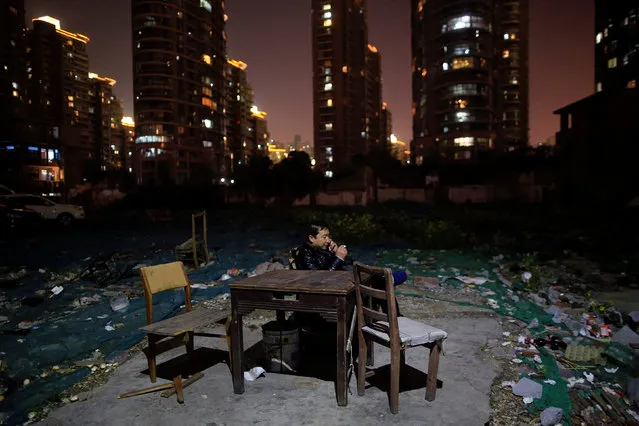
Li Guoqiang talks on his phone outside his house at Guangfuli neighbourhood, in Shanghai, China, April 1, 2016. Li, 38, is a deliveryman who rents a place at Guangfuli. (Photo by Aly Song/Reuters)

Li Guoqiang talks on his phone outside his house at Guangfuli neighbourhood, in Shanghai, China, April 1, 2016. Li, 38, is a deliveryman who rents a place at Guangfuli. In a corner of Shanghai, surrounded by a cement wall, lies one of the world's most valuable fields of debris and garbage. On paper, the Guangfuli neighbourhood is a real estate investor's dream: a plot in the middle of one of the world's most expensive and fast-rising property markets. But the reality is more like a developer's nightmare, thanks to hundreds of people living there who have refused to budge from their ramshackle homes for nearly 16 years as the local authority sought to clear the land for new construction. (Photo by Aly Song/Reuters)
Details
06 May 2016 13:54:00
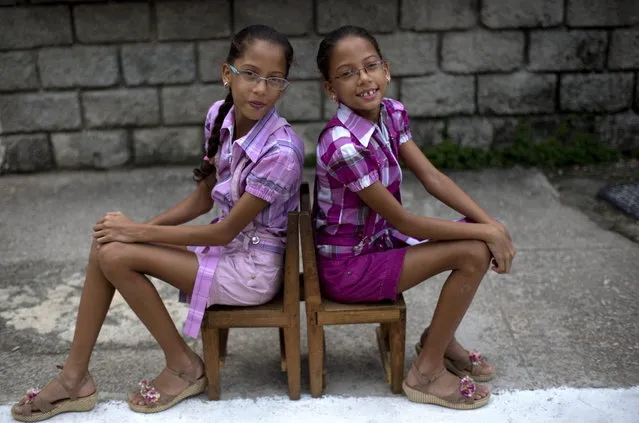
In this Sept. 29, 2013 photo, nine-year-old twin sisters Camila, left, and Carla Rodriguez pose for a portrait along their street in Havana, Cuba. 12 sets of twins live along two consecutive blocks in western Havana, ranging in age from newborns to senior citizens. “We love living on this block because we have twin friends”, said Carla. (Photo by Ramon Espinosa/AP Photo)

A street in the Cuban capital, Havana, is home to 12 sets of twins, ranging from toddlers to senior citizens. Some say it could be something in the water. Others point to a tree with mystical significance for locals. And maybe it's just chance. Photo: In this September 29, 2013 photo, nine-year-old twin sisters Camila, left, and Carla Rodriguez pose for a portrait along their street in Havana, Cuba. 12 sets of twins live along two consecutive blocks in western Havana, ranging in age from newborns to senior citizens. “We love living on this block because we have twin friends”, said Carla. (Photo by Ramon Espinosa/AP Photo)
Details
07 Oct 2013 06:44:00