Loading...
Done
Fans dressed as Darth Vader and Chewbacca take a boat trip to the Skelligs on May 4, 2018 in Portmagee, Ireland. (Photo by Charles McQuillan/Getty Images)

Fans dressed as Darth Vader and Chewbacca take a boat trip to the Skelligs on May 4, 2018 in Portmagee, Ireland. The first ever Star Wars festival is taking place against the backdrop of the famous Skellig Michael island which was used extensively in Episode VII and Episode VIII of the popular science fiction saga. The small fishing village of Portmagee, which is closest to the location, has seen a boom in tourism following the latest films. The vilage will host a Star Wars drive-in and a Star Wars themed Irish dancing competition over the weekend. (Photo by Charles McQuillan/Getty Images)
Details
07 May 2018 00:05:00
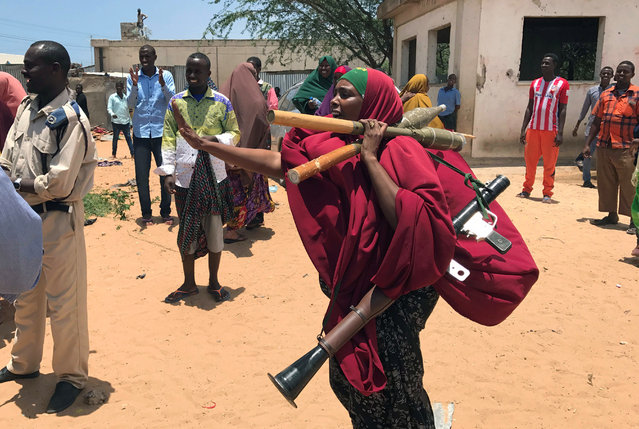
A Somali Armed Forces member carries her ammunition during fighting between the military and police backed by intelligence forces in the Dayniile district of Mogadishu, Somalia September 16, 2017. (Photo by Feisal Omar/Reuters)

A Somali Armed Forces member carries her ammunition during fighting between the military and police backed by intelligence forces in the Dayniile district of Mogadishu, Somalia September 16, 2017. (Photo by Feisal Omar/Reuters)
Details
18 Sep 2017 07:40:00
Trick rider Kendel Sampson performs during the trick riding session of the RAM Rodeo in Warkworth, Ontario, on August 1, 2013. The teenage Encore Presentation Trick Riders perform daring stunts every rodeo season in towns throughout Canada. (Photo by Norm Betts/Barcroft Media)

Trick rider Kendel Sampson performs during the trick riding session of the RAM Rodeo in Warkworth, Ontario, on August 1, 2013. The teenage Encore Presentation Trick Riders perform daring stunts every rodeo season in towns throughout Canada. (Photo by Norm Betts/Barcroft Media)
Details
03 Aug 2013 11:38:00
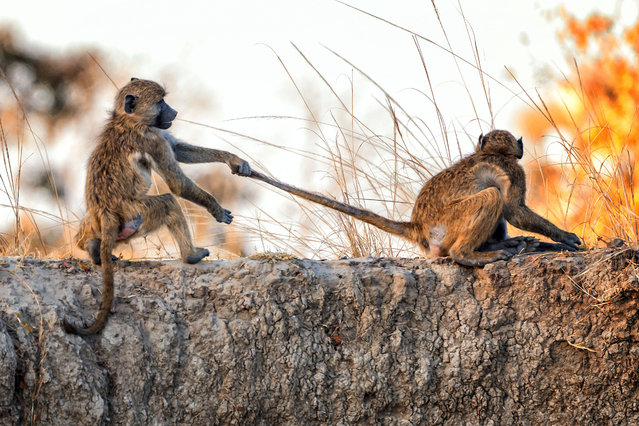
Going toe-to-toe, these fighting primates could give Floyd Mayweather a run for his money. The amazing images – captured by Australian tourist Julie Rathbone on the banks of the Zambezi river in Africa – show the pair engaging in a few fisticuffs. The Chacma baboons appeared to settle a disagreement by fighting - before a senior baboon plays referee and steps in to break it up. Nurse unit manager Julie Rathbone, 59, from New South Wales, was on a cruise down the river when she spotted the fracas unfolding. (Photo by Julie Rathbone/Caters News)

Going toe-to-toe, these fighting primates could give Floyd Mayweather a run for his money. The amazing images – captured by Australian tourist Julie Rathbone on the banks of the Zambezi river in Africa – show the pair engaging in a few fisticuffs. The Chacma baboons appeared to settle a disagreement by fighting – before a senior baboon plays referee and steps in to break it up. Nurse unit manager Julie Rathbone, 59, from New South Wales, was on a cruise down the river when she spotted the fracas unfolding. (Photo by Julie Rathbone/Caters News)
Details
28 Mar 2015 12:05:00
Will Burrard-Lucas takes a photo while a Meerkat perches on his lens on January 2014 in Makgadikgadi, Botswana. These adorable Meerkats used a photographer as a look out post before trying their hand at taking pictures. The beautiful images were caught by wildlife photographer Will Burrard-Lucas after he spent six days with the quirky new families in the Makgadikgadi region of Botswana. Will has photographed Meerkats in the past and was delighted when he realised he would be shooting new arrivals. (Photo by Will Burrard-Lucas/Barcroft Media)

Will Burrard-Lucas takes a photo while a Meerkat perches on his lens on January 2014 in Makgadikgadi, Botswana. These adorable Meerkats used a photographer as a look out post before trying their hand at taking pictures. The beautiful images were caught by wildlife photographer Will Burrard-Lucas after he spent six days with the quirky new families in the Makgadikgadi region of Botswana. Will has photographed Meerkats in the past and was delighted when he realised he would be shooting new arrivals. (Photo by Will Burrard-Lucas/Barcroft Media)

P.S. All pictures are presented in high resolution. To see Hi-Res images – just TWICE click on any picture. In other words, click small picture – opens the BIG picture. Click BIG picture – opens VERY BIG picture (if available; this principle works anywhere on the site AvaxNews)
Details
13 Apr 2014 08:42:00
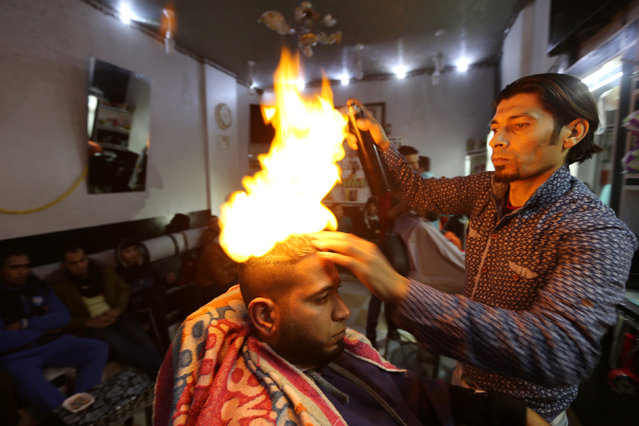
Palestinian barber Ramadan Odwan styles and straightens the hair of a customer with fire at his salon in Rafah, in the southern Gaza Strip February 2, 2017. In Ramadan Odwan's barbershop in Gaza, hair isn't just blow-dried, it's blowtorch-dried. “People have gone crazy about it, many people are curious to go through the experience and they are not afraid”, he told Reuters. “People here love adventures”. Odwan, 37, is not the first stylist in the world to use flame to straighten hair, but his craft is unique in the Gaza Strip. In his salon in the southern Gaza town of Rafah, Odwan applied what he described as a protective liquid coating to a customer's hair – he declined to disclose its contents – before aiming for the head and pressing the button on a small blowtorch. “I control how long I apply fire, I keep it on and off for 10 seconds or 15 seconds. It is completely safe and I have not encountered any accident since I started it two months ago”, Odwan added. Odwan charges 20 shekels ($5.20) for a haircut and fire-straightening. A barber for the past 18 years, he said part of the reason he uses the technique is to show that Palestinian barbers are as “professional as those out there around the world”. (Photo by Ibraheem Abu Mustafa/Reuters)

Palestinian barber Ramadan Odwan styles and straightens the hair of a customer with fire at his salon in Rafah, in the southern Gaza Strip February 2, 2017. In Ramadan Odwan's barbershop in Gaza, hair isn't just blow-dried, it's blowtorch-dried. “People have gone crazy about it, many people are curious to go through the experience and they are not afraid”, he told Reuters. “People here love adventures”. (Photo by Ibraheem Abu Mustafa/Reuters)
Details
11 Feb 2017 00:05:00
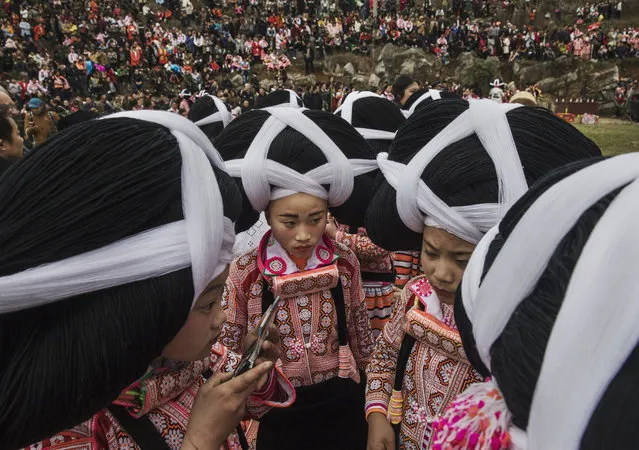
Girls of the Long Horn Miao ethnic minority group wear headdresses as they prepare gather for Tiaohua or Flower Festival as part of the Lunar New Year on February 6, 2017 in Longga village, Guizhou province, southern China. The Long Horn Miao are recognized for their declining practice of wrapping a blend of linen, wool, and the hair of their ancestors around animal horns or a wooden clip to make headdresses. Many young women say they now wear the headdresses only for special occasions and festivals, as the ornaments, which are attached by the horns to their real hair, have proved impractical for modern daily life in a fast changing world. China officially recognizes 56 different ethnic minorities, and statistics show over 7 million Chinese identifying themselves as Miao. But the small Long Horn Miao community counts only around 5000 people living in 12 villages, whose age-old traditions, language, and culture are fading. It is increasingly difficult in a modernizing China, as young people are drawn from remote rural villages to opportunities in bigger cities amongst wide-scale urbanization. Farming and labour remain the mainstays of life for the Long Horn Miao, leaving the area relatively poor in comparison with many parts of China. The government has invested significant amounts into local infrastructure and the tourism industry to try to bolster the local economy. (Photo by Kevin Frayer/Getty Images)

Girls of the Long Horn Miao ethnic minority group wear headdresses as they prepare gather for Tiaohua or Flower Festival as part of the Lunar New Year on February 6, 2017 in Longga village, Guizhou province, southern China. (Photo by Kevin Frayer/Getty Images)
Details
13 Feb 2017 00:01:00
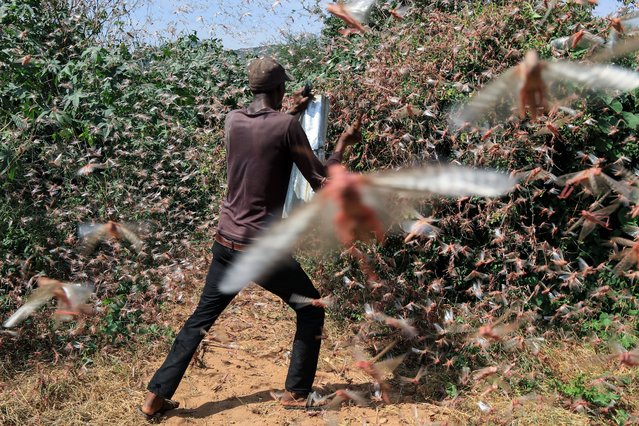
A man uses iron sheet to make noises, as a way of trying to disperse desert locusts that had invaded their farms during the second wave invasion in Kakongo village, in Nuu-Mwingi East, in Kitui, Kenya, 06 February 2021. The second wave invasion of the desert locusts in the country comes at a time where most famers are expecting to harvest their farm produce in the country. According to the United Nations Food and Agriculture Organization (FAO), on 04 February, warned numerous immature desert locust swarms persist in southern Ethiopia and Kenya. Some of the swarms are in community areas and therefore cannot be treated. In Kenya, immature swarms continue to spread westwards across northern and central counties where there are currently about 20 small swarms present, mostly about 50 hectares in size, it said. (Photo by Daniel Irungu/EPA/EFE)

A man uses iron sheet to make noises, as a way of trying to disperse desert locusts that had invaded their farms during the second wave invasion in Kakongo village, in Nuu-Mwingi East, in Kitui, Kenya, 06 February 2021. The second wave invasion of the desert locusts in the country comes at a time where most famers are expecting to harvest their farm produce in the country. (Photo by Daniel Irungu/EPA/EFE)
Details
25 Feb 2021 08:17:00