Loading...
Done
Max Gold, 20, of NYC, cruises on his skateboard as thousands gather on the National Mall for the March for Science on Saturday, April 22, 2017, in Washington, DC.  Activists and scientists descend on the nation's capital to rally for environmental causes and government policies rooted in scientific research as part of the Earth Day and March for Science rallies. (Photo by Jahi Chikwendiu/The Washington Post)

Max Gold, 20, of NYC, cruises on his skateboard as thousands gather on the National Mall for the March for Science on Saturday, April 22, 2017, in Washington, DC. Activists and scientists descend on the nation's capital to rally for environmental causes and government policies rooted in scientific research as part of the Earth Day and March for Science rallies. (Photo by Jahi Chikwendiu/The Washington Post)
Details
22 May 2017 07:38:00
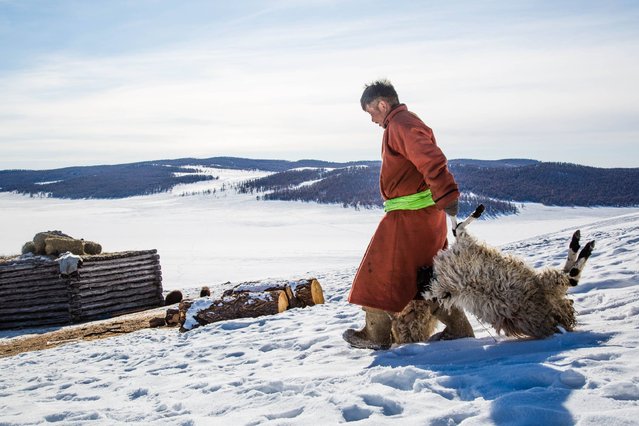
This handout photo taken on February 12, 2017 and released on February 16 by the International Federation of Red Cross and Red Crescent Societies (IFRC) shows Mongolian herder Munkhbat Bazarragchaa (C) dragging two sheep – which recently died due to the weather - to a pile of dead animals behind his “ger” in Khuvsgul province, northern Mongolia. Thousands of Mongolian herders face disastrous livestock losses from dreaded severe weather  known as the “dzud”, the Red Cross said on February 16, 2017 in launching an international emergency aid appeal. (Photo by Mirva Helenius/AFP Photo/IFRC)

This handout photo taken on February 12, 2017 and released on February 16 by the International Federation of Red Cross and Red Crescent Societies (IFRC) shows Mongolian herder Munkhbat Bazarragchaa (C) dragging two sheep – which recently died due to the weather - to a pile of dead animals behind his “ger” in Khuvsgul province, northern Mongolia. Thousands of Mongolian herders face disastrous livestock losses from dreaded severe weather known as the “dzud”, the Red Cross said on February 16, 2017 in launching an international emergency aid appeal. (Photo by Mirva Helenius/AFP Photo/IFRC)
Details
17 Feb 2017 11:40:00
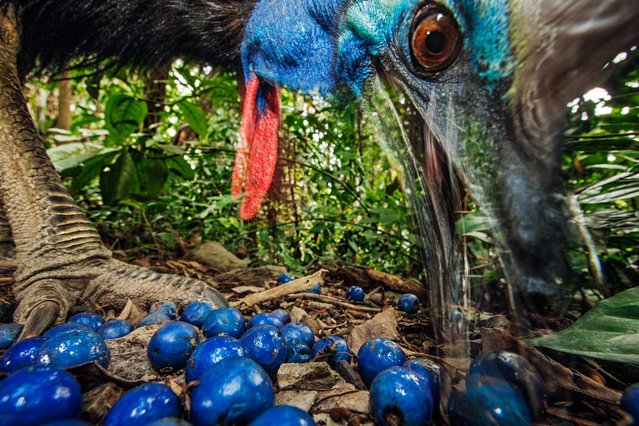
“Cassowaries are large, flightless birds related to emus and (more distantly) to ostriches, rheas, and kiwis”, writes Olivia Judson in the September issue of National Geographic magazine. (Photo by Christian Ziegler/National Geographic)

“Cassowaries are large, flightless birds related to emus and (more distantly) to ostriches, rheas, and kiwis”, writes Olivia Judson in the September issue of National Geographic magazine. How large? People-size: Adult males stand well over five foot five and top 110 pounds. Females are even taller, and can weigh more than 160 pounds. Dangerous when roused, they’re shy and peaceable when left alone. But even birds this big and tough are prey to habitat loss. The dense New Guinea and Australia rain forests where they live have dwindled. Today cassowaries might number 1,500 to 2,000. And because they help shape those same forests – by moving seeds from one place to another – “if they vanish”, Judson writes, “the structure of the forest would gradually change” too. (Photo by Christian Ziegler/National Geographic)
Details
06 Jan 2014 12:21:00
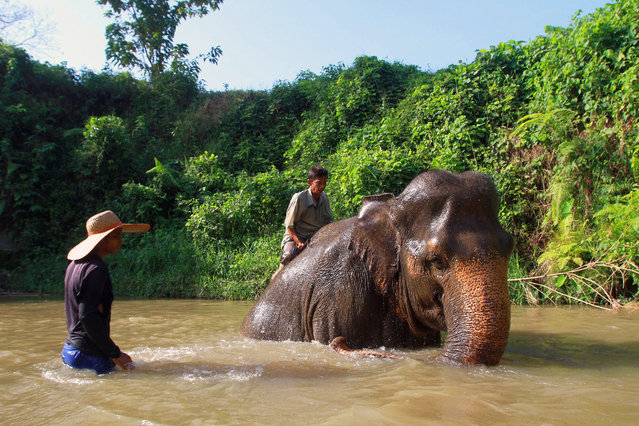
Indonesian mahouts clean their Sumatran elephant in a river near the zoo in Medan, North Sumatra, Indonesia, 12 December 2014. According media reports, the smallest of the Asian elephants, Sumatran elephant (Elephas maximus sumatrensis) is facing serious pressures arising from illegal logging and associated habitat loss and fragmentation in Indonesia. The population has come under increasing threat from rapid forest conversion to plantations. (Photo by Dedi Sahputra/EPA)

Indonesian mahouts clean their Sumatran elephant in a river near the zoo in Medan, North Sumatra, Indonesia, 12 December 2014. According media reports, the smallest of the Asian elephants, Sumatran elephant (Elephas maximus sumatrensis) is facing serious pressures arising from illegal logging and associated habitat loss and fragmentation in Indonesia. The population has come under increasing threat from rapid forest conversion to plantations. (Photo by Dedi Sahputra/EPA)
Details
13 Dec 2014 13:23:00
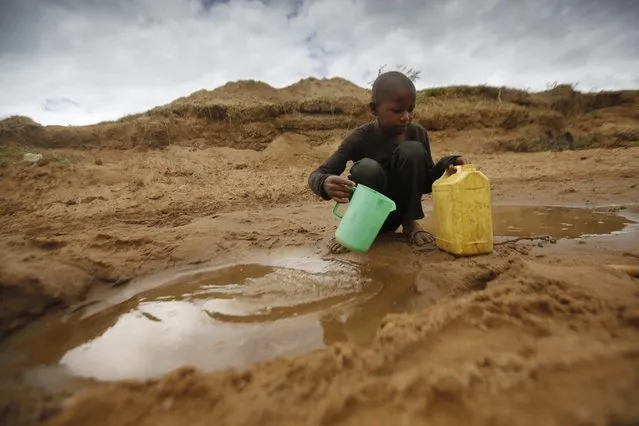
A young boy scoops water from a hand-dug well in the dry riverbed near Matinyani, in the semi-arid Kitui County in southeastern Kenya, 22 March 2015, the World Water Day. Residents of Kitui County and other arid and semi-arid areas of the country have been hard-hit by extremely poor rainfall this year while the government said in previous month that some 1.6 million people countrywide are facing acute starvation due to the drought and will need relief food over the next six months. (Photo by Dai Kurokawa/EPA)

A young boy scoops water from a hand-dug well in the dry riverbed near Matinyani, in the semi-arid Kitui County in southeastern Kenya, 22 March 2015, the World Water Day. Residents of Kitui County and other arid and semi-arid areas of the country have been hard-hit by extremely poor rainfall this year while the government said in previous month that some 1.6 million people countrywide are facing acute starvation due to the drought and will need relief food over the next six months. Residents of Matinyani say they haven't seen a drop of rain in nearly four months. Thousands of Kenyans in rural areas walk tens of kilometers just to fetch water to drink and to be used in their homes. According to an estimate by UNESCO (United Nations Educational, Scientific and Cultural Organization), 17 million people lack access to safe water in Kenya, where the drought is a perennial problem. (Photo by Dai Kurokawa/EPA)
Details
23 Mar 2015 11:01:00
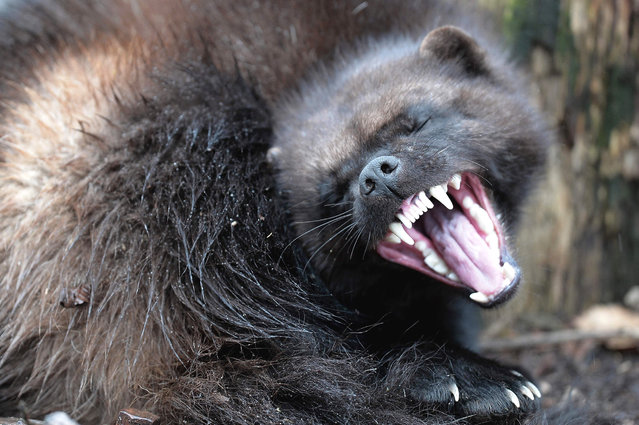
A wolverine is pictured during its first public appearance at the Animal Park of Sainte-Croix in Rhodes, eastern France on January 28, 2016. (Photo by Frederick Florin/AFP Photo)

A wolverine is pictured during its first public appearance at the Animal Park of Sainte-Croix in Rhodes, eastern France on January 28, 2016. (Photo by Frederick Florin/AFP Photo)
Details
31 Jan 2016 08:43:00
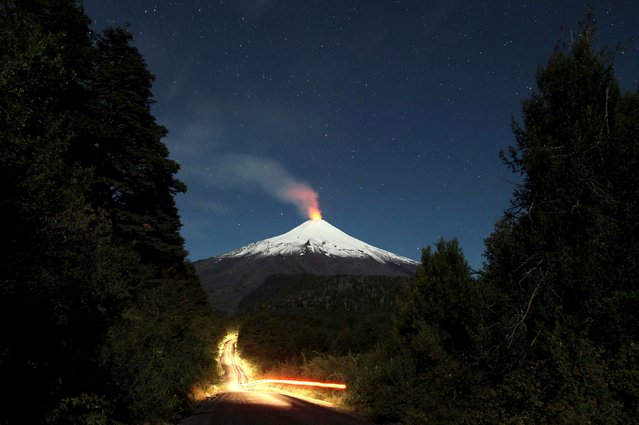
The Villarrica Volcano is seen at night in Chile, April 16, 2016. Villarrica is one of Chile's most active volcanoes. Picture taken with long exposure. Picture taken April 16, 2016. (Photo by Cristobal Saavedra/Reuters)

The Villarrica Volcano is seen at night in Chile, April 16, 2016. Villarrica is one of Chile's most active volcanoes. Picture taken with long exposure. (Photo by Cristobal Saavedra/Reuters)
Details
18 Apr 2016 10:23:00
A demonstrator is detained during May Day rallies in Santiago May 1, 2013. (Photo by Ivan Alvarado/Reuters)

A demonstrator is detained during May Day rallies in Santiago May 1, 2013. (Photo by Ivan Alvarado/Reuters)
Details
03 May 2013 07:59:00