A girl with white powder on her face celebrates the Songkran holiday which marks the Thai New Year in Bangkok, Thailand, on April 14, 2024. (Photo by Chalinee Thirasupa/Reuters)
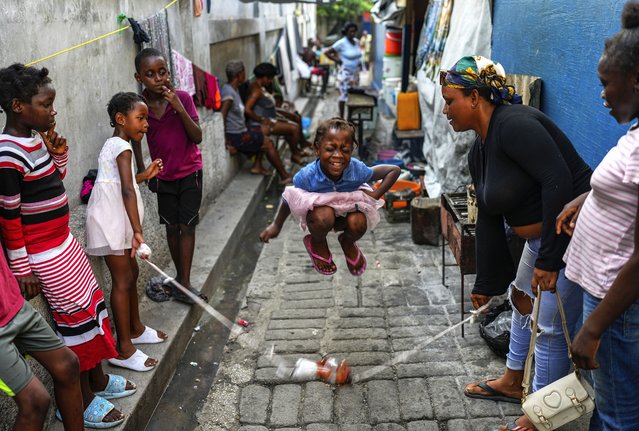
A girl plays a jump rope game at a school housing residents displaced by gang violence in Port-au-Prince, Haiti, Wednesday, May 15, 2024. (Photo by Ramon Espinosa/AP Photo)
A little girl rubs her tired eyes during the first day at the lyceum named after Moldovan writer Gheorghe Asachi in Chisinau on September 2, 2024. (Photo by Dumitru Doru/Radio Free Europe/Radio Liberty)
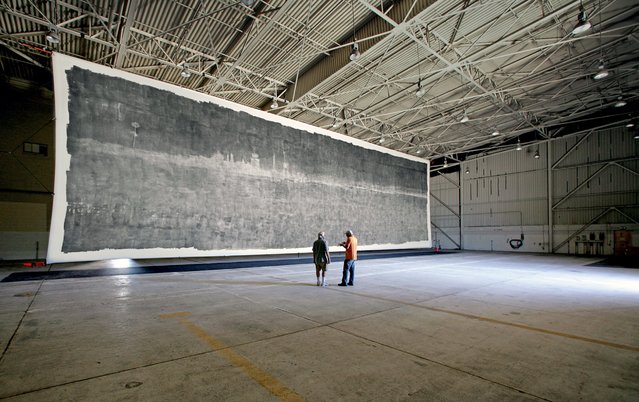
The Great Picture” is a black and white panoramic print of Marine Corps Air Station El Toro, an old military outpost. The print measures 111 feet wide by 32 feet high on seamless white muslin cloth. (Photo by Caters News)
Shanghai-based artist Hong Yi, also known as Red, used 750 pair of socks to create a rather unusual sock portrait of famous Chinese film director Zhang Yimou. Yi, which is famous for her Coffee Stain Portrait, spent over three weeks on the project and used black, white and grey socks. (Photo by Ohiseered.com)
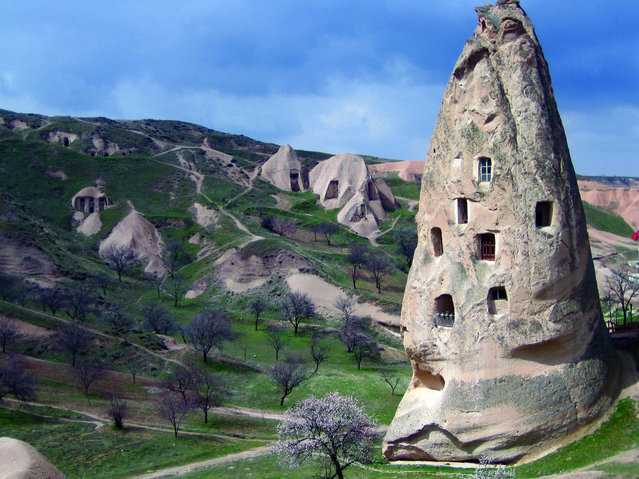
Cappadocia is a historical region in Central Anatolia, largely in Nevşehir Province, in Turkey.
In the time of Herodotus, the Cappadocians were reported as occupying the whole region from Mount Taurus to the vicinity of the Euxine (Black Sea). Cappadocia, in this sense, was bounded in the south by the chain of the Taurus Mountains that separate it from Cilicia, to the east by the upper Euphrates and the Armenian Highland, to the north by Pontus, and to the west by Lycaonia and eastern Galatia.
This artwork created using the end of a drill is the work of Swiss photographer Fabian Oefner who captures the flight of paint in just one 40,000th of a second. His latest Black Hole series celebrates the physics of centripetal force and the effects it has on simple paint and a an ordinary drill with a metal rod connected on the end. The incredible result of Fabians work comes out looking like a picture taken on the Hubble Telescope of some cosmic event. (Photo by Fabian Oefner/Caters News)
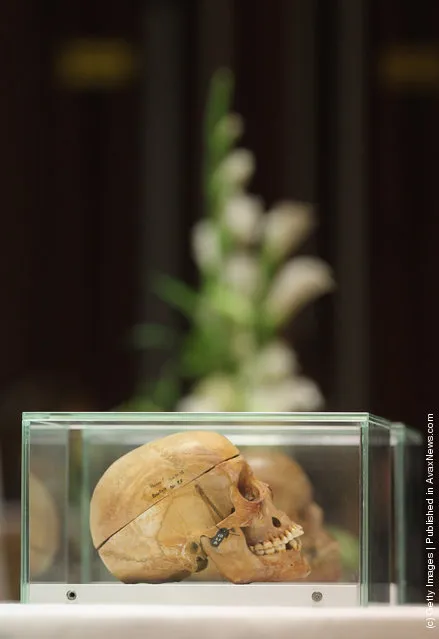
Two of 20 skulls to be taken possession of by a delegation from Namibia stand on display at a ceremony at Charite hospital on September 30, 2011 in Berlin, Germany. The skulls are from Herero and Nama tribespeople taken by German colonial forces between 1904 and 1908, when the Germans violently suppressed an uprising in what was then German Southwest Africa, which is today's Namibia, and in the process killed tens of thousand of Herero and Nama. German scientists at the time took the skulls back to Berlin to demonstrate the racial superiority of Europeans over black Africans. Many Namibians demand a formal apology from the German government. (Photo by Sean Gallup/Getty Images)