Loading...
Done
Anda Oliveira, 34, enjoys a waterfall in the Tijuca National Park, one of the world's biggest urban forests, marking the World Water Day in Rio de Janeiro, Brazil on March 15, 2024. (Photo by Pilar Olivares/Reuters)

Anda Oliveira, 34, enjoys a waterfall in the Tijuca National Park, one of the world's biggest urban forests, marking the World Water Day in Rio de Janeiro, Brazil on March 15, 2024. (Photo by Pilar Olivares/Reuters)
Details
01 Jul 2025 02:56:00
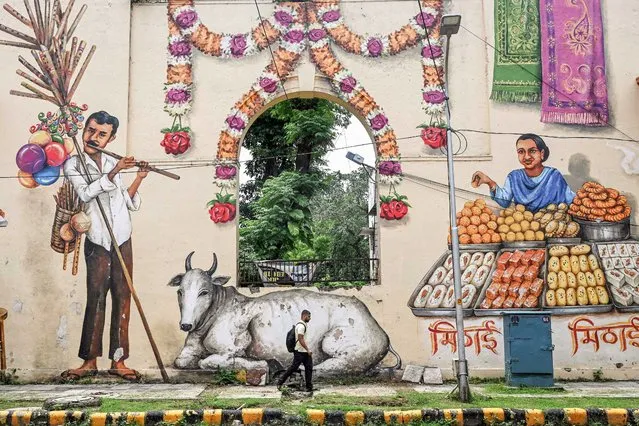
A man walks past a mural along a street in New Delhi on June 30, 2023. (Photo by Arun Sankar/AFP Photo)

A man walks past a mural along a street in New Delhi on June 30, 2023. (Photo by Arun Sankar/AFP Photo)
Details
22 Aug 2023 03:30:00
An alligator and his reflection seen in the Wakodahatchee Wetlands in Delray Beach, Florida on May 2, 2024. The wetlands attract nature lovers and wildlife photographers and are home to more than 140 bird species and a variety of other wildlife. (Photo by Ronen Tivony/ZUMA Press Wire/Rex Features/Shutterstock)

An alligator and his reflection seen in the Wakodahatchee Wetlands in Delray Beach, Florida on May 2, 2024. The wetlands attract nature lovers and wildlife photographers and are home to more than 140 bird species and a variety of other wildlife. (Photo by Ronen Tivony/ZUMA Press Wire/Rex Features/Shutterstock)
Details
19 May 2024 05:12:00
Supporters of Venezuela's President Nicolas Maduro take part in a rally in support of the government in Caracas, Venezuela on May 20, 2019. (Photo by Ivan Alvarado/Reuters)

Supporters of Venezuela's President Nicolas Maduro take part in a rally in support of the government in Caracas, Venezuela on May 20, 2019. (Photo by Ivan Alvarado/Reuters)
Details
15 Jul 2019 00:01:00
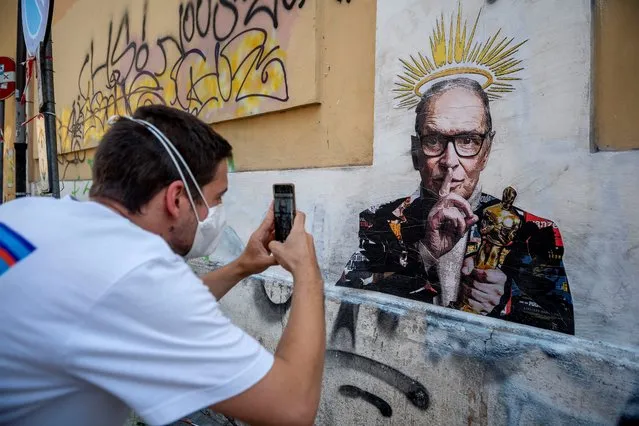
A man takes a picture of the mural painted by the street artist Harry Greb depicting the Italian music composer Ennio Morricone, a day after the 91-year-old composer's death, on July 7, 2020 in Rome, Italy. (Photo by Antonio Masiello/Getty Images)

A man takes a picture of the mural painted by the street artist Harry Greb depicting the Italian music composer Ennio Morricone, a day after the 91-year-old composer's death, on July 7, 2020 in Rome, Italy. (Photo by Antonio Masiello/Getty Images)
Details
15 Jul 2020 00:03:00
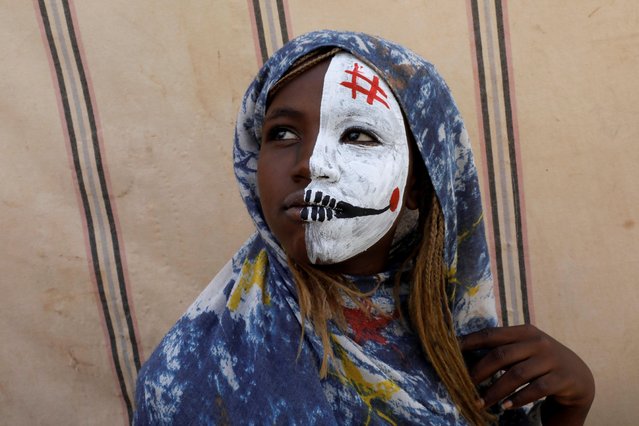
A Sudanese girl with half painted face watches as protesters demonstrate outside the defense ministry compound in Khartoum, Sudan, April 25, 2019. (Photo by Umit Bektas/Reuters)

A Sudanese girl with half painted face watches as protesters demonstrate outside the defense ministry compound in Khartoum, Sudan, April 25, 2019. (Photo by Umit Bektas/Reuters)
Details
11 May 2019 00:01:00
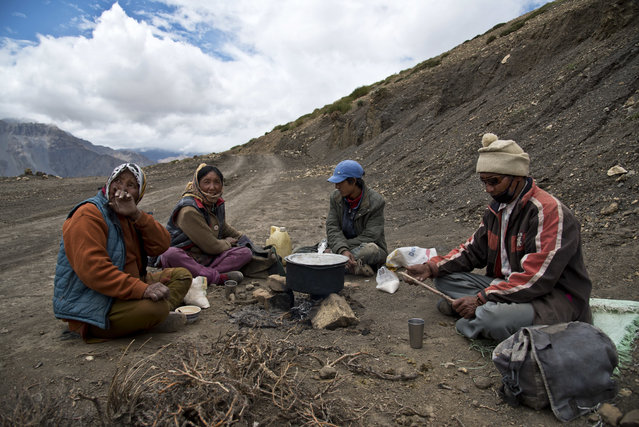
In this August 17, 2016, photo, from left to right, Chhering Chodom, 60, Tashi Yangzom, 50, Lobsang Chhering, 27, and Dorje Tandup, 58, drink milk tea on the side of the road. For centuries, the sleepy valley nestled in the Indian Himalayas remained a hidden Buddhist enclave forbidden to outsiders. Enduring the harsh year-round conditions of the high mountain desert, the people of Spiti Valley lived by a simple communal code – share the Earth's bounty, be hospitable to neighbors, and eschew greed and temptation at all turns. That's all starting to change, for better or worse. Since India began allowing its own citizens as well as outsiders to visit the valley in the early 1990s, tourism and trade have boomed. And the marks of modernization, such as solar panels, asphalt roads and concrete buildings, have begun to appear around some of the villages that dot the remote landscape at altitudes above 4,000 meters (13,000 feet). (Photo by Thomas Cytrynowicz/AP Photo)

In this August 17, 2016, photo, from left to right, Chhering Chodom, 60, Tashi Yangzom, 50, Lobsang Chhering, 27, and Dorje Tandup, 58, drink milk tea on the side of the road. For centuries, the sleepy valley nestled in the Indian Himalayas remained a hidden Buddhist enclave forbidden to outsiders. Enduring the harsh year-round conditions of the high mountain desert, the people of Spiti Valley lived by a simple communal code – share the Earth's bounty, be hospitable to neighbors, and eschew greed and temptation at all turns. That's all starting to change, for better or worse. (Photo by Thomas Cytrynowicz/AP Photo)

Details
15 Sep 2016 09:22:00
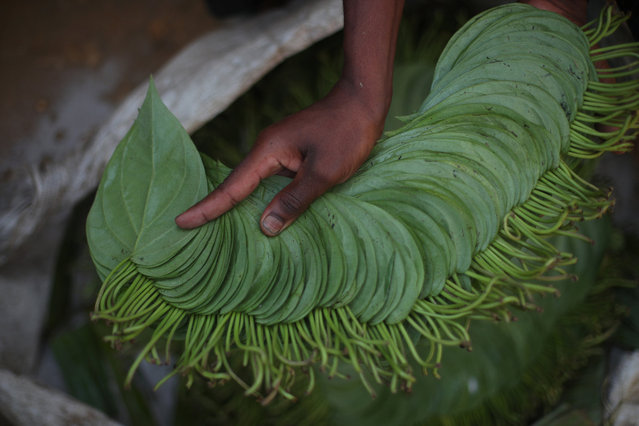
Faruk, 17, a Rohingya refugee trader holds betel leaves which are on sale at a stall in Palong Khali refugee camp near Cox's Bazar, Bangladesh, November 3, 2017. He left his village in Myanmar when the military opened fire towards the Rohingya. “I buy this betel leaf from Palong Khali market, in one bundle there are 160 pieces, I buy it for 80 taka and I sell it for 100 taka. Bangladeshi's and I sell for the same rate in the camp. Outside in the local market it is 80 taka per bundle. My problem is that I don't have money so I can't buy anything to eat, I can't buy fish to eat”, he said. (Photo by Hannah McKay/Reuters)

Faruk, 17, a Rohingya refugee trader holds betel leaves which are on sale at a stall in Palong Khali refugee camp near Cox's Bazar, Bangladesh, November 3, 2017. He left his village in Myanmar when the military opened fire towards the Rohingya. “I buy this betel leaf from Palong Khali market, in one bundle there are 160 pieces, I buy it for 80 taka and I sell it for 100 taka (1 Bangladeshi Taka = 0.012 US Dollar). Bangladeshi's and I sell for the same rate in the camp. Outside in the local market it is 80 taka per bundle. My problem is that I don't have money so I can't buy anything to eat, I can't buy fish to eat”, he said. (Photo by Hannah McKay/Reuters)
Details
27 Nov 2017 08:54:00