Loading...
Done
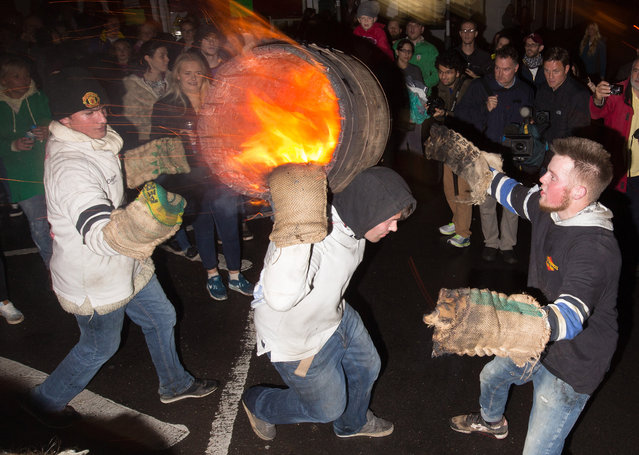
A boy runs with a burning barrel soaked in tar at the annual Ottery St Mary tar barrel festival on November 5, 2015 in Ottery St. Mary, England. The tradition, which is over 400 years old, sees competitors (who must have been born in the town to take part) running with burning barrels on their backs through the village, until the heat becomes too unbearable or the barrel breaks down, starting with junior barrels carried by children and continuing all evening with ever larger and larger barrels. (Photo by Matt Cardy/Getty Images)

A boy runs with a burning barrel soaked in tar at the annual Ottery St Mary tar barrel festival on November 5, 2015 in Ottery St. Mary, England. The tradition, which is over 400 years old, sees competitors (who must have been born in the town to take part) running with burning barrels on their backs through the village, until the heat becomes too unbearable or the barrel breaks down, starting with junior barrels carried by children and continuing all evening with ever larger and larger barrels. The event, which has been threatened with closure on previous years due to increasing public liability insurance costs, raises thousands of pounds for charity and attracts spectators from around the world. (Photo by Matt Cardy/Getty Images)
Details
07 Nov 2015 08:07:00
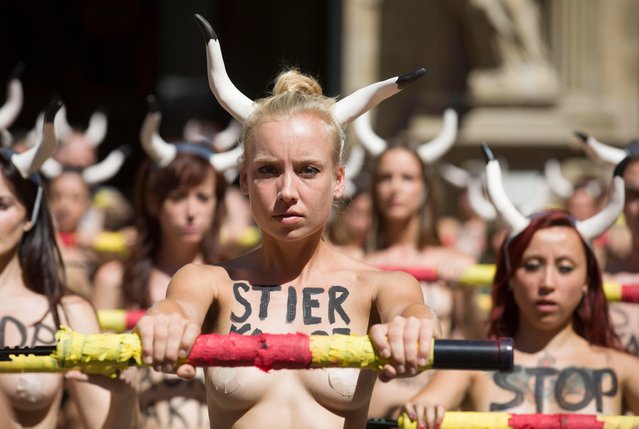
Topless protesters from the organization PETA (People for the Ethical Treatment of Animals) stand with “banderillas” filled with red powder as about 100 people rally in front of the town hall square in Pamplona, Navarra, northern Spain, demonstrating against the treatment of fighting bulls in the Fiesta de San Fermin, 05 July 2017. The renowned eight-day festival made famous by Ernest Hemingway's 1926 novel “The Sun Also Rises” has running-with-the-bulls and a bullfight each day for the fair, which begins at noon on 06 July 2017. (Photo by Jim Hollander/EPA)

Topless protesters from the organization PETA (People for the Ethical Treatment of Animals) stand with “banderillas” filled with red powder as about 100 people rally in front of the town hall square in Pamplona, Navarra, northern Spain, demonstrating against the treatment of fighting bulls in the Fiesta de San Fermin, 05 July 2017. The renowned eight-day festival made famous by Ernest Hemingway's 1926 novel “The Sun Also Rises” has running-with-the-bulls and a bullfight each day for the fair, which begins at noon on 06 July 2017. (Photo by Jim Hollander/EPA)
Details
06 Jul 2017 09:08:00
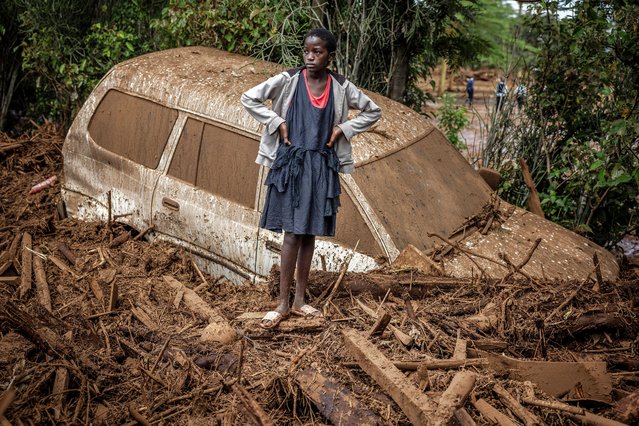
A girl looks on next to a damaged car buried in mud in an area heavily affected by torrential rains and flash floods in the village of Kamuchiri, near Mai Mahiu, on April 29, 2024. At least 45 people died when a dam burst its banks near a town in Kenya's Rift Valley, police said on April 29, 2024, as torrential rains and floods battered the country The disaster raises the total death toll over the March-May wet season in Kenya to more than 120 as heavier than usual rainfall pounds East Africa, compounded by the El Nino weather pattern. (Photo by Luis Tato/AFP Photo)

A girl looks on next to a damaged car buried in mud in an area heavily affected by torrential rains and flash floods in the village of Kamuchiri, near Mai Mahiu, on April 29, 2024. At least 45 people died when a dam burst its banks near a town in Kenya's Rift Valley, police said on April 29, 2024, as torrential rains and floods battered the country The disaster raises the total death toll over the March-May wet season in Kenya to more than 120 as heavier than usual rainfall pounds East Africa, compounded by the El Nino weather pattern. (Photo by Luis Tato/AFP Photo)
Details
07 May 2024 03:35:00
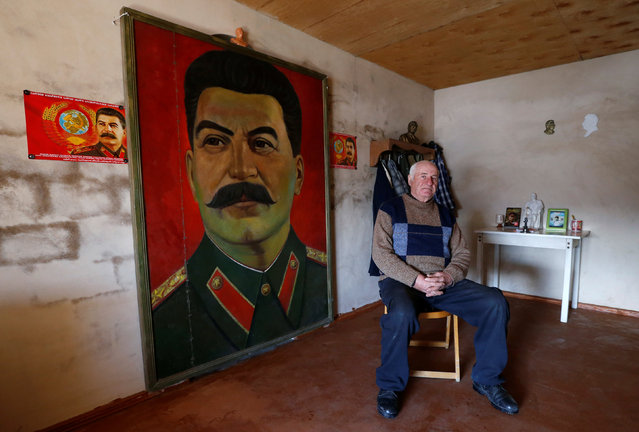
Retired builder Vasili Sidamonidze, 70, poses for a portrait at his home in Gori, Georgia, December 6, 2016. “Unfortunately, Stalin is not popular nowadays. Our people don't respect him. Only we, members of the (Communist) Party, respect him”, Sidamonidze said. “I always try to attend Stalin's birthday anniversaries in Gori. Unfortunately many people don't want to join us even if they live nearby. They look at us from their windows”. Stalin, who was born in Gori in 1878 and died in 1953, is largely reviled today in Georgia, which regained its independence during the 1991 collapse of the Soviet Union. Over the years, his memorials have been dismantled, most recently in 2010 when authorities removed a statue of the dictator from Gori's central square. But Stalin is still revered by a small group of mainly elderly supporters who stress his role in the industrialisation of the Soviet Union and in defeating Nazi Germany in World War Two. Each Dec. 21, a few dozen people mark his birthday by gathering outside a Gori museum dedicated to Stalin, where they make speeches and walk to the square where a 6-meter-high bronze statue of him once stood, calling for it to be reinstated. Opponents say it was a symbol of Moscow's still lingering shadow. In 2008, Russia fought a brief war with Georgia and recognised its breakaway regions of Abkhazia and South Ossetia as independent states. (Photo by David Mdzinarishvili/Reuters)

Retired builder Vasili Sidamonidze, 70, poses for a portrait at his home in Gori, Georgia, December 6, 2016. “Unfortunately, Stalin is not popular nowadays. Our people don't respect him. Only we, members of the (Communist) Party, respect him”, Sidamonidze said. “I always try to attend Stalin's birthday anniversaries in Gori. Unfortunately many people don't want to join us even if they live nearby. They look at us from their windows”. (Photo by David Mdzinarishvili/Reuters)
Details
17 Dec 2016 07:59:00
Women labourers work at the construction site of a road in Kolkata January 8, 2015. Across towns and cities in India, it is not uncommon to see women cleaning building sites, carrying bricks and or shoveling gravel - helping construct the infrastructure necessary for the country's economic and social development. (Photo by Rupak De Chowdhuri/Reuters)

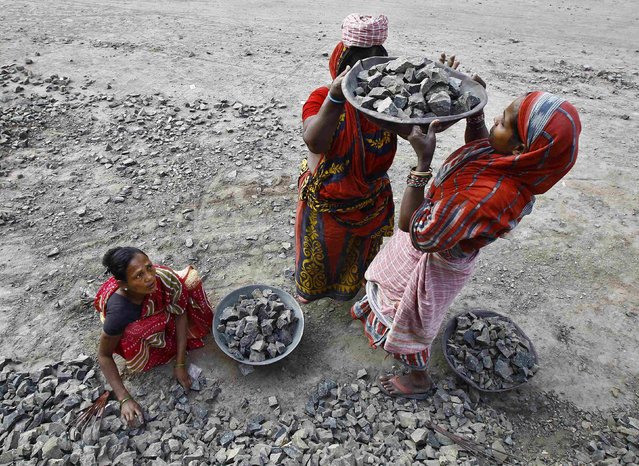
Women labourers work at the construction site of a road in Kolkata January 8, 2015. Across towns and cities in India, it is not uncommon to see women cleaning building sites, carrying bricks and or shoveling gravel – helping construct the infrastructure necessary for the country's economic and social development. They help build roads, railway tracks, airports, and offices. They lay pipes for clean water supplies, cables for telecommunications, and dig the drains for sewage systems. But although women make up at least 20 percent of India's 40 million construction workers, they are less recognized than male workers with lower pay and often prone to safety hazards and sexual harassment. They are often unaware of their rights or scared to complain, say activists now trying to campaign for better treatment of women in the construction industry. (Photo by Rupak De Chowdhuri/Reuters)
Details
15 Jan 2015 13:47:00
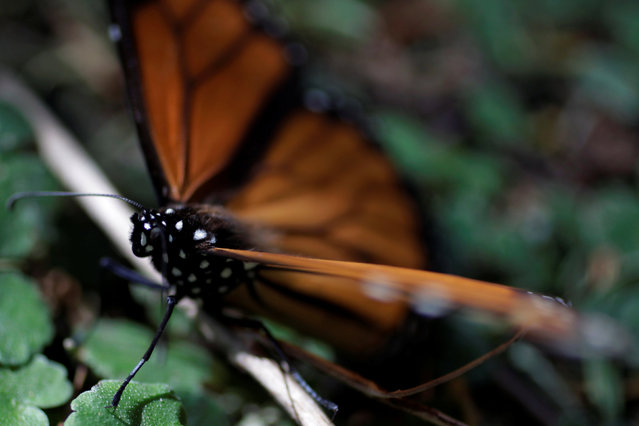
A monarch butterfly rests on the ground at the Sierra Chincua butterfly sanctuary on a mountain in Angangeo, Michoacan November 24, 2016. Angangueo is a town and municipality located in far eastern Michoacán state in central Mexico noted for its history of mining and its location in the Monarch Butterfly Biosphere Reserve. The Monarch Butterfly Biosphere Reserve is a World Heritage Site containing most of the over-wintering sites of the eastern population of the monarch butterfly. The reserve is located in the Trans-Mexican Volcanic Belt pine-oak forests ecoregion on the border of Michoacán and State of Mexico, 100 km (62 miles), northwest of Mexico City. Millions of butterflies arrive in the reserve annually. Butterflies only inhabit a fraction of the 56,000 hectares of the reserve from October–March. (Photo by Carlos Jasso/Reuters)

A monarch butterfly rests on the ground at the Sierra Chincua butterfly sanctuary on a mountain in Angangeo, Michoacan November 24, 2016. Angangueo is a town and municipality located in far eastern Michoacán state in central Mexico noted for its history of mining and its location in the Monarch Butterfly Biosphere Reserve. The Monarch Butterfly Biosphere Reserve is a World Heritage Site containing most of the over-wintering sites of the eastern population of the monarch butterfly. (Photo by Carlos Jasso/Reuters)
Details
26 Nov 2016 10:20:00
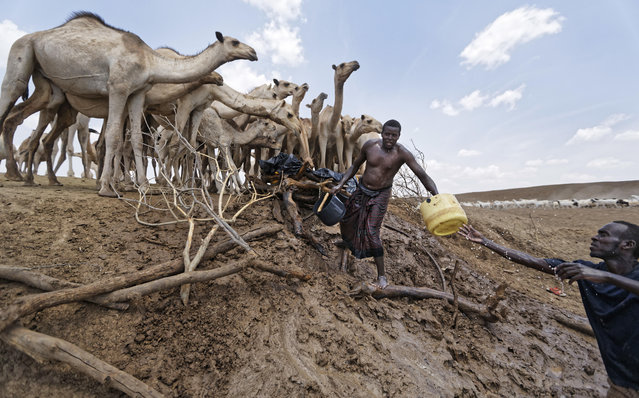
Camel herders scoop up water in plastic buckets from one of the few watering holes in the area, to water their animals near the drought-affected village of Bandarero, near Moyale town on the Ethiopian border, in northern Kenya, Friday, March 3, 2017. The U.N. humanitarian chief, Stephen O'Brien, toured Bandarero village on Friday and called on the international community to act to “avert the very worst of the effects of drought and to avert a famine to make sure we don't go from what is deep suffering to a catastrophe”. (Photo by Ben Curtis/AP Photo)

Camel herders scoop up water in plastic buckets from one of the few watering holes in the area, to water their animals near the drought-affected village of Bandarero, near Moyale town on the Ethiopian border, in northern Kenya, Friday, March 3, 2017. The U.N. humanitarian chief, Stephen O'Brien, toured Bandarero village on Friday and called on the international community to act to “avert the very worst of the effects of drought and to avert a famine to make sure we don't go from what is deep suffering to a catastrophe”. (Photo by Ben Curtis/AP Photo)
Details
05 Mar 2017 00:03:00
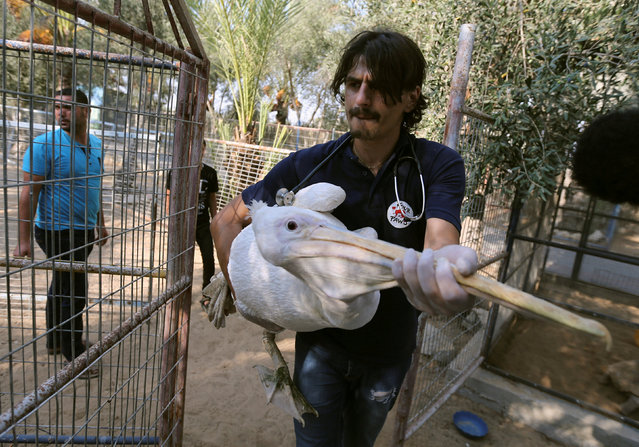
A member of Four Paws International team carries a pelican to be taken out of Gaza, at a zoo in Khan Younis in the southern Gaza Strip August 23, 2016. Fifteen animals including a bengal tiger were removed from “the world’s worst zoo” in the Gaza town of Khan Younis as it was finally closed down. Animal welfare group, Four Paws International, will help bring most of the refugees to a zoo in Jordan, but the tiger will be taken to a refuge in South Africa. Five monkeys, a porcupine, an emu and the tiger, among others, crossed from the occupied territory into Israel after the zoo suffered from years of difficulty. With lack of awareness of animal welfare in Gaza, the densely-populated territory has previously made headlines after another zoo painted donkeys with stripes to resemble zebras in 2009. (Photo by Ibraheem Abu Mustafa/Reuters)

A member of Four Paws International team carries a pelican to be taken out of Gaza, at a zoo in Khan Younis in the southern Gaza Strip August 23, 2016. Fifteen animals including a bengal tiger were removed from “the world’s worst zoo” in the Gaza town of Khan Younis as it was finally closed down. Animal welfare group, Four Paws International, will help bring most of the refugees to a zoo in Jordan, but the tiger will be taken to a refuge in South Africa. (Photo by Ibraheem Abu Mustafa/Reuters)
Details
26 Aug 2016 10:22:00