Loading...
Done
Paramilitary policemen take part in a training in Chaohu, Anhui province, China December 28, 2015. (Photo by Reuters/China Daily)

Paramilitary policemen take part in a training in Chaohu, Anhui province, China December 28, 2015. (Photo by Reuters/China Daily)
Details
30 Dec 2015 09:29:00
A Shiite fighter from the Hashed al-Shaabi (Popular Mobilisation) patrols in the village of Ayn Nasir, south of Mosul, on October 29, 2016, after recapturing it from Islamic State group jihadists in an ongoing operation to retake the city of Mosul. Iraqi paramilitary forces launched an operation to cut the Islamic State group's supply lines between its Mosul bastion and neighbouring Syria, opening a new front in the nearly two-week-old offensive. (Photo by Ahmad Al-Rubaye/AFP Photo)

A Shiite fighter from the Hashed al-Shaabi (Popular Mobilisation) patrols in the village of Ayn Nasir, south of Mosul, on October 29, 2016, after recapturing it from Islamic State group jihadists in an ongoing operation to retake the city of Mosul. Iraqi paramilitary forces launched an operation to cut the Islamic State group's supply lines between its Mosul bastion and neighbouring Syria, opening a new front in the nearly two-week-old offensive. (Photo by Ahmad Al-Rubaye/AFP Photo)
Details
31 Oct 2016 11:20:00
A child coughs as migrants and refugees run away after Macedonian police fired tear gas at hundreds of Iraqi and Syrian migrants who tried to break through the Greek border fence in Idomeni, on February 29, 2016. Greek police said more than 6,000 people were massed at the border, in a buildup triggered by Austria and Balkan states capping the numbers of migrants entering their territory. (Photo by Louisa Gouliamaki/AFP Photo)

A child coughs as migrants and refugees run away after Macedonian police fired tear gas at hundreds of Iraqi and Syrian migrants who tried to break through the Greek border fence in Idomeni, on February 29, 2016. Greek police said more than 6,000 people were massed at the border, in a buildup triggered by Austria and Balkan states capping the numbers of migrants entering their territory. (Photo by Louisa Gouliamaki/AFP Photo)
Details
01 Mar 2016 09:58:00
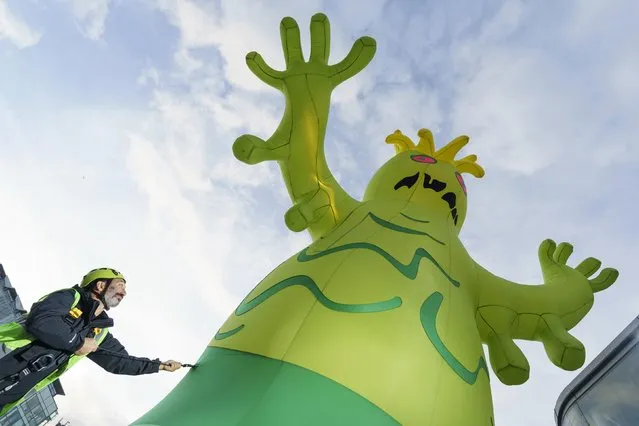
The artist Luke Egan, also known as Filthy Luker, gets Horrible Harvey, his inflatable monster on October 26, 2022, pumped up for his debut at the annual Halloween in the City celebrations in Manchester, United Kingdom this weekend. (Photo by Dominic Lipinski/PA Wire Press Association via Getty Images)

The artist Luke Egan, also known as Filthy Luker, gets Horrible Harvey, his inflatable monster on October 26, 2022, pumped up for his debut at the annual Halloween in the City celebrations in Manchester, United Kingdom this weekend. (Photo by Dominic Lipinski/PA Wire Press Association via Getty Images)
Details
28 Oct 2022 05:16:00
The Arizona State Sun Devils cheer team performs during the second half of the NCAAF game at Sun Devil Stadium on September 01, 2022 in Tempe, Arizona. (Photo by Christian Petersen/Getty Images)

The Arizona State Sun Devils cheer team performs during the second half of the NCAAF game at Sun Devil Stadium on September 01, 2022 in Tempe, Arizona. (Photo by Christian Petersen/Getty Images)
Details
06 Sep 2022 04:49:00
Ravi Nath poses for a photograph with a cobra snake in Jogi Dera (Snake charmers settlement), in the village of Baghpur, in the central state of Uttar Pradesh, India November 10, 2016. (Photo by Adnan Abidi/Reuters)

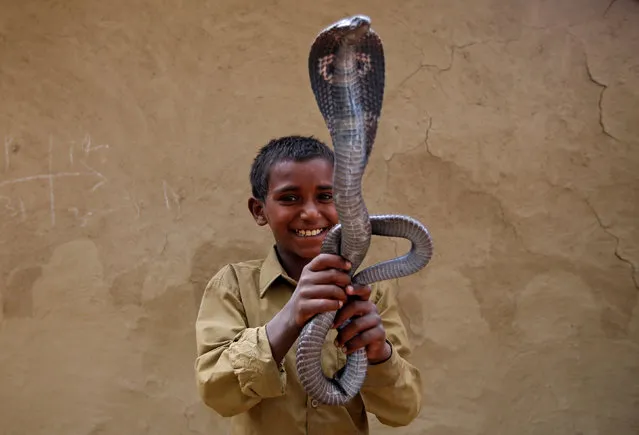
Ravi Nath poses for a photograph with a cobra snake in Jogi Dera (Snake charmers settlement), in the village of Baghpur, in the central state of Uttar Pradesh, India November 10, 2016. An ancient tribe of snake charmers, known as Saperas, have thrived over the generations by catching venomous snakes and making them dance to their music. Snakes are revered by Hindus in India and snake charmers are considered the followers of Lord Shiva, the blue-skinned Hindu god who is usually portrayed wearing a king cobra around his neck. (Photo by Adnan Abidi/Reuters)

Details
26 Jan 2017 13:06:00
A man uses iron sheet to make noises, as a way of trying to disperse desert locusts that had invaded their farms during the second wave invasion in Kakongo village, in Nuu-Mwingi East, in Kitui, Kenya, 06 February 2021. The second wave invasion of the desert locusts in the country comes at a time where most famers are expecting to harvest their farm produce in the country. According to the United Nations Food and Agriculture Organization (FAO), on 04 February, warned numerous immature desert locust swarms persist in southern Ethiopia and Kenya. Some of the swarms are in community areas and therefore cannot be treated. In Kenya, immature swarms continue to spread westwards across northern and central counties where there are currently about 20 small swarms present, mostly about 50 hectares in size, it said. (Photo by Daniel Irungu/EPA/EFE)

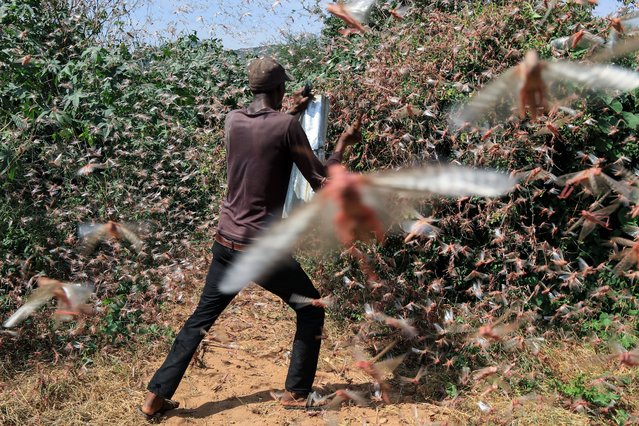
A man uses iron sheet to make noises, as a way of trying to disperse desert locusts that had invaded their farms during the second wave invasion in Kakongo village, in Nuu-Mwingi East, in Kitui, Kenya, 06 February 2021. The second wave invasion of the desert locusts in the country comes at a time where most famers are expecting to harvest their farm produce in the country. (Photo by Daniel Irungu/EPA/EFE)
Details
25 Feb 2021 08:17:00
28 year old Rupa has her hair shaven to donate to the Gods at the Thiruthani Murugan Temple November 10, 2016 in Thiruttani, India. Rupa donated her hair with the wish that her daughter's illness is cured. The process of shaving ones hair and donating it to the Gods is known as tonsuring. It is common for Hindu believers to tonsure their hair at a temple as a young child, and also to celebrate a wish coming true, such as the birth of a baby or the curing of an illness. The “temple hair”, as it's known, is then auctioned off to a processing plant and then sold as pricey wigs and weaves in the US, Europe and Africa. (Photo by Allison Joyce/Getty Images)

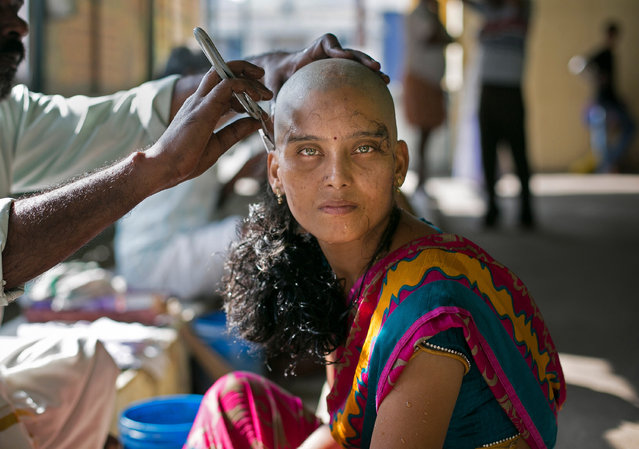
28 year old Rupa has her hair shaven to donate to the Gods at the Thiruthani Murugan Temple November 10, 2016 in Thiruttani, India. Rupa donated her hair with the wish that her daughter's illness is cured. The process of shaving ones hair and donating it to the Gods is known as tonsuring. It is common for Hindu believers to tonsure their hair at a temple as a young child, and also to celebrate a wish coming true, such as the birth of a baby or the curing of an illness. The “temple hair”, as it's known, is then auctioned off to a processing plant and then sold as pricey wigs and weaves in the US, Europe and Africa. (Photo by Allison Joyce/Getty Images)
Details
21 Nov 2016 10:30:00