Loading...
Done
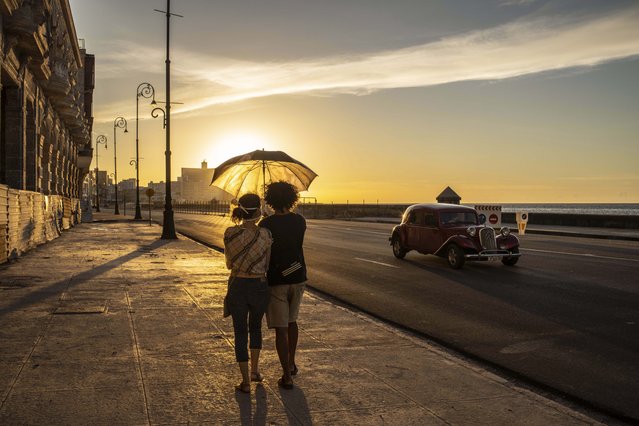
A couple wearing masks as a precaution against the spread of the new coronavirus walk on the Malecon seawall at sunset in Havana, Cuba, Monday, August 31, 2020. Cuban authorities will introduce new measures starting tomorrow Tuesday aimed at containing the spread of the coronavirus in Havana among others a curfew from 7 pm until 5 am and no one without special permission will be able to enter or leave the province. The new measures will last at least 15 days. (Photo by Ramon Espinosa/AP Photo)

A couple wearing masks as a precaution against the spread of the new coronavirus walk on the Malecon seawall at sunset in Havana, Cuba, Monday, August 31, 2020. Cuban authorities will introduce new measures starting tomorrow Tuesday aimed at containing the spread of the coronavirus in Havana among others a curfew from 7 pm until 5 am and no one without special permission will be able to enter or leave the province. The new measures will last at least 15 days. (Photo by Ramon Espinosa/AP Photo)
Details
22 Oct 2020 00:05:00
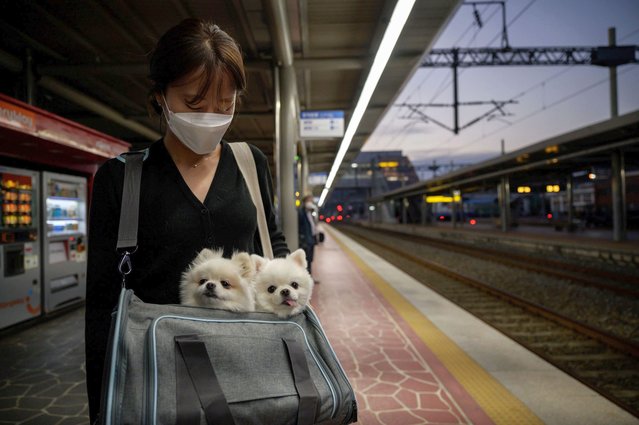
In a photo taken on October 7, 2020 a woman holds two dogs as she waits for a train in Suncheon. (Photo by Ed Jones/AFP Photo)

In a photo taken on October 7, 2020 a woman holds two dogs as she waits for a train in Suncheon. (Photo by Ed Jones/AFP Photo)
Details
26 Oct 2020 00:01:00
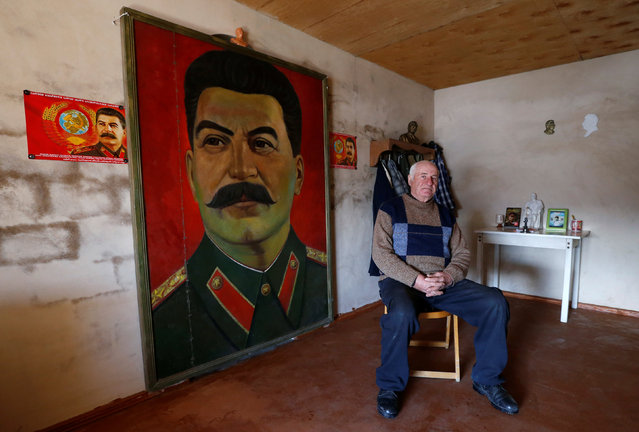
Retired builder Vasili Sidamonidze, 70, poses for a portrait at his home in Gori, Georgia, December 6, 2016. “Unfortunately, Stalin is not popular nowadays. Our people don't respect him. Only we, members of the (Communist) Party, respect him”, Sidamonidze said. “I always try to attend Stalin's birthday anniversaries in Gori. Unfortunately many people don't want to join us even if they live nearby. They look at us from their windows”. Stalin, who was born in Gori in 1878 and died in 1953, is largely reviled today in Georgia, which regained its independence during the 1991 collapse of the Soviet Union. Over the years, his memorials have been dismantled, most recently in 2010 when authorities removed a statue of the dictator from Gori's central square. But Stalin is still revered by a small group of mainly elderly supporters who stress his role in the industrialisation of the Soviet Union and in defeating Nazi Germany in World War Two. Each Dec. 21, a few dozen people mark his birthday by gathering outside a Gori museum dedicated to Stalin, where they make speeches and walk to the square where a 6-meter-high bronze statue of him once stood, calling for it to be reinstated. Opponents say it was a symbol of Moscow's still lingering shadow. In 2008, Russia fought a brief war with Georgia and recognised its breakaway regions of Abkhazia and South Ossetia as independent states. (Photo by David Mdzinarishvili/Reuters)

Retired builder Vasili Sidamonidze, 70, poses for a portrait at his home in Gori, Georgia, December 6, 2016. “Unfortunately, Stalin is not popular nowadays. Our people don't respect him. Only we, members of the (Communist) Party, respect him”, Sidamonidze said. “I always try to attend Stalin's birthday anniversaries in Gori. Unfortunately many people don't want to join us even if they live nearby. They look at us from their windows”. (Photo by David Mdzinarishvili/Reuters)
Details
17 Dec 2016 07:59:00
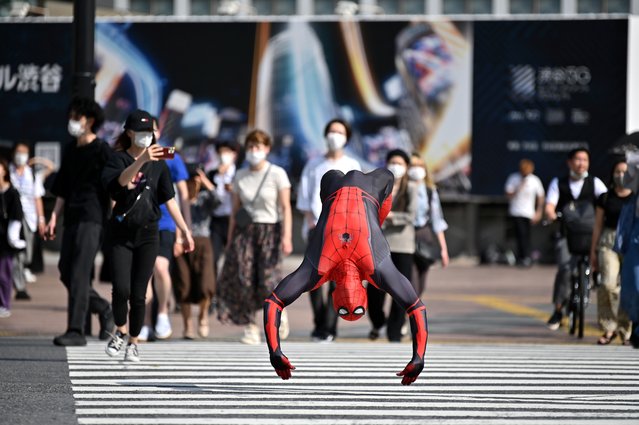
A man wearing a Spiderman costume jumps across Shibuya crossing in Tokyo on June 8, 2020. (Photo by Charly Triballeau/AFP Photo)

A man wearing a Spiderman costume jumps across Shibuya crossing in Tokyo on June 8, 2020. (Photo by Charly Triballeau/AFP Photo)
Details
10 Jun 2020 00:07:00
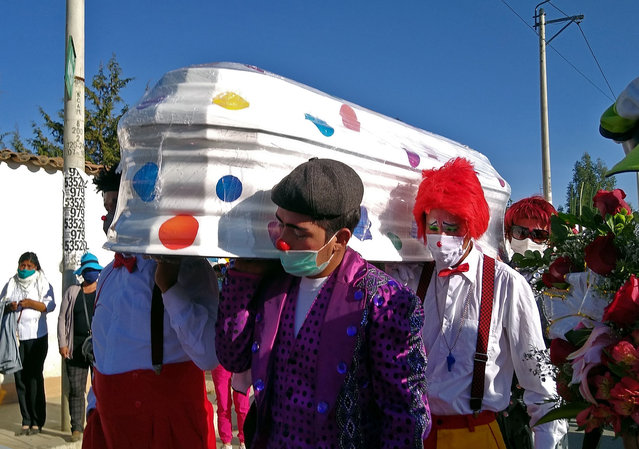
Admirers of Peruvian clown William Rojas, known professionally as “Chupetin”, carry his coffin during his funeral procession to the Eternal Hope cemetery in Huancayo, Peru, on July 2, 2020. Rojas, 45, died from COVID-19 after five days of being in intensive care. Peru surpassed 10,000 deaths from the coronavirus on Thursday, the health ministry said, a day after the government began easing a national lockdown in a bid to revive the economy. (Photo by Pedro Tinoco/AFP Photo)

Admirers of Peruvian clown William Rojas, known professionally as “Chupetin”, carry his coffin during his funeral procession to the Eternal Hope cemetery in Huancayo, Peru, on July 2, 2020. Rojas, 45, died from COVID-19 after five days of being in intensive care. Peru surpassed 10,000 deaths from the coronavirus on Thursday, the health ministry said, a day after the government began easing a national lockdown in a bid to revive the economy. (Photo by Pedro Tinoco/AFP Photo)
Details
05 Jul 2020 00:07:00
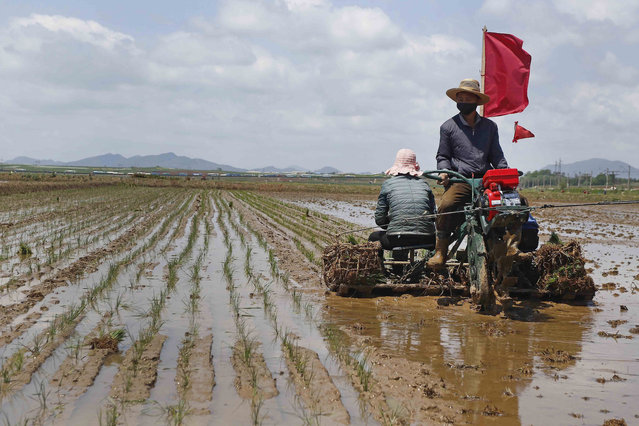
Agricultural workers are rice-transplanting at the Namsa Co-op Farm of Rangnang District in Pyongyang, DPRK, on Tuesday, May 25, 2021. (Photo by Jon Chol Jin/AP Photo)

Agricultural workers are rice-transplanting at the Namsa Co-op Farm of Rangnang District in Pyongyang, DPRK, on Tuesday, May 25, 2021. (Photo by Jon Chol Jin/AP Photo)
Details
24 Jun 2021 09:33:00
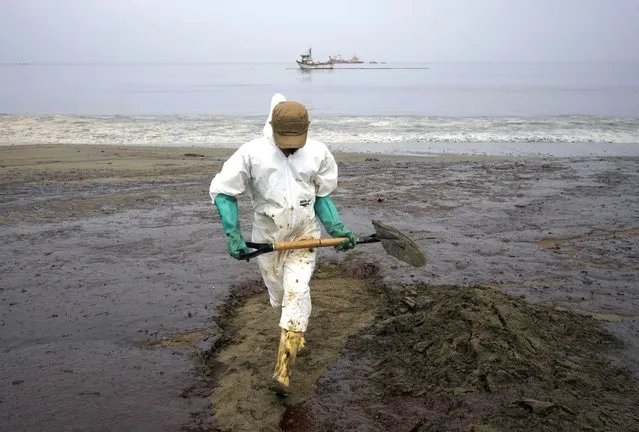
A worker, dressed in a protective suit, cleans Conchitas Beach contaminated by an oil spill, in Ancon, Peru, Thursday, January 20, 2022. The oil spill on the Peruvian coast was caused by the waves from an eruption of an undersea volcano in the South Pacific nation of Tonga. (Photo by Martin Mejia/AP Photo)

A worker, dressed in a protective suit, cleans Conchitas Beach contaminated by an oil spill, in Ancon, Peru, Thursday, January 20, 2022. The oil spill on the Peruvian coast was caused by the waves from an eruption of an undersea volcano in the South Pacific nation of Tonga. (Photo by Martin Mejia/AP Photo)
Details
27 Jan 2022 06:55:00
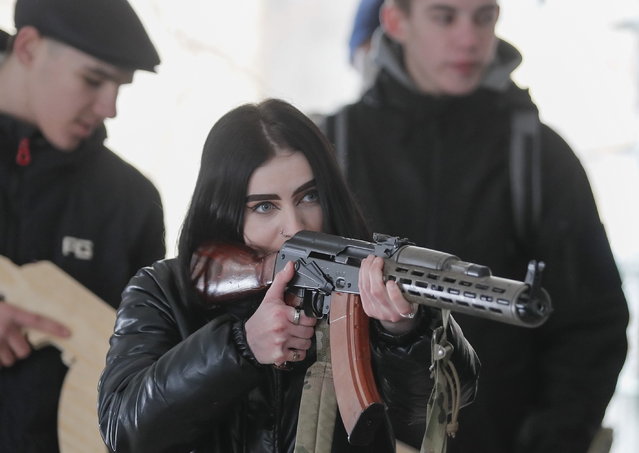
Ukrainians attend an open military training for civilians on a training range in Kiev, Ukraine, 06 February 2022. According to a survey conducted by the Kiev International Institute of Sociology (KIIS) from December 2021, 50.2 percent of Ukrainians said they would resist in case of a Russian military intervention into their city, town or village. Every third respondent to the poll said they were ready to engage in armed resistance, and 21.7 percent said they were ready to participate in civil resistance actions. (Photo by Sergey Dolzhenko/EPA/EFE/Rex Features/Shutterstock)

Ukrainians attend an open military training for civilians on a training range in Kiev, Ukraine, 06 February 2022. According to a survey conducted by the Kiev International Institute of Sociology (KIIS) from December 2021, 50.2 percent of Ukrainians said they would resist in case of a Russian military intervention into their city, town or village. Every third respondent to the poll said they were ready to engage in armed resistance, and 21.7 percent said they were ready to participate in civil resistance actions. (Photo by Sergey Dolzhenko/EPA/EFE/Rex Features/Shutterstock)
Details
15 Feb 2022 05:34:00