Loading...
Done
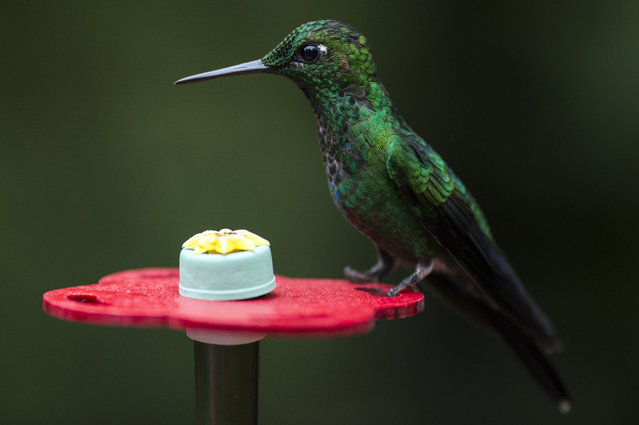
A Green Crowned Brilliant is pictured at a Hummingbird feeding station on January 15, 2016 in Alajuela Costa Rica. (Photo by Dan Kitwood/Getty Images)

A Green Crowned Brilliant is pictured at a Hummingbird feeding station on January 15, 2016 in Alajuela Costa Rica. Of the 338 known species of Hummingbird worldwide there are around 50 in Costa Rica. Hummingbirds are named for the distinctive sound made by their tiny beating wings, and are admired for their vibrantly coloured iridescent plumage. Their ability to hover, with wings beating between 12 and 90 times a second, and to fly backwards makes them different from all other birds. (Photo by Dan Kitwood/Getty Images)
Details
05 Feb 2016 10:45:00
This restroom on the rubbly flanks of Jonsknuten in Norway looks up at the peak of the 904m mountain. Yu have to leave the door open to enjoy the view but the chances of being disturbed are minimal. (Photo by Olaf Menz/Lonely Planet)

This restroom on the rubbly flanks of Jonsknuten in Norway looks up at the peak of the 904m mountain. Yu have to leave the door open to enjoy the view but the chances of being disturbed are minimal. (Photo by Olaf Menz/Lonely Planet)
Details
13 Apr 2016 09:00:00
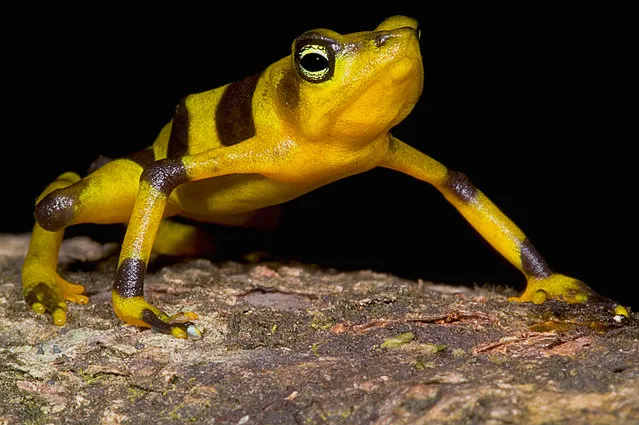
The golden harlequin toad has vanished from the wild, and only a small number live on in captivity. A fungus caused them, and many other amphibians, to die out in their home in Central America. (Photo by Danté Fenolio/The Guardian/Johns Hopkins University Press)

Wildlife photographer Danté Fenolio has headed into areas untouched by sunlight – deep seas, caves and underground – and found creatures that are exploding with colour. Here: The golden harlequin toad has vanished from the wild, and only a small number live on in captivity. A fungus caused them, and many other amphibians, to die out in their home in Central America. (Photo by Danté Fenolio/The Guardian/Johns Hopkins University Press)
Details
20 Jun 2016 12:19:00
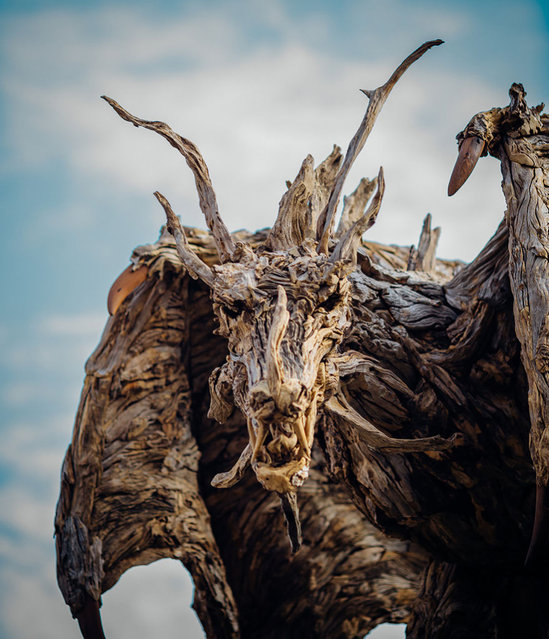
Driftwood Dragons Sculptures By James Doran

James Doran has created two epic dragon sculpture. The first, perched on a dead tree, is called ‘The Wyvern in the Baobabs’ (a wyvern is a type of dragon with two legs and two wings). The other, ‘Wyvern’s Folly,’ is perched on a gazebo made from reclaimed steel and recycled water bottles.
Details
07 Jul 2015 11:26:00


A member of the Eton public school O.T.C. (Officers Training Corps) practising shouting out orders during a training session, 20th January 1940. (Photo by Hulton Archive/Getty Images)
Details
04 Jun 2011 06:46:00
In this September 16, 2017 photo, a music fan poses for the photo against an angel wings' mural at the Rock in Rio music festival in Rio de Janeiro, Brazil. (Photo by Leo Correa/AP Photo)

In this September 16, 2017 photo, a music fan poses for the photo against an angel wings' mural at the Rock in Rio music festival in Rio de Janeiro, Brazil. (Photo by Leo Correa/AP Photo)
Details
22 Sep 2017 07:34:00
A history enthusiast, dressed as a soldier, fights during the re-enactment of Napoleon's famous battle of Austerlitz near the southern Moravian town of Slavkov u Brna December 5, 2015. (Photo by David W. Cerny/Reuters)

A history enthusiast, dressed as a soldier, fights during the re-enactment of Napoleon's famous battle of Austerlitz near the southern Moravian town of Slavkov u Brna December 5, 2015. Hundreds of history enthusiasts gathered near the city of Slavkov before a re-enactment of Napoleon's famous battle of Austerlitz on Saturday to mark its 210th anniversary. (Photo by David W. Cerny/Reuters)
Details
07 Dec 2015 08:00:00


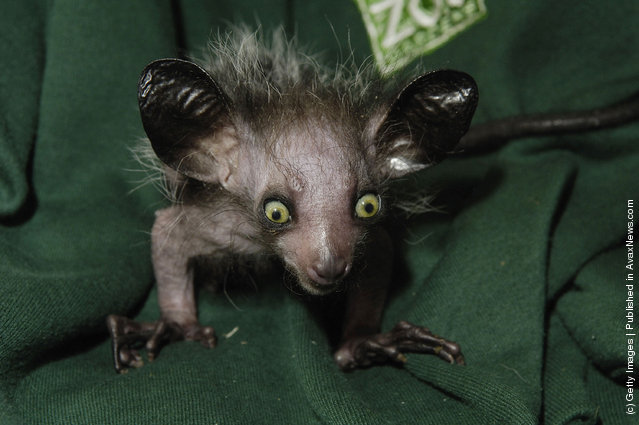
“The aye-aye (Daubentonia madagascariensis) is a lemur, a strepsirrhine primate native to Madagascar that combines rodent-like teeth and a special thin middle finger to fill the same ecological niche as a woodpecker. It is the world's largest nocturnal primate, and is characterized by its unusual method of finding food; it taps on trees to find grubs, then gnaws holes in the wood and inserts its narrow middle finger to pull the grubs out. The only other animal species known to find food in this way is the striped possum. From an ecological point of view the aye-aye fills the niche of a woodpecker as it is capable of penetrating wood to extract the invertebrates within”. – Wikipedia

Photo: In this handout image from Bristol Zoo is seen the first captive bred aye-aye in the UK named “Kintana” (meaning star in Malagasy) April 15, 2005 at Bristol Zoo Gardens, England. The zoo announced today only the second baby aye-aye to be hand-reared in the world (the first was in Jersey Zoo) and has now made his first public appearance since his birth on 11 February 2005. (Photo by Rob Cousins/Bristol Zoo via Getty Images)
Details
13 Apr 2011 13:33:00