Loading...
Done
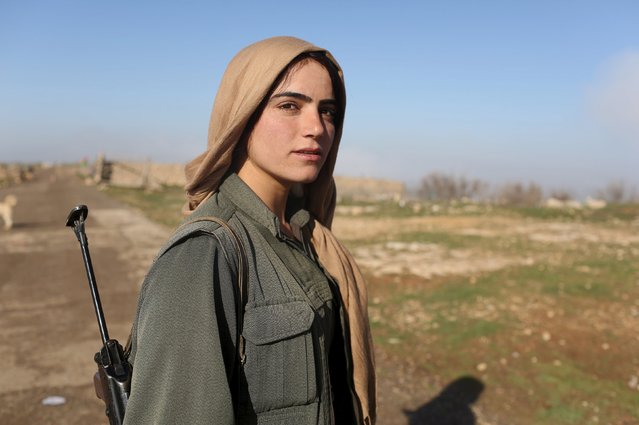
A female Kurdistan Workers Party (PKK) fighter stands near a security position in Sinjar, March 13, 2015. (Photo by Asmaa Waguih /Reuters)

A female Kurdistan Workers Party (PKK) fighter stands near a security position in Sinjar, March 13, 2015. Women fighters at a Kurdistan Workers Party (PKK) base on Mount Sinjar in northwest Iraq, just like their male counterparts, have to be ready for action at any time. Smoke from the front line, marking their battle against Islamic State, which launched an assault on northern Iraq last summer, is visible from the base. Many of the women have cut links with their families back home; the fighters come from all corners of the Kurdish region. (Photo by Asmaa Waguih /Reuters)
Details
02 May 2015 14:44:00
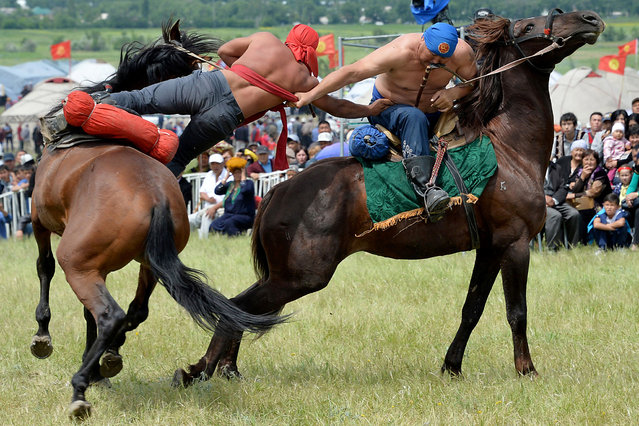
Kyrgyz men on horseback compete during their traditional game of “Oodarysh” during the celebrations of the 90th anniversary formation of the Chui region in the village of Kuntu some 20 kms from Bishkek on May 27, 2016. (Photo by Vyacheslav Oseledko/AFP Photo)

Kyrgyz men on horseback compete during their traditional game of “Oodarysh” during the celebrations of the 90th anniversary formation of the Chui region in the village of Kuntu some 20 kms from Bishkek on May 27, 2016. (Photo by Vyacheslav Oseledko/AFP Photo)
Details
28 May 2016 12:31:00
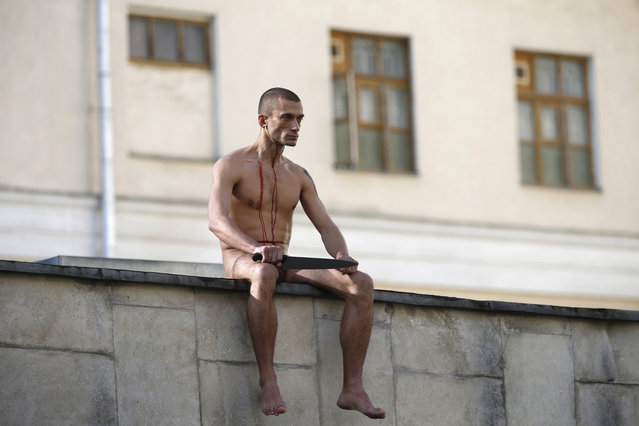
Artist Pyotr Pavlensky sits on the wall enclosing the Serbsky State Scientific Center for Social and Forensic Psychiatry after he cut off a part of his earlobe during his protest action titled “Segregation” in Moscow October 19, 2014. (Photo by Maxim Zmeyev/Reuters)

Artist Pyotr Pavlensky sits on the wall enclosing the Serbsky State Scientific Center for Social and Forensic Psychiatry after he cut off a part of his earlobe during his protest action titled “Segregation” in Moscow October 19, 2014. Pavlensky protested against the usage of forensic psychiatry for politically motivated purposes. He cut off his earlobe to demonstrate how authorities could “cut off” an unwanted individual from society by using psychiatric and medical diagnosis to forcefully send a person to a penitentiary hospital, according to Pavlensky. (Photo by Maxim Zmeyev/Reuters)
Details
21 Oct 2014 12:10:00
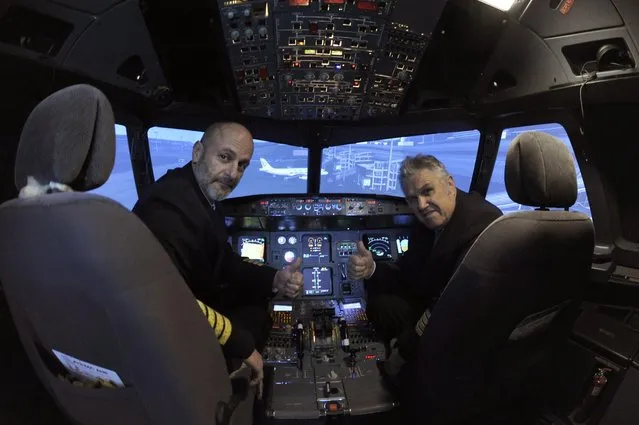
Igor Perne (L), 53, an electronic engineer and a member of the International Virtual Aviation Organisation (IVAO), and fellow virtual pilot Franc Lavric gesture for the camera before taking off on a virtual flight in a flight simulator in Nova Vas, Slovenia November 13, 2014. In 2011, Perne, a lifelong flying enthusiast, bought parts of a written-off Cyprus Airways airliner and then spent two and a half years turning the entire nose of the scrapped aircraft into an elaborate flight simulator. (Photo by Srdjan Zivulovic/Reuters)

Igor Perne (L), 53, an electronic engineer and a member of the International Virtual Aviation Organisation (IVAO), and fellow virtual pilot Franc Lavric gesture for the camera before taking off on a virtual flight in a flight simulator in Nova Vas, Slovenia November 13, 2014. In 2011, Perne, a lifelong flying enthusiast, bought parts of a written-off Cyprus Airways airliner and then spent two and a half years turning the entire nose of the scrapped aircraft into an elaborate flight simulator. (Photo by Srdjan Zivulovic/Reuters)
Details
16 Nov 2014 12:07:00


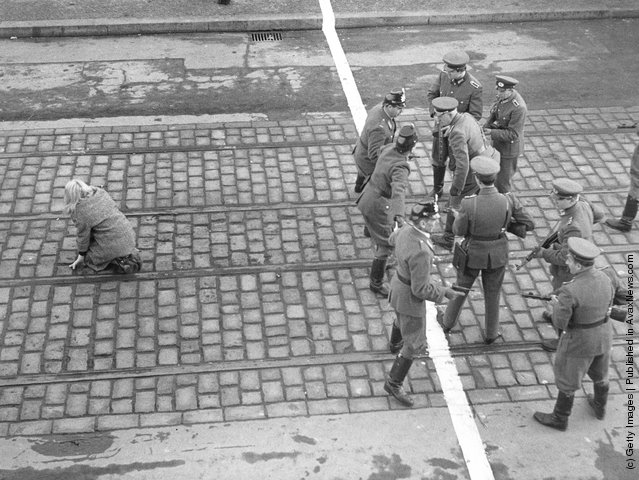
“The Berlin Wall (German: Berliner Mauer) was a barrier constructed by the German Democratic Republic (GDR, East Germany) starting on 13 August 1961, that completely cut off West Berlin from surrounding East Germany and from East Berlin. The barrier included guard towers placed along large concrete walls, which circumscribed a wide area (later known as the “death strip”) that contained anti-vehicle trenches, “fakir beds” and other defenses. The Soviet-dominated Eastern Bloc officially claimed that the wall was erected to protect its population from fascist elements conspiring to prevent the “will of the people” in building a socialist state in East Germany. However, in practice, the Wall served to prevent the massive emigration and defection that marked Germany and the communist Eastern Bloc during the post-World War II period”. – Wikipedia

Photo: West Berlin policemen and East German Volkspolizei face each other across the border in Berlin, circa 1955. (Photo by Three Lions/Hulton Archive/Getty Images)
Details
22 May 2011 10:49:00
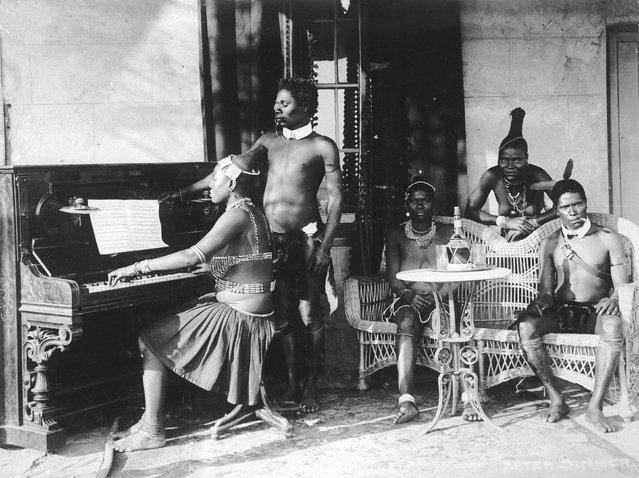
circa 1925:  A Zulu woman playing the piano while a group of others sit and listen.  (Photo by General Photographic Agency/Getty Images)

“The Zulu are the largest South African ethnic group, with an estimated 10–11 million people living mainly in the province of KwaZulu-Natal. Small numbers also live in Zimbabwe, Zambia, and Mozambique. Their language, Zulu, is a Bantu language; more specifically, part of the Nguni subgroup. The Zulu Kingdom played a major role in South African history during the 19th and 20th centuries. Under apartheid, Zulu people were classed as third-class citizens and suffered from state-sanctioned discrimination. They remain today the most numerous ethnic group in South Africa, and now have equal rights along with all other citizens”. – Wikipedia.

Photo: A Zulu woman playing the piano while a group of others sit and listen (to put it briefly, Englishmen scoff over Zulu). South Africa, circa 1925. (Photo by General Photographic Agency)

Details
03 Feb 2014 09:40:00
Schoolchildren look at a lifelike animatronics display of a dinosaur at the dinosaur-themed Zoo-rassic Park in Singapore on November 16, 2016. To raise awareness on the sixth mass extinction, the Singapore Zoo and River Safari displayed lifelike dinosaur animatronics where visitors can trail along the Dinosaur Valley which does not involve living animals. (Photo by Roslan Rahman/AFP Photo)

Schoolchildren look at a lifelike animatronics display of a dinosaur at the dinosaur-themed Zoo-rassic Park in Singapore on November 16, 2016. To raise awareness on the sixth mass extinction, the Singapore Zoo and River Safari displayed lifelike dinosaur animatronics where visitors can trail along the Dinosaur Valley which does not involve living animals. (Photo by Roslan Rahman/AFP Photo)
Details
17 Nov 2016 11:47:00
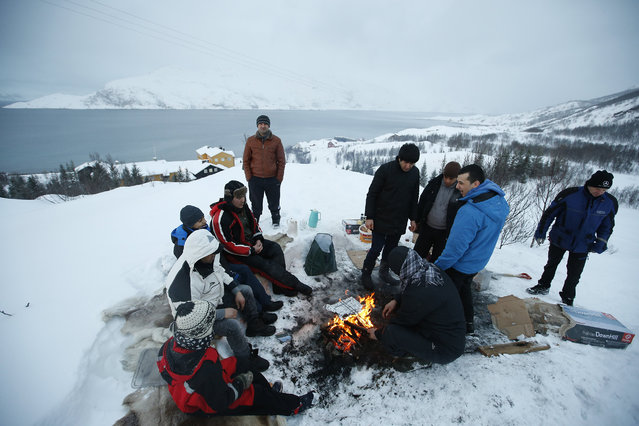
In this photo taken Tuesday, February 2, 2016, asylum seekers gather round a fire as they cook a meal overlooking the temporary Altnes camp refugee camp on the island of Seiland, northern Norway. (Photo by Alastair Grant/AP Photo)

In this photo taken Tuesday, February 2, 2016, asylum seekers gather round a fire as they cook a meal overlooking the temporary Altnes camp refugee camp on the island of Seiland, northern Norway. Waiting for their asylum claims to be processed, hundreds of people in emergency shelters in Hammerfest and neighboring towns are slowly getting used to the extreme climate and unfamiliar customs of the High North. They say they have adapted to the cold – the temperature rarely drops below minus 10 degrees C (14 F) along the coast, though it gets much colder further inland. It’s the darkness that throws them off. (Photo by Alastair Grant/AP Photo)
Details
18 Feb 2016 13:22:00