Loading...
Done
Children playing their smart phone during Lunar New Year's Eve celebrations at Fuk Ling Miau temple on January 28, 2025 in Yogyakarta, Indonesia. Chinese New Year, also known as Lunar New Year, will begin on January 29, 2025, marking the Year of the Snake. The celebrations, which last for approximately 15 days, are filled with traditional activities such as family gatherings, lion dances, and the exchange of red envelopes, making it a vibrant cultural event observed by Chinese communities worldwide. (Photo by Ulet Ifansasti/Getty Images)

Children playing their smart phone during Lunar New Year's Eve celebrations at Fuk Ling Miau temple on January 28, 2025 in Yogyakarta, Indonesia. Chinese New Year, also known as Lunar New Year, will begin on January 29, 2025, marking the Year of the Snake. The celebrations, which last for approximately 15 days, are filled with traditional activities such as family gatherings, lion dances, and the exchange of red envelopes, making it a vibrant cultural event observed by Chinese communities worldwide. (Photo by Ulet Ifansasti/Getty Images)
Details
25 Feb 2025 02:05:00
The picture dated January 30, 2025 shows the Red Arrows swooping through the skies as they carry out a winter training session over RAF Waddington in Lincolnshire. The team made the most of the sunny weather to practice their signature moves, with plenty of twists and turns in the blue skies. They train in the UK until mid-Spring when they move overseas to a location with more predictable, settled weather to maximise flying hours. (Photo by Caroline Haycock/Bav Media)

The picture dated January 30, 2025 shows the Red Arrows swooping through the skies as they carry out a winter training session over RAF Waddington in Lincolnshire. The team made the most of the sunny weather to practice their signature moves, with plenty of twists and turns in the blue skies. They train in the UK until mid-Spring when they move overseas to a location with more predictable, settled weather to maximise flying hours. (Photo by Caroline Haycock/Bav Media)
Details
21 Mar 2025 03:42:00
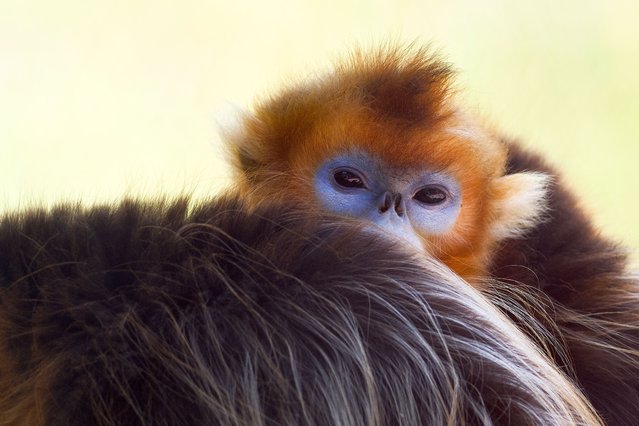
A golden snub-nosed monkeys (Rhinopitheque de Roxelane) looks through its enclosure after quarantine during its presentation at the Beauval Zoopark in Saint-Aignan Central France, on May 7, 2025. ZooParc de Beauval (Loir-et-Cher) welcomed three golden snub-nosed monkeys on April 3, 2025, an endangered species from China, as part of a conservation program, becoming the first zoo outside Asia to house these long-haired, red-furred primates with bluish faces. (Photo by Guillaume Souvant/AFP Photo)

A golden snub-nosed monkeys (Rhinopitheque de Roxelane) looks through its enclosure after quarantine during its presentation at the Beauval Zoopark in Saint-Aignan Central France, on May 7, 2025. ZooParc de Beauval (Loir-et-Cher) welcomed three golden snub-nosed monkeys on April 3, 2025, an endangered species from China, as part of a conservation program, becoming the first zoo outside Asia to house these long-haired, red-furred primates with bluish faces. (Photo by Guillaume Souvant/AFP Photo)
Details
18 May 2025 02:44:00
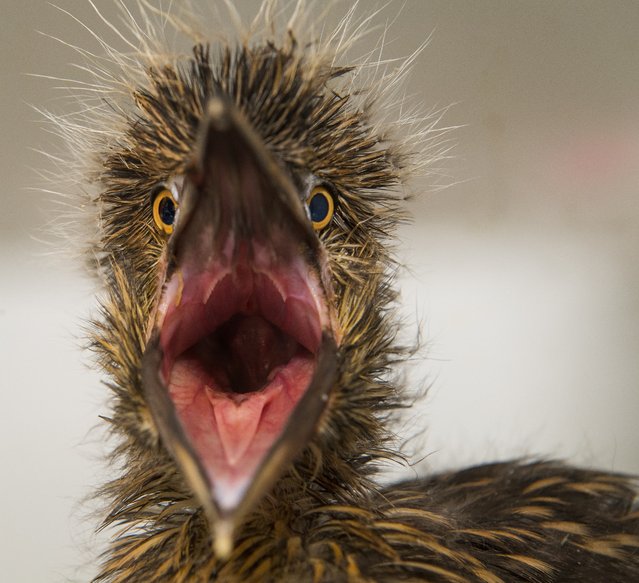
A baby Black-crowned Night Heron squawks in its incubator while being cared for at City Wildlife rescue and rehabilitation center in Washington, DC on May 31, 2017. The heron is one of several that have been brought to CW by the staff at The National Zoo over the past few years. The heron is a native bird and has made an established rookery inside the zoo grounds over a hundred years ago.  Every year at this time, some of the chicks get pushed or fall out of the nest and require human care.  Because the birds are native and not part of the Smithsonian collection, they partnered with CW to rehabilitate the herons for re-release back to the flock inside Zoo. They're reintroduced back to their flock so that they can migrate together in the Fall. The Black-crowned heron usually migrates from the DC area down to southeast North Carolina, some going as far as Jacksonville, FL in winter. The Black-crowned heron is the species of greatest conservation need in the District of Columbia because their numbers are in such rapid decline due to habitat loss. (Photo Linda Davidson/The Washington Post)

A baby Black-crowned Night Heron squawks in its incubator while being cared for at City Wildlife rescue and rehabilitation center in Washington, DC on May 31, 2017. The heron is one of several that have been brought to CW by the staff at The National Zoo over the past few years. (Photo Linda Davidson/The Washington Post)
Details
04 Jun 2017 08:04:00
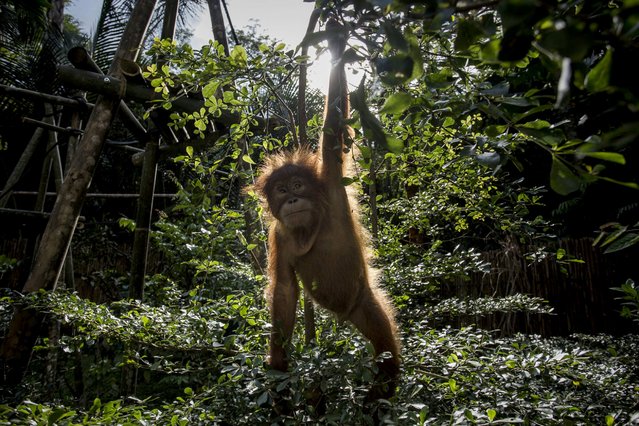
A Baby sumatran orangutan (Pongo abelii) plays around in a tree as they train at Sumatran Orangutan Conservation Programme's rehabilitation center on November 12, 2016 in Kuta Mbelin, North Sumatra, Indonesia. The Orangutans in Indonesia have been known to be on the verge of extinction as a result of deforestation and poaching. Found mostly in South-East Asia, where they live on the islands of Sumatra and Borneo, the endangered species continue to lose their habitat as a result of corporate expansion in a developing economy. Indonesia approved palm oil concessions on nearly 15 million acres of peatlands over the past years and thousands of square miles have been cleared for plantations, including the lowland areas that are the prime habitat for orangutans. (Photo by Ulet Ifansasti/Getty Images)

A Baby sumatran orangutan (Pongo abelii) plays around in a tree as they train at Sumatran Orangutan Conservation Programme's rehabilitation center on November 12, 2016 in Kuta Mbelin, North Sumatra, Indonesia. The Orangutans in Indonesia have been known to be on the verge of extinction as a result of deforestation and poaching. Found mostly in South-East Asia, where they live on the islands of Sumatra and Borneo, the endangered species continue to lose their habitat as a result of corporate expansion in a developing economy. Indonesia approved palm oil concessions on nearly 15 million acres of peatlands over the past years and thousands of square miles have been cleared for plantations, including the lowland areas that are the prime habitat for orangutans. (Photo by Ulet Ifansasti/Getty Images)
Details
16 Nov 2016 11:14:00
A pregnant woman poses on June 19, 2018 in Vertou, western France. France had an estimated population of 68.4 million by January 1, 2024, representing a further year-on-year increase of 0.3 percent, limited by a marked drop in the birth rate, the INSEE national statistics bureau of France reported on January 16, 2024. In 2023, 678,000 babies were born in France, 6.6 percent fewer than the previous year, the lowest number of births in any year since 1946. Over the same period, there were 631,000 deaths, down 6.5 percent on 2022, a year marked by the consequences of the Covid-19 pandemic and episodes of extreme heat. (Photo by Loic Venance/AFP Photo)

A pregnant woman poses on June 19, 2018 in Vertou, western France. France had an estimated population of 68.4 million by January 1, 2024, representing a further year-on-year increase of 0.3 percent, limited by a marked drop in the birth rate, the INSEE national statistics bureau of France reported on January 16, 2024. In 2023, 678,000 babies were born in France, 6.6 percent fewer than the previous year, the lowest number of births in any year since 1946. Over the same period, there were 631,000 deaths, down 6.5 percent on 2022, a year marked by the consequences of the Covid-19 pandemic and episodes of extreme heat. (Photo by Loic Venance/AFP Photo)
Details
27 Feb 2024 07:29:00


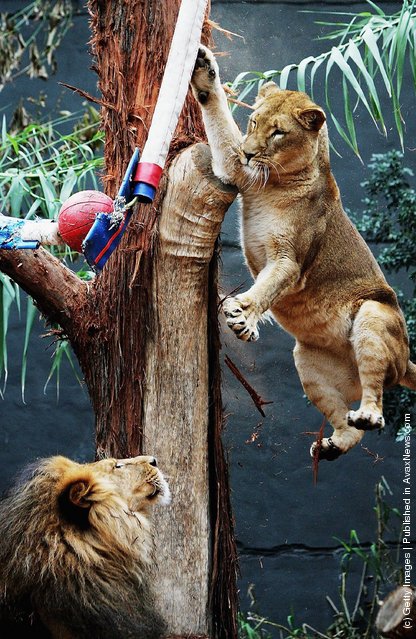
Young African lion Asali (R) jumps for a bungee-ball toy as her father Jambo or “Bruiser” looks on at the opening of a savannah-themed makeover of the lion enclosure at Taronga Zoo August 29, 2006 in Sydney, Australia. The renovation includes sandstone rock features, a wading pool, and red ochre crushed granite substrate in a move to make the enclosure more closely resemble the natural habitat of the African savannah. (Photo by Ian Waldie/Getty Images)
Details
15 Apr 2011 10:12:00
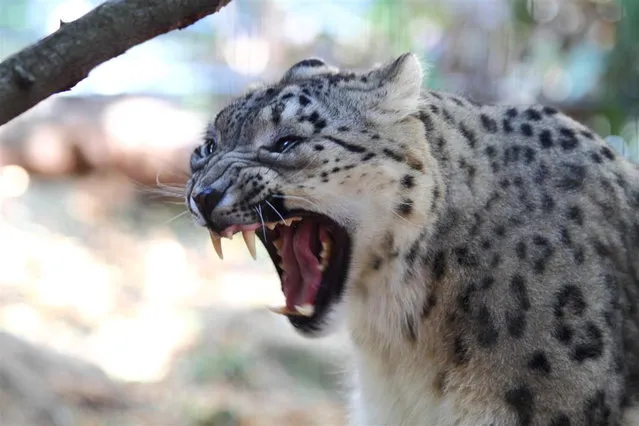
Snow Leopard

The snow leopard (Panthera uncia syn. Uncia uncia) is a large cat native to the mountain ranges of Central and South Asia. It is listed as endangered on the IUCN Red List of Threatened Species because as of 2003, the size of the global population was estimated at 4,080-6,590 adults, of which fewer than 2,500 individuals may reproduce in the wild.
Details
12 May 2014 10:14:00