Loading...
Done
A visitor looks at pictures of French photographer Jacques-Henri Lartigue (1894-1986), on July 1, 2013 during the 44thd annual Rencontres d'Arles photography festival in Arles, southern France. The event runs until September 22. (Photo by Boris Horvat/AFP Photo)

A visitor looks at pictures of French photographer Jacques-Henri Lartigue (1894-1986), on July 1, 2013 during the 44thd annual Rencontres d'Arles photography festival in Arles, southern France. The event runs until September 22. (Photo by Boris Horvat/AFP Photo)
Details
06 Jul 2013 11:34:00
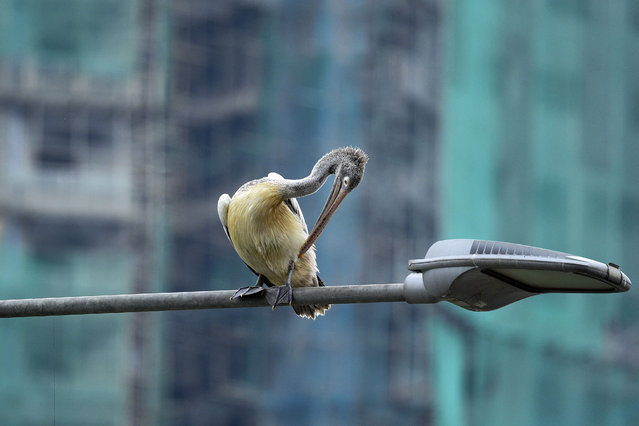
A spot-billed pelican sits on a street light in Colombo on March 16, 2021. (Photo by Ishara S. Kodikara/AFP Photo)

A spot-billed pelican sits on a street light in Colombo on March 16, 2021. (Photo by Ishara S. Kodikara/AFP Photo)
Details
10 Jun 2021 08:11:00
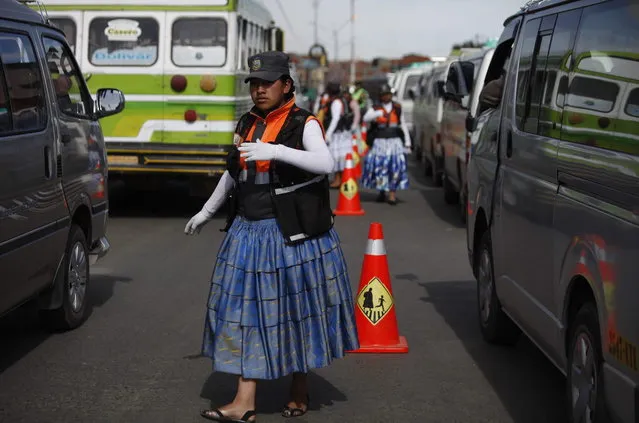
In this December 3, 2013 photo, an Aymara woman cops directs traffic on the streets of El Alto, Bolivia. The women wear the bright petticoats and shawls of indigenous women in the Andes, called cholitas in Bolivian slang, the main difference being that instead of bowler hats they wear khaki green police-style caps. Some don fluorescent traffic vests. (Photo by Juan Karita/AP Photo)

“This city in Bolivia's highlands has hired Aymara women dressed in traditional multilayered Andean skirts and brightly embroidered vests to work as traffic cops and bring order to its road chaos. About 20 of the “traffic cholitas” have been trained to direct cars and buses in El Alto, a teeming, impoverished sister city of La Paz in Bolivia's Andes mountains”. – El Alto via Associated Press. Photo: In this December 3, 2013 photo, an Aymara woman cops directs traffic on the streets of El Alto, Bolivia. The women wear the bright petticoats and shawls of indigenous women in the Andes, called cholitas in Bolivian slang, the main difference being that instead of bowler hats they wear khaki green police-style caps. Some don fluorescent traffic vests. (Photo by Juan Karita/AP Photo)
Details
25 Dec 2013 10:48:00
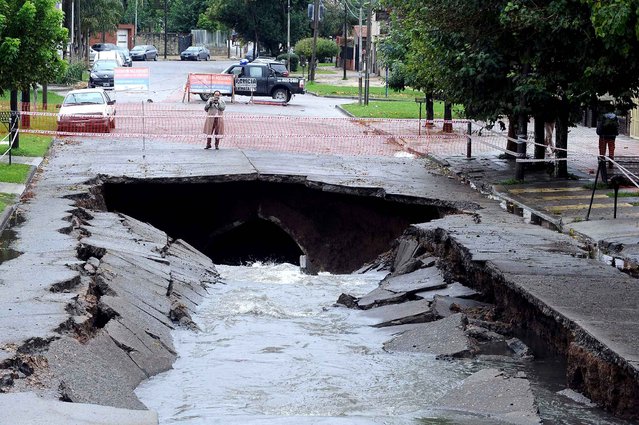
Handout picture released by Telam showing the tarmac of the Pedro Palacios Avenue in Ramos Mejia, province of Buenos Aires, Argentina, under which the channeled waters of the Maldonado stream flow, after it collapsed on April 8, 2014 leaving a 40-metre-long, 1.4-metre-deep hole. About 3000 people had to be evacuated in the Argentine provinces of Neuquen (soutwest), Catamarca (northwest), Santiago del estero (center) and Cordoba (center)due to the foods caused by heavy rain, official sources said. (Photo by Daniel Dabove/AFP Photo)

Handout picture released by Telam showing the tarmac of the Pedro Palacios Avenue in Ramos Mejia, province of Buenos Aires, Argentina, under which the channeled waters of the Maldonado stream flow, after it collapsed on April 8, 2014 leaving a 40-metre-long, 1.4-metre-deep hole. About 3000 people had to be evacuated in the Argentine provinces of Neuquen (soutwest), Catamarca (northwest), Santiago del estero (center) and Cordoba (center)due to the foods caused by heavy rain, official sources said. (Photo by Daniel Dabove/AFP Photo)
Details
12 Apr 2014 12:40:00
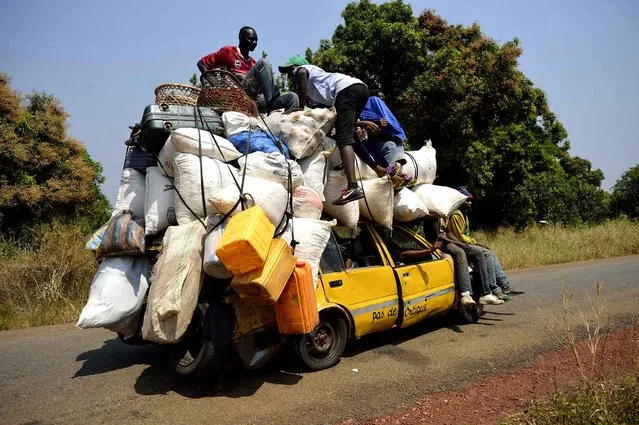
Christian people crowd a bush taxi on a road 55km north of Bangui as they are on their way to the capital where they expect to sell some products on the market on January 19, 2014. Fresh fighting broke out in the strife-torn Central African Republic on the eve of an announcement on Sunday of the candidates seeking to become the new interim president. (Photo by Eric Feferberg/AFP Photo)

Christian people crowd a bush taxi on a road 55km north of Bangui as they are on their way to the capital where they expect to sell some products on the market on January 19, 2014. Fresh fighting broke out in the strife-torn Central African Republic on the eve of an announcement on Sunday of the candidates seeking to become the new interim president. Sectarian violence has gripped the landlocked country after a March 2013 coup launched by the mostly Muslim Seleka rebels, and the UN has warned that the bloodshed could turn into genocide. (Photo by Eric Feferberg/AFP Photo)
Details
26 Jan 2014 12:39:00
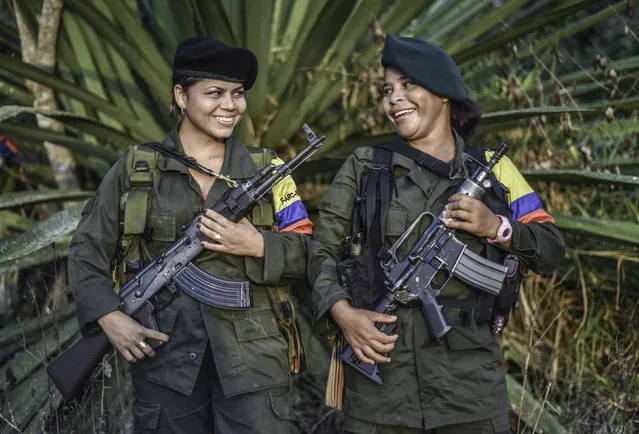
Manuela (L) and Marta, members of the Revolutionary Armed Forces of Colombia (FARC), pose for a picture at a camp in the Colombian mountains on February 18, 2016. Many of these women are willing to be reunited with the children they gave birth and then left under protection of relatives or farmers, whenever the peace agreement will put an end to the country's internal conflict. (Photo by Luis Acosta/AFP Photo)

Manuela (L) and Marta, members of the Revolutionary Armed Forces of Colombia (FARC), pose for a picture at a camp in the Colombian mountains on February 18, 2016. Many of these women are willing to be reunited with the children they gave birth and then left under protection of relatives or farmers, whenever the peace agreement will put an end to the country's internal conflict. (Photo by Luis Acosta/AFP Photo)
Details
27 Feb 2016 10:40:00
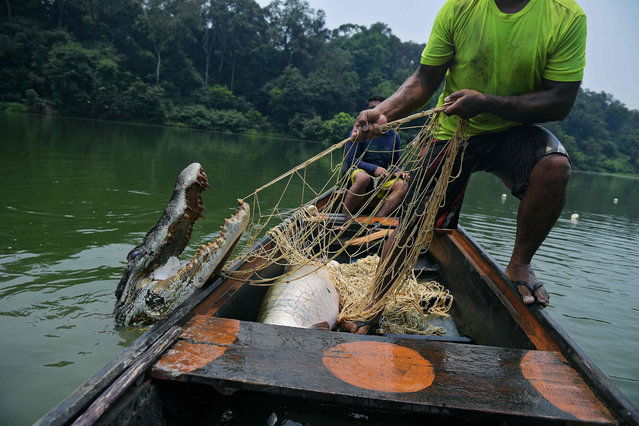
Fishermen pull up a live 2.5 metre crocodile in their net in the Western Amazon region, Brazil on September 20, 2017. The fishermen were fishing for a large river fish called Arapaima but sometimes crocodiles become stuck in the nets as well. (Photo by Carl de Souza/AFP Photo)

Fishermen pull up a live 2.5 metre crocodile in their net in the Western Amazon region, Brazil on September 20, 2017. The fishermen were fishing for a large river fish called Arapaima but sometimes crocodiles become stuck in the nets as well. (Photo by Carl de Souza/AFP Photo)
Details
24 Sep 2017 06:47:00
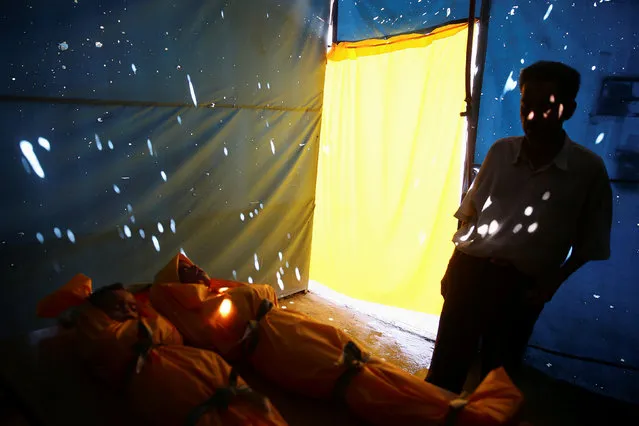
A man stands near bodies of his young relatives after an airstrike in the rebel held Douma neighbourhood of Damascus, Syria August 22, 2016. (Photo by Bassam Khabieh/Reuters)

A man stands near bodies of his young relatives after an airstrike in the rebel held Douma neighbourhood of Damascus, Syria August 22, 2016. (Photo by Bassam Khabieh/Reuters)
Details
26 Aug 2016 10:52:00