Loading...
Done
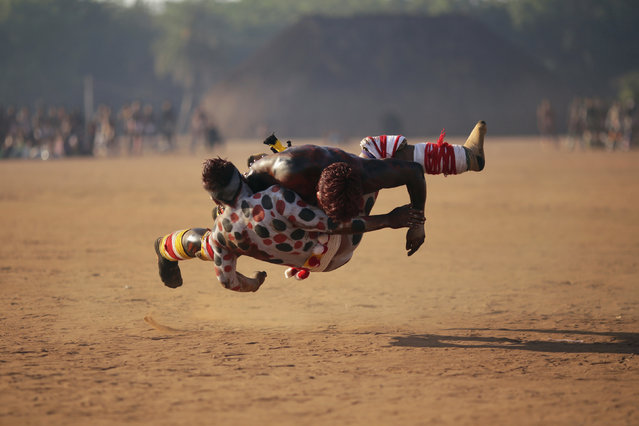
Waura Indians wrestle during this year's “quarup”, a ritual held over several days to honour in death a person of great importance to them, in Xingu National Park, Mato Grosso State, Brazil August 25, 2013. (Photo by Ueslei Marcelino/Reuters)

Waura Indians wrestle during this year's “quarup”, a ritual held over several days to honour in death a person of great importance to them, in Xingu National Park, Mato Grosso State, Brazil August 25, 2013. (Photo by Ueslei Marcelino/Reuters)
Details
09 Aug 2015 10:26:00
Men stroll past roadside vendors as a painted truck makes its way through the busy street in Kabul, Afghanistan, November, 1961. (Photo by Henry S. Bradsher/AP Photo via The Atlantic)

Men stroll past roadside vendors as a painted truck makes its way through the busy street in Kabul, Afghanistan, November, 1961. (Photo by Henry S. Bradsher/AP Photo via The Atlantic)
Details
03 Jul 2013 11:04:00
Man your battle stations: The crew chief of helicopter Yankee Papa 13, lance corporal James C. Farley, mans an M-60 machine gun during a mission near Da Nang, Vietnam on March 31, 1965. (Photo by Larry Burrows/Time & Life Pictures)

In the spring of 1965, within weeks of 3,500 American Marines arriving in Vietnam, a 39-year-old Briton named Larry Burrows began work on a feature for LIFE magazine, chronicling the day-to-day experience of U.S. troops on the ground – and in the air – in the midst of the rapidly widening war. The photographs in this gallery focus on a calamitous March 31, 1965, helicopter mission; Burrows’ “report from Da Nang”, featuring his pictures and his personal account of the harrowing operation, was published two weeks later as a now-famous cover story in the April 16, 1965, issue of LIFE.

Photo: Man your battle stations: The crew chief of helicopter Yankee Papa 13, lance corporal James C. Farley, mans an M-60 machine gun during a mission near Da Nang, Vietnam on March 31, 1965. (Photo by Larry Burrows/Time & Life Pictures)

Details
07 Apr 2013 07:08:00
Two Chinese farmers got more than they bargained for when they pulled up the root of a fleece flower – and came face-to-face with the doppelganger of Homer Simpson, on May 17, 2013. The large root appears to have two bulging eyes and a prominent nose – giving it an uncanny resemblance to the famous cartoon character. With two offshoot roots shaped like arms, it even looks like it is pondering or confused – just what you would expect from the real Homer. (Photo by ImagineChina)

Two Chinese farmers got more than they bargained for when they pulled up the root of a fleece flower – and came face-to-face with the doppelganger of Homer Simpson, on May 17, 2013. The large root appears to have two bulging eyes and a prominent nose – giving it an uncanny resemblance to the famous cartoon character. With two offshoot roots shaped like arms, it even looks like it is pondering or confused – just what you would expect from the real Homer. (Photo by ImagineChina)
Details
18 May 2013 11:52:00
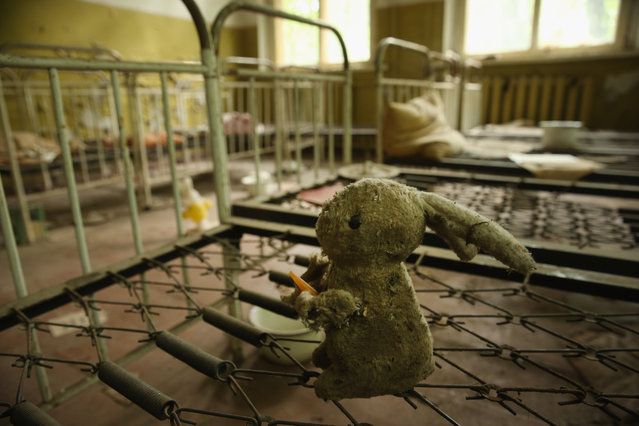
A stuffed rabbit doll sits among children's beds standing in the abandoned kindergarten of Kopachi village located inside the Chernobyl Exclusion Zone on September 29, 2015 near Chornobyl, Ukraine. Kopachi, a village that before 1986 had a population of 1,114, lies only a few kilometers south of the former Chernobyl nuclear power plant, where in 1986 workers inadvertantly caused reactor number four to explode, creating the worst nuclear accident in history. Radiation fallout was so high that authorities bulldozed and buried all of Kopachi's structures except for the kindergarten. (Photo by Sean Gallup/Getty Images)

A stuffed rabbit doll sits among children's beds standing in the abandoned kindergarten of Kopachi village located inside the Chernobyl Exclusion Zone on September 29, 2015 near Chornobyl, Ukraine. Kopachi, a village that before 1986 had a population of 1,114, lies only a few kilometers south of the former Chernobyl nuclear power plant, where in 1986 workers inadvertantly caused reactor number four to explode, creating the worst nuclear accident in history. (Photo by Sean Gallup/Getty Images)
Details
27 Apr 2016 09:28:00
Twenty-year-old women draped in traditional kimonos gather for their “Coming-of-Age Day” ceremony at the Tokyo Disneyland in Urayasu, eastern suburb of Tokyo on January 13, 2020. (Photo by Kazuhiro Nogi/AFP Photo)

Twenty-year-old women draped in traditional kimonos gather for their “Coming-of-Age Day” ceremony at the Tokyo Disneyland in Urayasu, eastern suburb of Tokyo on January 13, 2020. (Photo by Kazuhiro Nogi/AFP Photo)
Details
01 Jan 2021 00:01:00
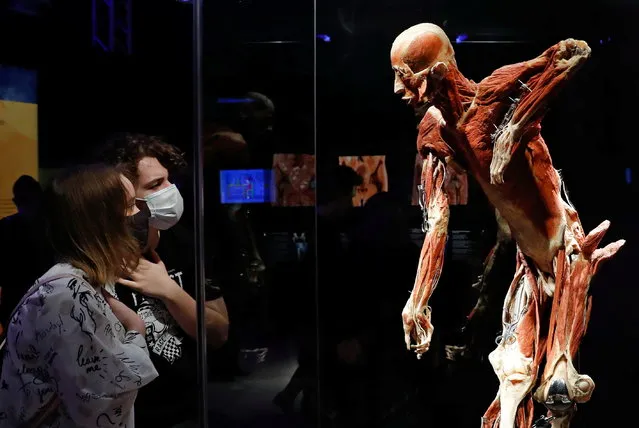
Visitors look at a plastinated human body during the “Body Worlds” exhibition by German anatomist Gunther von Hagens at a pavilion of the Exhibition of Achievements of National Economy (VDNKh) in Moscow, Russia on March 24, 2021. Head of Russian Investigative Committee Alexander Bastrykin ordered a probe of the exhibition after it sparked outrage among conservative religious groups and public figure. (Photo by Evgenia Novozhenina/Reuters)

Visitors look at a plastinated human body during the “Body Worlds” exhibition by German anatomist Gunther von Hagens at a pavilion of the Exhibition of Achievements of National Economy (VDNKh) in Moscow, Russia on March 24, 2021. Head of Russian Investigative Committee Alexander Bastrykin ordered a probe of the exhibition after it sparked outrage among conservative religious groups and public figure. (Photo by Evgenia Novozhenina/Reuters)
Details
25 Mar 2021 09:38:00
Omar Gamal, a 28-year-old pigeon keeper, stands next to his pigeon coop on his rooftop in the Egyptian capital's twin city of Giza on February 21, 2021, with the Pyramids of (R to L) Khufu (Cheops), Khafre (Chephren), and Menkaure (Menkheres) in the background. An ancient tradition handed down through the generations, the practice of domesticating pigeons stretches across borders from the banks of the Nile to north Africa and beyond, with people not only training birds for competitions, but also serving them up as a dining delicacy. (Photo by Khaled Desouki/AFP Photo)

Omar Gamal, a 28-year-old pigeon keeper, stands next to his pigeon coop on his rooftop in the Egyptian capital's twin city of Giza on February 21, 2021, with the Pyramids of (R to L) Khufu (Cheops), Khafre (Chephren), and Menkaure (Menkheres) in the background. An ancient tradition handed down through the generations, the practice of domesticating pigeons stretches across borders from the banks of the Nile to north Africa and beyond, with people not only training birds for competitions, but also serving them up as a dining delicacy. (Photo by Khaled Desouki/AFP Photo)
Details
27 Mar 2021 09:11:00