Loading...
Done
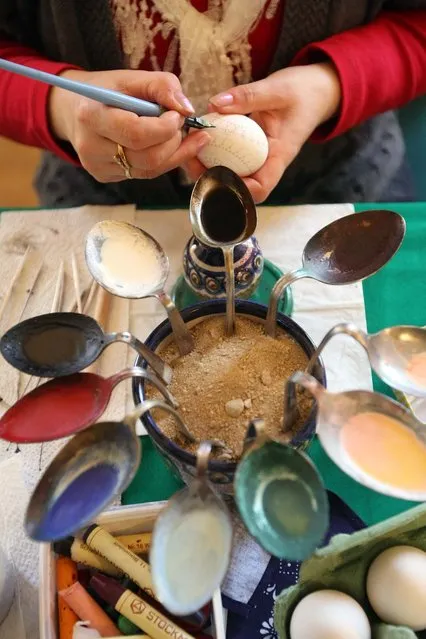
A Sorb egg painter decorates an Easter egg while using bent spoons full of melted wax as coloring at the annual Easter egg market on March 16, 2013 in Schleife, Germany. Easter is a particularly important time of year for Sorbs, a Slavic minority in eastern Germany, and the period includes the tradition of painting Easter eggs that include visual elements intended to ward off evil. Many Sorbs still speak Sorbian, a language closely related to Polish and Czech.  (Photo by Adam Berry)

A Sorb egg painter decorates an Easter egg while using bent spoons full of melted wax as coloring at the annual Easter egg market on March 16, 2013 in Schleife, Germany. Easter is a particularly important time of year for Sorbs, a Slavic minority in eastern Germany, and the period includes the tradition of painting Easter eggs that include visual elements intended to ward off evil. Many Sorbs still speak Sorbian, a language closely related to Polish and Czech. (Photo by Adam Berry)
Details
19 Mar 2013 06:41:00
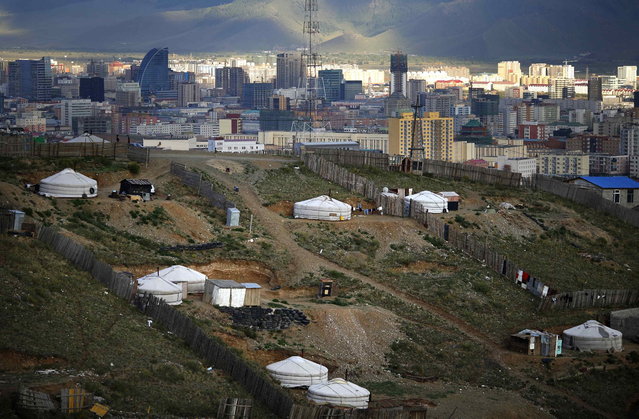
Gers, traditional Mongolian tents, are seen on a hill in an area known as a ger district in Ulan Bator June 26, 2013. (Photo by Carlos Barria/Reuters)

Gers, traditional Mongolian tents, are seen on a hill in an area known as a ger district in Ulan Bator June 26, 2013. Approximately 60 percent of the population of Ulan Bator live in settlements known as ger districts and in many cases residents have limited access to basic services such as water and sanitation. According to a 2010 National Population Center census, every year between thirty and forty thousand people migrate from the countryside to the capital Ulan Bator. Ger districts in the city have been expanding rapidly in recent years. Mongolia is the world's least densely populated country, with 2.8 million people spread across an area around three times the size of France. (Photo by Carlos Barria/Reuters)
Details
11 Aug 2013 11:45:00
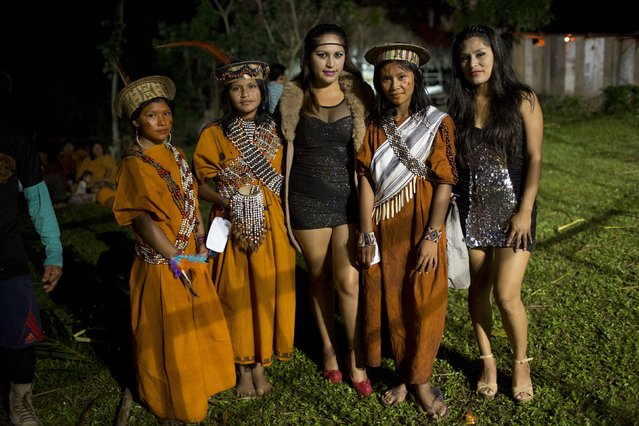
In this June 23, 2015 photo, Ashaninka Indian beauty contestants pose for a photo with members of a visiting music group, hired to perform during the annual founding anniversary festivities, in Otari Nativo, Pichari, Peru. The contestants wear the simple brown dresses of the Ashaninka woman, their faces dotted in a traditional design with a red dye extracted from a spice called achiote. (Photo by Rodrigo Abd/AP Photo)

In this June 23, 2015 photo, Ashaninka Indian beauty contestants pose for a photo with members of a visiting music group, hired to perform during the annual founding anniversary festivities, in Otari Nativo, Pichari, Peru. The contestants wear the simple brown dresses of the Ashaninka woman, their faces dotted in a traditional design with a red dye extracted from a spice called achiote. (Photo by Rodrigo Abd/AP Photo)
Details
16 Jul 2015 11:12:00
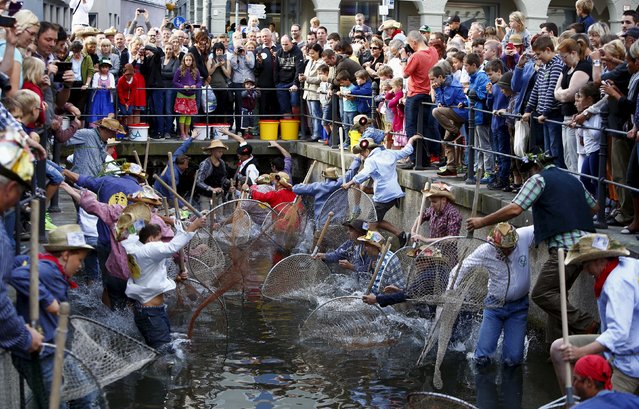
Fishermen jump into a small river to catch trout as they celebrate Fischertag (Fisherman's Day) in downtown Memmingen, southern Germany, July 25, 2015. The annual Fisherman's Day (Fischertag) tradition goes back to the year of 1465 where every fisherman who were born in Memmingen tries to catch trout from the river. The participant who catches the biggest trout will be named the “Fisher King” for one year. (Photo by Michaela Rehle/Reuters)

Fishermen jump into a small river to catch trout as they celebrate Fischertag (Fisherman's Day) in downtown Memmingen, southern Germany, July 25, 2015. The annual Fisherman's Day (Fischertag) tradition goes back to the year of 1465 where every fisherman who were born in Memmingen tries to catch trout from the river. The participant who catches the biggest trout will be named the “Fisher King” for one year. (Photo by Michaela Rehle/Reuters)
Details
26 Jul 2015 10:37:00
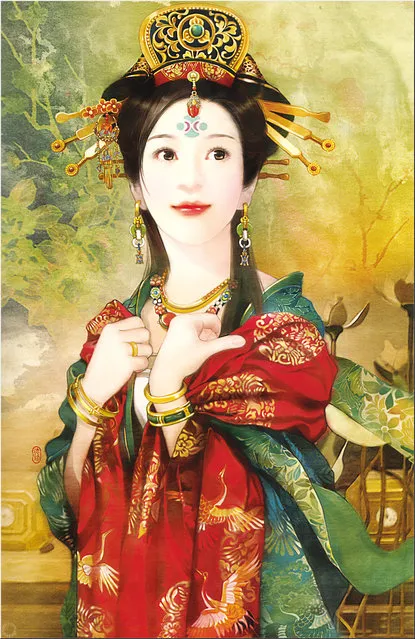
Der Jen (Dezhen; 德珍繪館) – The beauty of Brocade

“Der Jen (Dezhen; 德珍繪館) has achieved fame in her homeland and that fame is now spreading to other parts of the world as more and more people become familiar with her beautiful paintings. This Taiwanese artist depicts these beautiful ladies in classic, traditional dress that would have been worn by members of the royal court or an empress herself. Traditional hair styles and jewelry depicted in her pieces are also considered authentic. Der Jens art can be found in Chinese advertising, childrens magazines, romance novels, tarot cards, and even on public transit tickets. Its also making its way to our pcs as desktop wallpaper”.

Photo: Der Jen (Dezhen; 德珍繪館) – “The beauty of Brocade” (please click to enlarge).
Details
17 Oct 2012 12:03:00
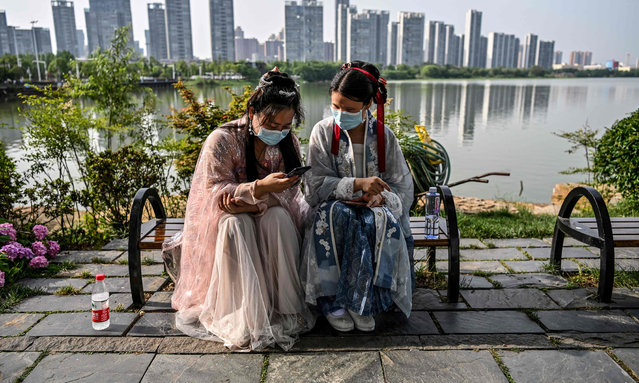
Young women wearing facemasks and traditional costumes of Song dynasty and Tang dynasty are seated on a bench in a park next to the East Lake in Wuhan, in China’s central Hubei province on May 17, 2020. The Guardian picture desk has chosen on December 17, 2020, the AFP photojournalist Hector Retamal as “Agency Photographer of the Year 2020” for his coverage of the novel coronavirus Covid-19 pandemic in Wuhan, China. (Photo by Hector Retamal/AFP Photo)

Young women wearing facemasks and traditional costumes of Song dynasty and Tang dynasty are seated on a bench in a park next to the East Lake in Wuhan, in China’s central Hubei province on May 17, 2020. The Guardian picture desk has chosen on December 17, 2020, the AFP photojournalist Hector Retamal as “Agency Photographer of the Year 2020” for his coverage of the novel coronavirus Covid-19 pandemic in Wuhan, China. (Photo by Hector Retamal/AFP Photo)
Details
12 Jan 2021 00:03:00
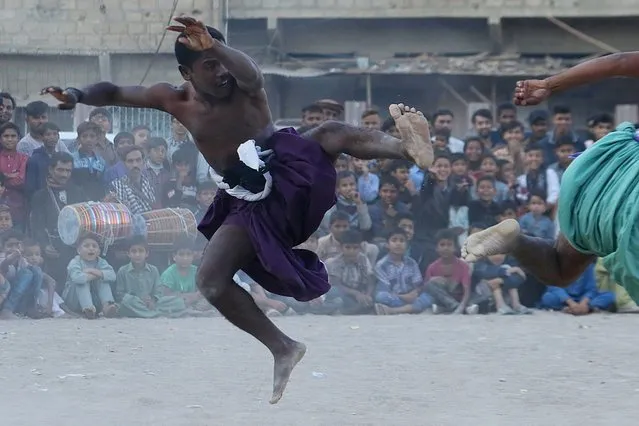
WrestlerTeddy Sheedi (L) fights his opponent during the traditional Sindhi Malakhra wrestling in Karachi, Pakistan, 13 December 2020. A Malakhra match begins with both wrestlers tying a twisted cloth around the opponent's waist. Each one then holds onto the opponent's waistcloth and tries to throw him to the ground. (Photo by Shahzaib Akber/EPA/EFE)

WrestlerTeddy Sheedi (L) fights his opponent during the traditional Sindhi Malakhra wrestling in Karachi, Pakistan, 13 December 2020. A Malakhra match begins with both wrestlers tying a twisted cloth around the opponent's waist. Each one then holds onto the opponent's waistcloth and tries to throw him to the ground. (Photo by Shahzaib Akber/EPA/EFE)
Details
13 Jan 2021 00:05:00
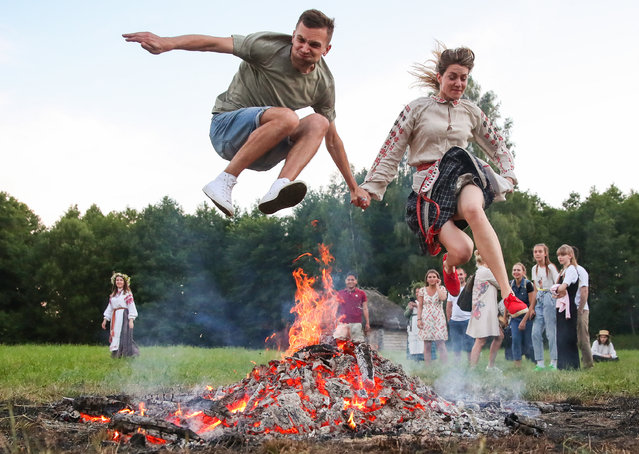
A man and a woman jump over a bonfire during Ivan Kupala Day celebrations held by the Belarusian State Museum of Folk Architecture and Rural Lifestyle in the village of Ozertso near Minsk, Belarus on July 4, 2020. Ivan Kupala Day, also known as Ivana-Kupala or Kupala Night, is a traditional pagan holiday celebrated in eastern Slavic cultures. Various rituals are traditionally performed on Kupala Night, including making flower wreaths, fortune-telling, jumping over bonfires, and burning a wheel-like effigy symbolizing the sun. (Photo by Natalia Fedosenko/TASS)

A man and a woman jump over a bonfire during Ivan Kupala Day celebrations held by the Belarusian State Museum of Folk Architecture and Rural Lifestyle in the village of Ozertso near Minsk, Belarus on July 4, 2020. Ivan Kupala Day, also known as Ivana-Kupala or Kupala Night, is a traditional pagan holiday celebrated in eastern Slavic cultures. Various rituals are traditionally performed on Kupala Night, including making flower wreaths, fortune-telling, jumping over bonfires, and burning a wheel-like effigy symbolizing the sun. (Photo by Natalia Fedosenko/TASS)
Details
23 Jan 2021 09:53:00