Loading...
Done
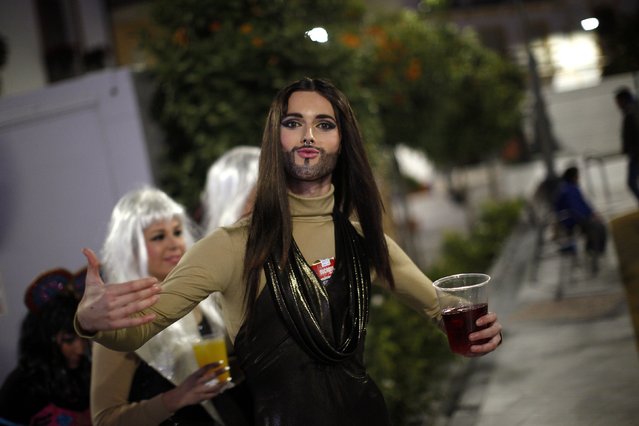
A reveller dressed up as Austrian drag queen and 2014 Eurovision song contest winner Conchita Wurst takes part in New Year's celebrations in Coin, near Malaga, southern Spain, early January 1, 2015. Villagers and revellers dressed up in funny costumes to take part in the New Year's celebration. (Photo by Jon Nazca/Reuters)

A reveller dressed up as Austrian drag queen and 2014 Eurovision song contest winner Conchita Wurst takes part in New Year's celebrations in Coin, near Malaga, southern Spain, early January 1, 2015. Villagers and revellers dressed up in funny costumes to take part in the New Year's celebration. (Photo by Jon Nazca/Reuters)
Details
02 Jan 2015 12:19:00
A Pakistani farmer guides his bulls as he competes in a traditional bull race in Khunda village in the northwestern district of Attock, some 80 kilometers from Islamabad on January 3, 2015. Tens of thousands of people gather whenever there is a bull race held in Pakistan which are usually the highlight of festivals organized in rural areas of the Asian country, and attract lots of spectators due to their thrilling nature. (Photo by Aamir Qureshi/AFP Photo)

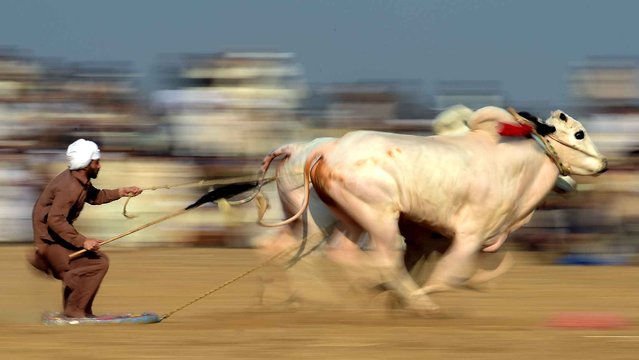
A Pakistani farmer guides his bulls as he competes in a traditional bull race in Khunda village in the northwestern district of Attock, some 80 kilometers from Islamabad on January 3, 2015. Tens of thousands of people gather whenever there is a bull race held in Pakistan which are usually the highlight of festivals organized in rural areas of the Asian country, and attract lots of spectators due to their thrilling nature. The traditional competition attracts landlords and farmers from all around the province where the race is held, and they all bring their fastest and strongest bulls in hopes of gaining a reputation. (Photo by Aamir Qureshi/AFP Photo)
Details
10 Jan 2015 12:58:00
In this photo taken Wednesday, April 30, 2014, a dragonfly sits on the nose of a Gharial, rare crocodile-like creatures, in the River Chambal near Bhopepura village in the northern Indian state of Uttar Pradesh. The narrow 250-mile stretch of the Chambal is a place of crocodiles and jackals, of river dolphins and the occasional wolf. Hundreds of species of birds, storks, geese, babblers, larks, falcons and so many more, nest along the river. (Photo by Altaf Qadri/AP Photo)

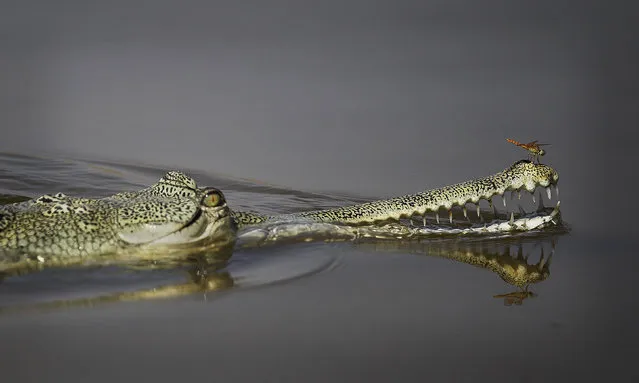
In this photo taken Wednesday, April 30, 2014, a dragonfly sits on the nose of a Gharial, rare crocodile-like creatures, in the River Chambal near Bhopepura village in the northern Indian state of Uttar Pradesh. The narrow 250-mile stretch of the Chambal is a place of crocodiles and jackals, of river dolphins and the occasional wolf. Hundreds of species of birds, storks, geese, babblers, larks, falcons and so many more, nest along the river. Endangered birds lay small speckled eggs in tiny pits they dig in the sandbars. Gharials, rare crocodile-like creatures that look like they swaggered out of the Mesozoic Era, are commonplace here and nowhere else. (Photo by Altaf Qadri/AP Photo)
Details
23 Feb 2015 12:55:00
In this Tuesday, March 31, 2015 photo, Indian women walk carrying firewood they collected from a forest at Gobhali village on the outskirts of Gauhati, India. Every evening, hundreds of millions of Indian women hover over crude stoves making dinner for their families. They feed the flames with polluting fuels like kerosene or cow dung, and breathe the acrid smoke wafting from the fires. (Photo by Anupam Nath/AP Photo)

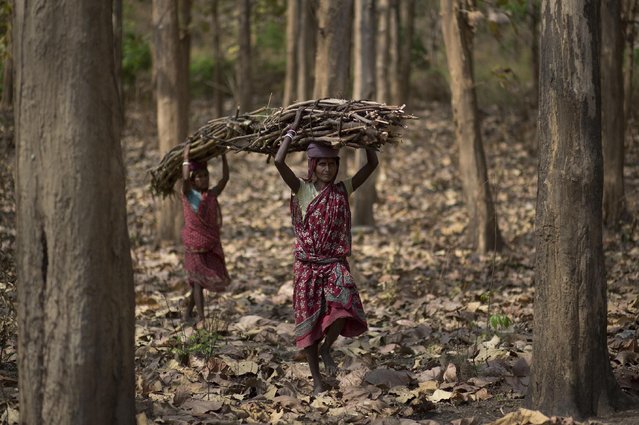
In this Tuesday, March 31, 2015 photo, Indian women walk carrying firewood they collected from a forest at Gobhali village on the outskirts of Gauhati, India. Every evening, hundreds of millions of Indian women hover over crude stoves making dinner for their families. They feed the flames with polluting fuels like kerosene or cow dung, and breathe the acrid smoke wafting from the fires. (Photo by Anupam Nath/AP Photo)
Details
16 Apr 2015 12:29:00
In this photo taken on Saturday, April, 4, 2015, a bear chews on a corncob at a shelter that attracts hundreds of visitors and volunteers from around the world every year, in Kutarevo, Croatia. Over a decade ago, Ivan Crnkovic-Pavenka, a retired Croatian social worker decided to help bears become “ambassadors of the wilderness” among people and set up a unique shelter for brown bears in the idyllic mountain village of Kutarevo in central Croatia, where eight bears currently live in two huge enclosures. (Photo by Amel Emric/AP Photo)

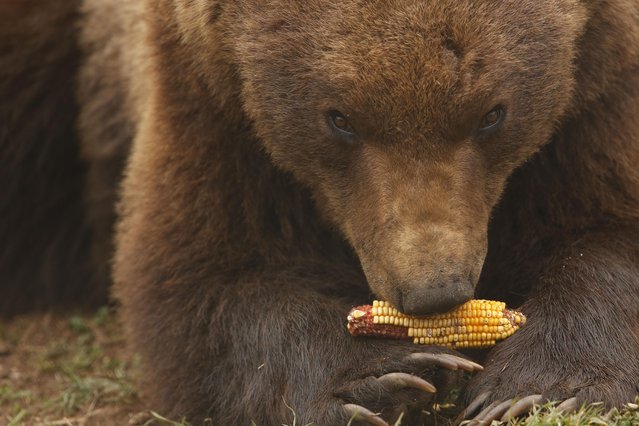
In this photo taken on Saturday, April, 4, 2015, a bear chews on a corncob at a shelter that attracts hundreds of visitors and volunteers from around the world every year, in Kutarevo, Croatia. Over a decade ago, Ivan Crnkovic-Pavenka, a retired Croatian social worker decided to help bears become “ambassadors of the wilderness” among people and set up a unique shelter for brown bears in the idyllic mountain village of Kutarevo in central Croatia, where eight bears currently live in two huge enclosures. (Photo by Amel Emric/AP Photo)
Details
20 Apr 2015 13:03:00
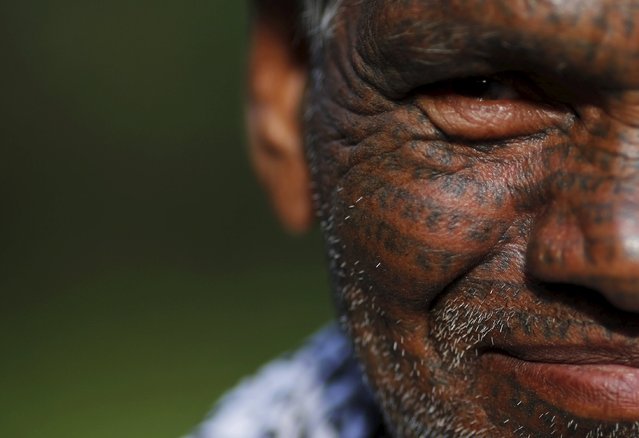
Tiharu Ram, 70, a follower of Ramnami Samaj, who has tattooed the name of the Hindu god Ram on his face, poses for a picture outside his house in the village of Chandlidi, in the eastern state of Chhattisgarh, India, November 16, 2015. (Photo by Adnan Abidi/Reuters)

Tiharu Ram, 70, a follower of Ramnami Samaj, who has tattooed the name of the Hindu god Ram on his face, poses for a picture outside his house in the village of Chandlidi, in the eastern state of Chhattisgarh, India, November 16, 2015. Denied entry to temples and forced to use separate wells, low-caste Hindus in the eastern state of Chhattisgarh first tattooed their bodies and faces more than 100 years ago as an act of defiance and devotion. (Photo by Adnan Abidi/Reuters)
Details
14 Jan 2016 08:05:00
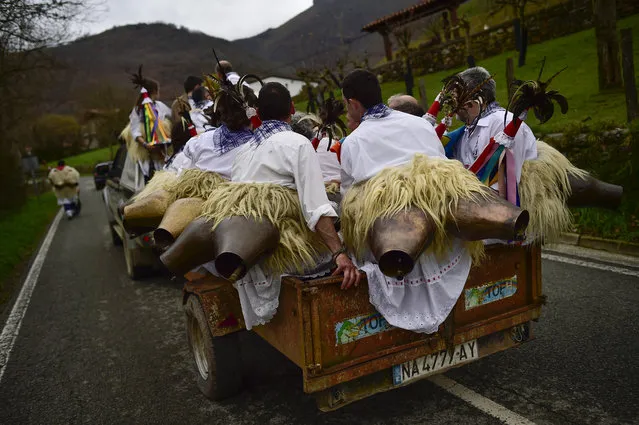
Joaldunaks return in a trailer to their town at the end of Carnival between of the Pyrenees villages of Ituren and Zubieta, northern Spain, Monday, February 1, 2016. In one of the most ancient carnivals in Europe, dating from before the Roman empire, companies of Joaldunak (cowbells) made up of residents of two towns, Ituren and Zubieta, parade the streets costumed in sandals, lace petticoats, sheepskins around the waist and shoulders, coloured neckerchiefs, conical caps with ribbons and a hyssop of horsehair in their right hands and cowbells hung across their lower back. (Photo by Alvaro Barrientos/AP Photo)

Joaldunaks return in a trailer to their town at the end of Carnival between of the Pyrenees villages of Ituren and Zubieta, northern Spain, Monday, February 1, 2016. In one of the most ancient carnivals in Europe, dating from before the Roman empire, companies of Joaldunak (cowbells) made up of residents of two towns, Ituren and Zubieta, parade the streets costumed in sandals, lace petticoats, sheepskins around the waist and shoulders, coloured neckerchiefs, conical caps with ribbons and a hyssop of horsehair in their right hands and cowbells hung across their lower back. (Photo by Alvaro Barrientos/AP Photo)
Details
02 Feb 2016 13:07:00
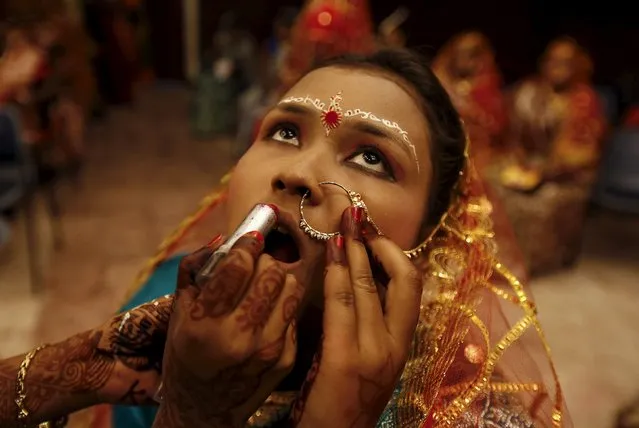
A bride gets her make-up done before the start of a mass marriage ceremony in Kolkata, India, February 14, 2016. A total of 150 tribal Hindu, Muslim and Christian couples from various villages across the state took their wedding vows on Sunday during the day-long mass marriage ceremony organised by a social organisation, the organisers said. (Photo by Rupak De Chowdhuri/Reuters)

A bride gets her make-up done before the start of a mass marriage ceremony in Kolkata, India, February 14, 2016. A total of 150 tribal Hindu, Muslim and Christian couples from various villages across the state took their wedding vows on Sunday during the day-long mass marriage ceremony organised by a social organisation, the organisers said. (Photo by Rupak De Chowdhuri/Reuters)
Details
15 Feb 2016 10:44:00