Loading...
Done
Macaque monkeys crowd together in their cage at a monkey farm on February 3, 2016 in Xinye county, Henan province, China. The area boasts a centuries-long and lucrative history of raising and training monkeys for performance. In Xinye, villagers are seeing an increase in business with the lunar calendar's “Year of the Monkey”. Farmers say most of the monkeys are bred and raised for domestic zoos, circuses, and performing groups, but add that some are also sold for medical research in China and the United States. Despite the popularity of the tradition, critics contend the training methods and conditions constitute animal cruelty. (Photo by Kevin Frayer/Getty Images)

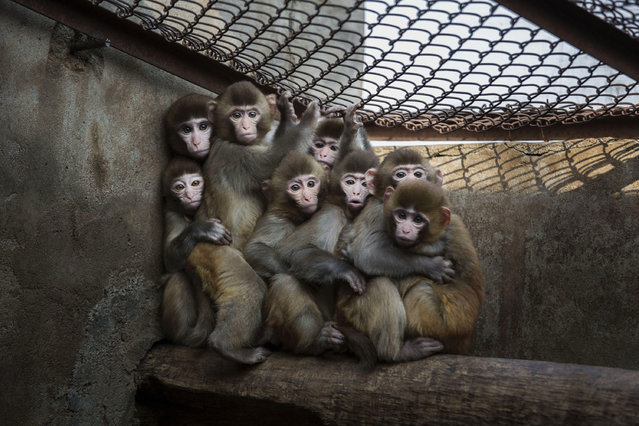
Macaque monkeys crowd together in their cage at a monkey farm on February 3, 2016 in Xinye county, Henan province, China. The area boasts a centuries-long and lucrative history of raising and training monkeys for performance. In Xinye, villagers are seeing an increase in business with the lunar calendar's “Year of the Monkey”. Farmers say most of the monkeys are bred and raised for domestic zoos, circuses, and performing groups, but add that some are also sold for medical research in China and the United States. Despite the popularity of the tradition, critics contend the training methods and conditions constitute animal cruelty. (Photo by Kevin Frayer/Getty Images)
Details
31 Dec 2016 09:56:00
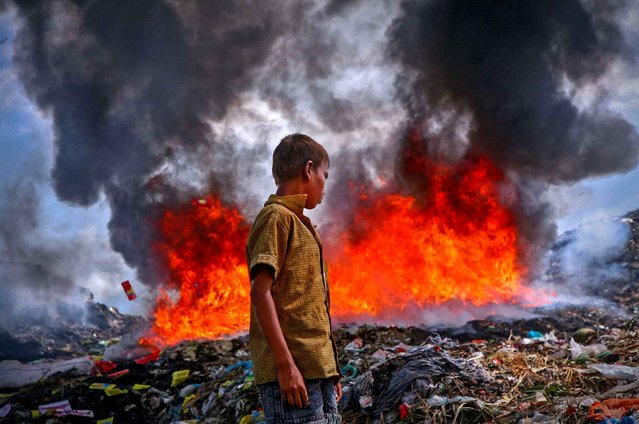
A boy looks for sellable materials close to the burning garbage in the permanent waste land under Sylhet City Corporation for a living, on January 15, 2015. (Photo by Md. Akhlas Uddin/Pacific Press)

A boy looks for sellable materials close to the burning garbage in the permanent waste land under Sylhet City Corporation for a living, on January 15, 2015. (Photo by Md. Akhlas Uddin/Pacific Press)
Details
18 Feb 2015 13:32:00
Luling, Louisiana US. New evidence contradicts previous claims of the relative safety of glyphosate, the world’s most widely used herbicide, which is manufactured here. It is often used in conjunction with seeds that have been genetically modified to tolerate its application, meaning that anyone consuming these crops is eating a genetically modified plant, and whatever residue of the pesticide that remains. (Photo by J. Henry Fair/Industrial Scars/Papadakis Publisher)

Luling, Louisiana, US. New evidence contradicts previous claims of the relative safety of glyphosate, the world’s most widely used herbicide, which is manufactured here. It is often used in conjunction with seeds that have been genetically modified to tolerate its application, meaning that anyone consuming these crops is eating a genetically modified plant, and whatever residue of the pesticide that remains. (Photo by J. Henry Fair/Industrial Scars/Papadakis Publisher)
Details
25 Oct 2016 10:40:00
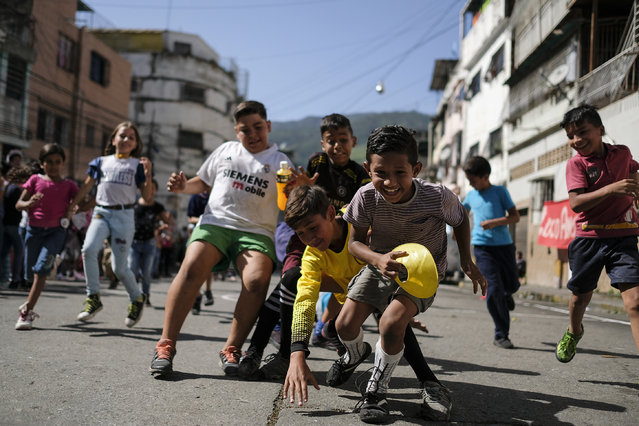
In this July 20, 2019 photo, children play during a sports event organized by members of the Caracas FC soccer club, in Catia, one of the poorest slums in Caracas, Venezuela. When the Caracas Football Club plays, its supporters leave their ideological preferences and socioeconomic differences behind, joining together to support and take care of each other inside and outside the stadium. (Photo by Matias Delacroix/AP Photo)

In this July 20, 2019 photo, children play during a sports event organized by members of the Caracas FC soccer club, in Catia, one of the poorest slums in Caracas, Venezuela. When the Caracas Football Club plays, its supporters leave their ideological preferences and socioeconomic differences behind, joining together to support and take care of each other inside and outside the stadium. (Photo by Matias Delacroix/AP Photo)
Details
04 Feb 2020 00:05:00
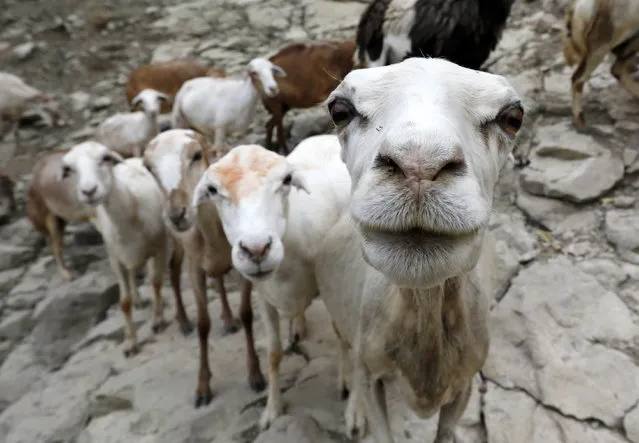
A flock of sheep and goats is led by shepherds to pastures at a mountain village on the outskirts of Sana'a, Yemen, 27 July 2023. At least eight million sheep and goats from about 470,000 pastoralist and agro pastoralist households across Yemen will be treated and vaccinated over the two years 2023 and 2024, in an effort to reduce livestock losses, improve production efficiency, and household income generation amid an acute food insecurity, the UN Food and Agriculture Organization (FAO) has reported. Livestock production in Yemen is a main income-generating activity for many rural and poor households. Yemen remains one of the worst humanitarian crises in the world with over 17 million people out of its 30-million population are food insecure due to a combination of prolonged conflicts and economic crisis. (Photo by Yahya Arhab/EPA)

A flock of sheep and goats is led by shepherds to pastures at a mountain village on the outskirts of Sana'a, Yemen, 27 July 2023. At least eight million sheep and goats from about 470,000 pastoralist and agro pastoralist households across Yemen will be treated and vaccinated over the two years 2023 and 2024, in an effort to reduce livestock losses, improve production efficiency, and household income generation amid an acute food insecurity, the UN Food and Agriculture Organization (FAO) has reported. (Photo by Yahya Arhab/EPA)
Details
01 Aug 2023 03:44:00
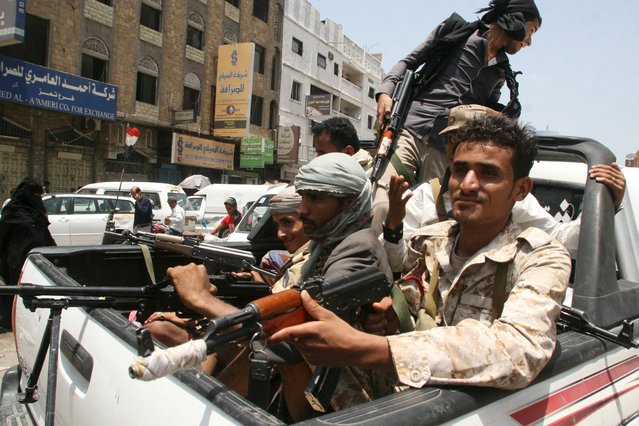
Militants loyal to Yemen's exiled government ride on the back of a pick-up truck in the country's central city of Taiz August 19, 2015. Militia forces loyal to Yemen's exiled government fought their way deep into the central city of Taiz this week, local officials said, largely pushing out Houthi militiamen from the country's third largest city. (Photo by Reuters/Stringer)

Militants loyal to Yemen's exiled government ride on the back of a pick-up truck in the country's central city of Taiz August 19, 2015. Militia forces loyal to Yemen's exiled government fought their way deep into the central city of Taiz this week, local officials said, largely pushing out Houthi militiamen from the country's third largest city. (Photo by Reuters/Stringer)
Details
21 Aug 2015 12:12:00
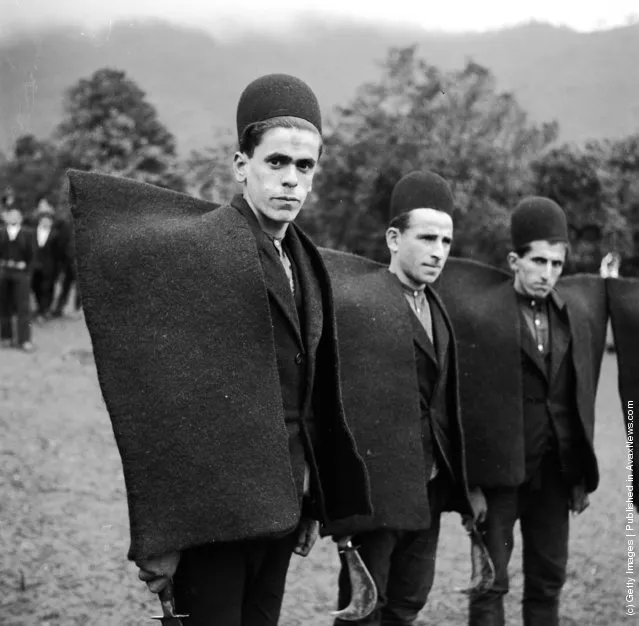
1952:  Shepherds from the north wear their traditional heavy woollen mantles as they stand ready to shear sheep with sycthe-like shears

Shepherds from the north wear their traditional heavy woollen mantles as they stand ready to shear sheep with sycthe-like shears. (Photo by Three Lions/Getty Images). Circa 1952
Details
03 Dec 2011 13:34:00
A Kurdish girl wears her relative's assault rifle and ammunition belt as she waits at the  Iraqi Kurdish Shaqouli checkpoint, some 35 kilometres east of Mosul, on November 10, 2016. Since the start of the Mosul offensive the Kurds have moved their border some 10 kms closer to Iraq's second city, marking it out with a line in the sand. (Photo by Odd Andersen/AFP Photo)

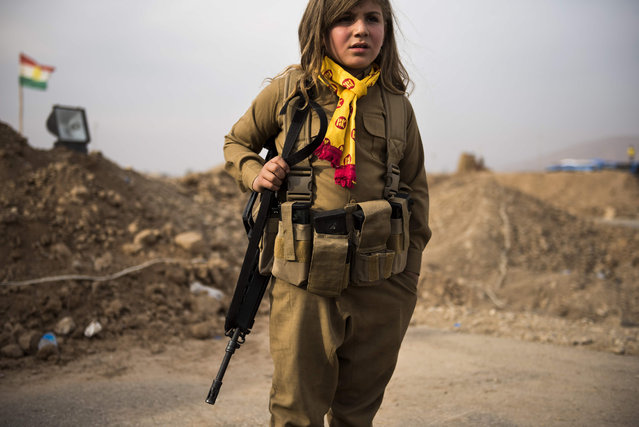
A Kurdish girl wears her relative's assault rifle and ammunition belt as she waits at the Iraqi Kurdish Shaqouli checkpoint, some 35 kilometres east of Mosul, on November 10, 2016. Since the start of the Mosul offensive the Kurds have moved their border some 10 kms closer to Iraq's second city, marking it out with a line in the sand. (Photo by Odd Andersen/AFP Photo)
Details
11 Nov 2016 08:02:00