Loading...
Done
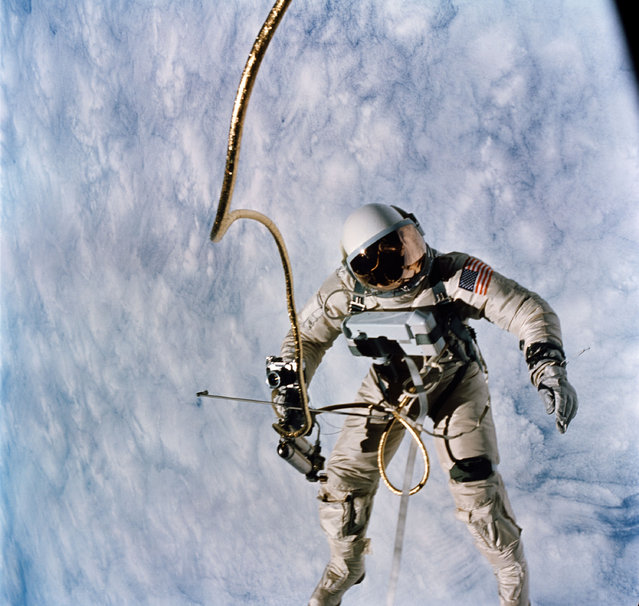
Astronaut Edward H. White II, pilot for the Gemini-Titan 4 (GT-4) spaceflight, floats in the zero-gravity of space during the third revolution of the GT-4 spacecraft on June 3, 1965. White wears a specially designed spacesuit. His face is shaded by a gold-plated visor to protect him from unfiltered rays of the sun. (Photo by NASA)

Astronaut Edward H. White II, pilot for the Gemini-Titan 4 (GT-4) spaceflight, floats in the zero-gravity of space during the third revolution of the GT-4 spacecraft on June 3, 1965. White wears a specially designed spacesuit. His face is shaded by a gold-plated visor to protect him from unfiltered rays of the sun. In his right hand he carries a Hand-Held Self-Maneuvering Unit (HHSMU) that gives him control over his movements in space. White also wears an emergency oxygen chest pack; and he carries a camera mounted on the HHSMU for taking pictures of the sky, Earth and the GT-4 spacecraft. He is secured to the spacecraft by a 25-feet umbilical line and a 23-feet tether line. Both lines are wrapped together in gold tape to form one cord. Astronaut James A. McDivitt, command pilot, remained inside the spacecraft during the extravehicular activity (EVA). Astronaut White died in the Apollo/Saturn 204 fire at Cape Kennedy on January 27, 1967. (Photo by NASA)
Details
22 Jul 2014 12:05:00
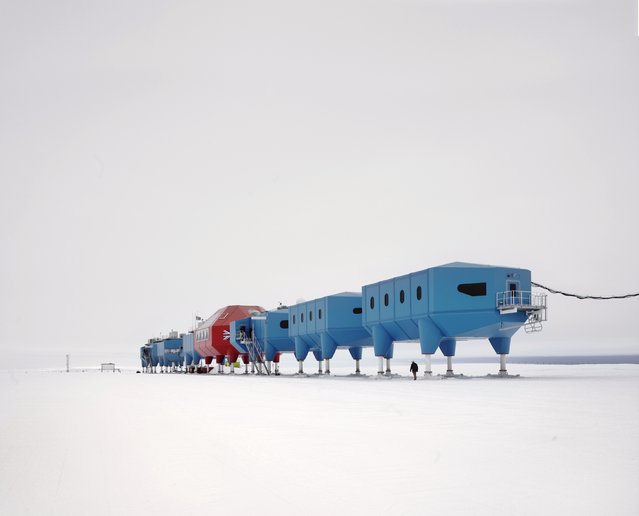
Undated handout photo issued by World Architecture Festival 2013 of The Halley VI centre designed by British architects Hugh Broughton in Antarctica which is a dismantlable research station created in the icy wastes for the British Antarctic Survey and has been shortlisted for a global architecture award. (Photo by World Architecture Festival 2013/PA Wire)

Undated handout photo issued by World Architecture Festival 2013 of The Halley VI centre designed by British architects Hugh Broughton in Antarctica which is a dismantlable research station created in the icy wastes for the British Antarctic Survey and has been shortlisted for a global architecture award. (Photo by World Architecture Festival 2013/PA Wire)
Details
01 Sep 2013 06:45:00
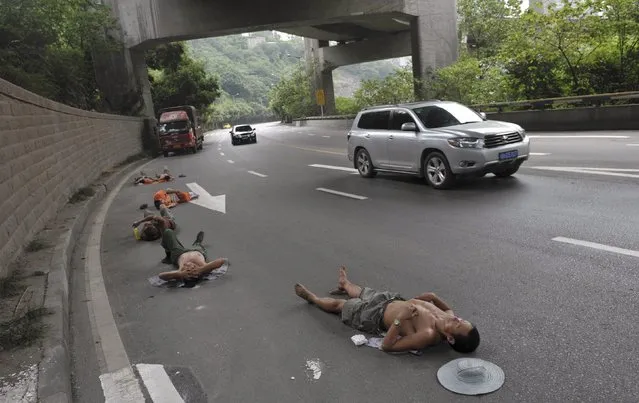
Labourers who work nearby nap on a road as cars drive past in Chongqing Municipality, July 23, 2013. (Photo by Reuters/Stringer)

Labourers who work nearby nap on a road as cars drive past in Chongqing Municipality, July 23, 2013. (Photo by Reuters/Stringer)
Details
05 Sep 2013 10:28:00
Fotos Pole Street Buenos Aires – Miss Pole Dance Argentina 2012. (Photo by Diego Castillo)

Fotos Pole Street Buenos Aires – Miss Pole Dance Argentina 2012. (Photo by Diego Castillo)
Details
21 May 2013 07:48:00
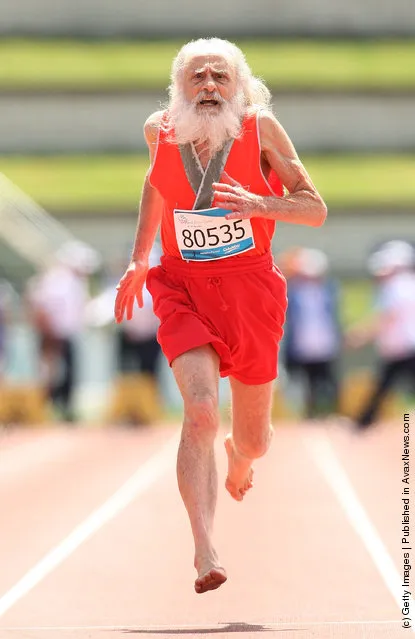
O Santa Claus of Australia competes in the mens 80-84 years 100 metres heats during day two of the 2009 Sydney World Masters Games

O Santa Claus of Australia competes in the mens 80–84 years 100 metres heats during day two of the 2009 Sydney World Masters Games at Sydney Olympic Park on October 11, 2009 in Sydney, Australia. (Photo by Mark Nolan/Getty Images)
Details
23 Oct 2011 16:10:00


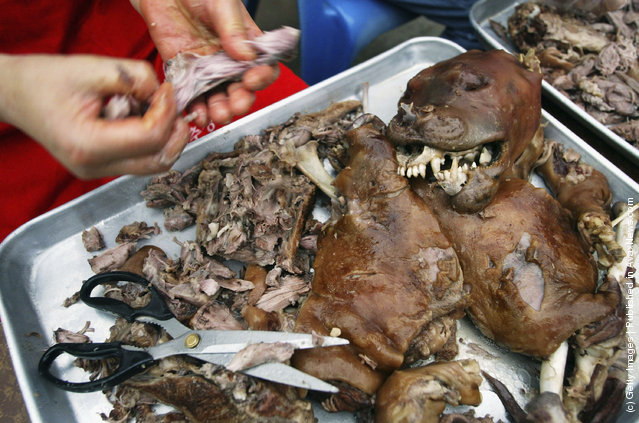
“Dog meat refers to edible parts and the flesh derived from (predominantly domestic) dogs. Human consumption of dog meat has been recorded in many parts of the world, including ancient China, ancient Mexico, and ancient Rome. According to contemporary reports, dog meat is consumed in a variety of countries such as Switzerland, China, Vietnam, the Philippines, and Korea. In addition, dog meat has also been used as survival food in times of war and/or other hardships”. – Wikipedia

Photo: A chef prepares dog meat at a restaurant on July 4, 2005 in Gwacheon, South Korea. Dog meat is a traditional dish in Korea dating back to the Samkuk period (period of the three kingdoms BC 57 – AD 668). Although many recipes existed historically for dog meat, now chefs only make soups, or dishes using boiled or roasted meat. Koreans traditionally eat dog meat on the hottest day of the summer, for it's reputed benefits of virility, invigoration and health. (Photo by Chung Sung-Jun/Getty Images)
Details
24 Jul 2011 13:21:00
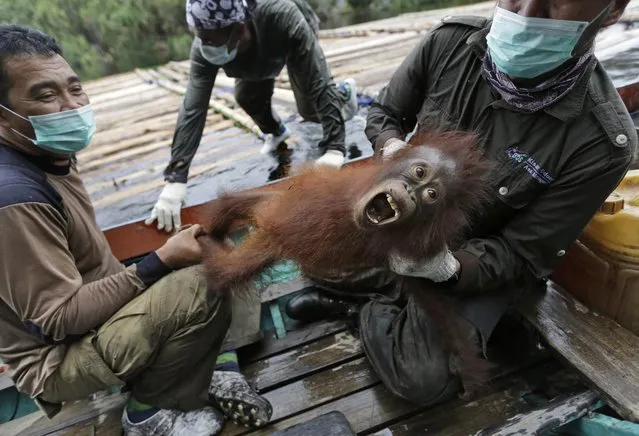
In this January 7, 2016, photo, conservationists of Borneo Orangutan Survival Foundation hold a baby orangutan rescued along with its mother during a rescue and release operation for orangutans trapped in a swath of jungle in Sungai Mangkutub, Central Kalimantan, Indonesia. Last year's forest fires drove orangutans closer to the river bank, where they had to live in an over-populated swath of forest as thin as 30 meters wide along the river. (Photo by Dita Alangkara/AP Photo)

In this January 7, 2016, photo, conservationists of Borneo Orangutan Survival Foundation hold a baby orangutan rescued along with its mother during a rescue and release operation for orangutans trapped in a swath of jungle in Sungai Mangkutub, Central Kalimantan, Indonesia. Last year's forest fires drove orangutans closer to the river bank, where they had to live in an over-populated swath of forest as thin as 30 meters wide along the river. (Photo by Dita Alangkara/AP Photo)
Details
25 Jan 2016 11:36:00
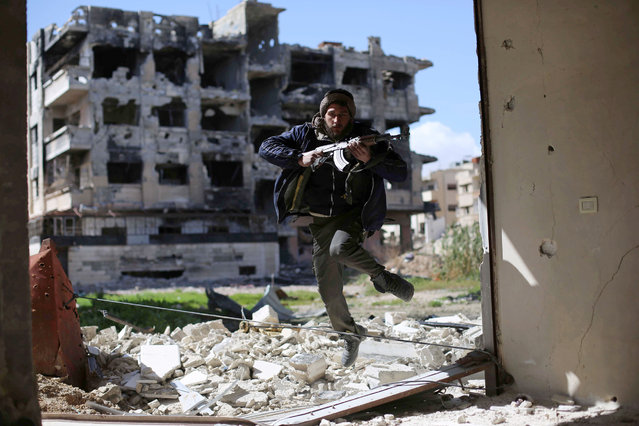
A fighter belonging to Jaish al-Islam (Islam Army) runs to take cover near the frontline on March 14, 2016 in the neighbourhood of Jobar, on the eastern outskirts of the capital Damascus. (Photo by Amer Almohibany/AFP Photo)

A fighter belonging to Jaish al-Islam (Islam Army) runs to take cover near the frontline on March 14, 2016 in the neighbourhood of Jobar, on the eastern outskirts of the capital Damascus. (Photo by Amer Almohibany/AFP Photo)
Details
25 Mar 2016 13:28:00