Loading...
Done
Visitors review their cell phone photos of an installation called 'Plexus A1' by artist Gabriel Dawe, one of nine large-scale art installations displayed at the 'Wonders' exhibit at the Renwick Art Gallery in Washington, DC, Wednesday, January 13, 2016. Built in the 1860s, the Renwick was the first American building to be designed specifically as an art museum; it recently reopened after a two year renovation. (Photo by Jim Lo Scalzo/EPA)

Visitors review their cell phone photos of an installation called “Plexus A1” by artist Gabriel Dawe, one of nine large-scale art installations displayed at the “Wonders” exhibit at the Renwick Art Gallery in Washington, DC, Wednesday, January 13, 2016. Built in the 1860s, the Renwick was the first American building to be designed specifically as an art museum; it recently reopened after a two year renovation. (Photo by Jim Lo Scalzo/EPA)
Details
14 Jan 2016 11:58:00
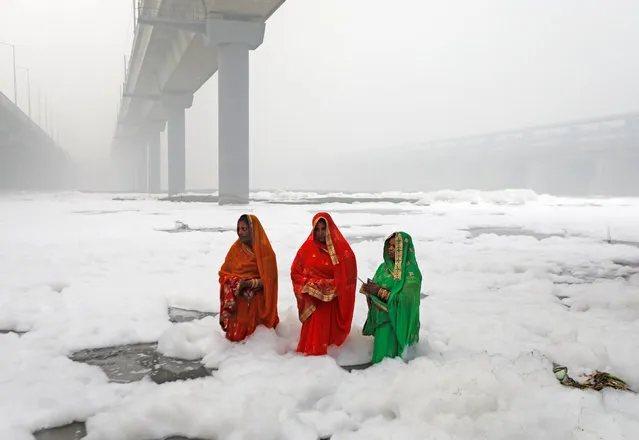
Hindu women worship the Sun god in the polluted waters of the river Yamuna during the Hindu religious festival of Chatth Puja in New Delhi, India, November 3, 2019. (Photo by Adnan Abidi/Reuters)

Hindu women worship the Sun god in the polluted waters of the river Yamuna during the Hindu religious festival of Chatth Puja in New Delhi, India, November 3, 2019. (Photo by Adnan Abidi/Reuters)
Details
05 Nov 2019 00:05:00
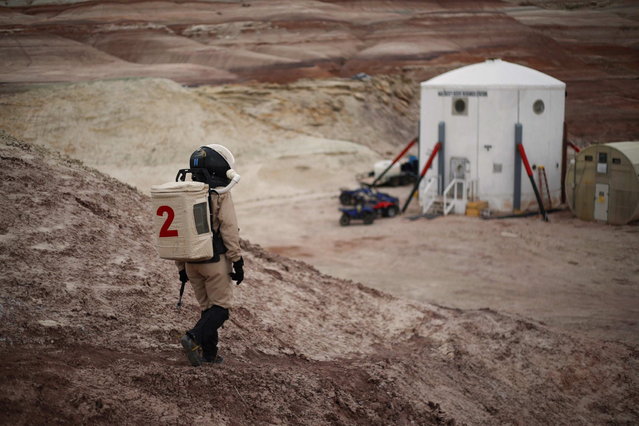
Csilla Orgel, a geologist of Crew 125 EuroMoonMars B mission, makes her way back to the Mars Desert Research Station (MDRS) in the Utah desert March 3, 2013. (Photo by Jim Urquhart/Reuters)

NASA says it could be another 20 years before humans touch down on Mars, but in a sense, the Mars Society has been exploring the red planet for more than a decade – in Utah. Photo: Csilla Orgel, a geologist of Crew 125 EuroMoonMars B mission, makes her way back to the Mars Desert Research Station (MDRS) in the Utah desert March 3, 2013. The MDRS aims to investigate the feasibility of a human exploration of Mars and uses the Utah desert's Mars-like terrain to simulate working conditions on the red planet. Scientists, students and enthusiasts work together developing field tactics and studying the terrain. All outdoor exploration is done wearing simulated spacesuits and carrying air supply packs and crews live together in a small communication base with limited amounts of electricity, food, oxygen and water. Everything needed to survive must be produced, fixed and replaced on site. (Photo by Jim Urquhart/Reuters)
Details
14 Mar 2013 12:11:00
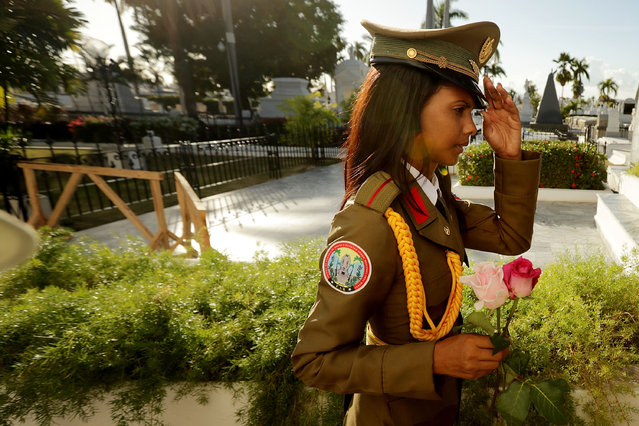
A military guard carries flowers through the Cementerio Santa Ifigenia where the remains of former Cuban President Fidel Castro were entombed December 4, 2016 in Santiago de Cuba, Cuba. The tomb stands to the side of a memorial to the rebel soldiers killed in an attack that Castro led on Santiago's Moncada barracks on July 26, 1953, and in front of the mausoleum of Cuban national hero Jose Marti. (Photo by Chip Somodevilla/Getty Images)

A military guard carries flowers through the Cementerio Santa Ifigenia where the remains of former Cuban President Fidel Castro were entombed December 4, 2016 in Santiago de Cuba, Cuba. The tomb stands to the side of a memorial to the rebel soldiers killed in an attack that Castro led on Santiago's Moncada barracks on July 26, 1953, and in front of the mausoleum of Cuban national hero Jose Marti. (Photo by Chip Somodevilla/Getty Images)
Details
06 Dec 2016 10:50:00
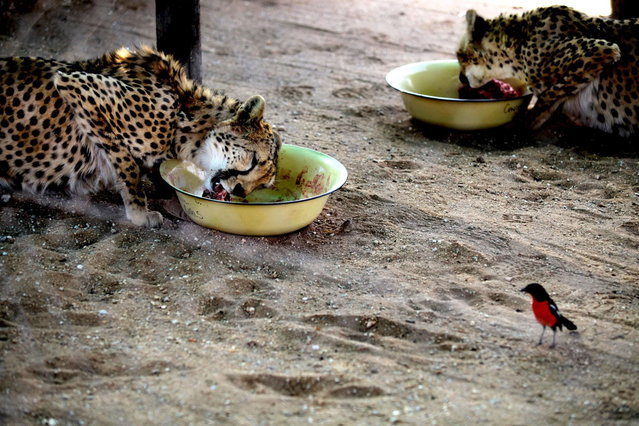
Young cheetahs eat meat at The Cheetah Conservation Fund (CCF) center in Otjiwarongo, Namibia, on August 13, 2013. The CCF started breeding Anatolian livestock dogs to promote cheetah-friendly farming after some 10,000 big cats – the current total worldwide population – were killed or moved off farms in the 1980s.  Up to 1,000 cheetahs were being killed a year, mostly by farmers who saw them as livestock killers. But the use of dogs has slashed losses for sheep and goat farmers and led to less retaliation against the vulnerable cheetah. (Photo by Jennifer Bruce/AFP Photo)

Young cheetahs eat meat at The Cheetah Conservation Fund (CCF) center in Otjiwarongo, Namibia, on August 13, 2013. The CCF started breeding Anatolian livestock dogs to promote cheetah-friendly farming after some 10,000 big cats – the current total worldwide population – were killed or moved off farms in the 1980s. Up to 1,000 cheetahs were being killed a year, mostly by farmers who saw them as livestock killers. But the use of dogs has slashed losses for sheep and goat farmers and led to less retaliation against the vulnerable cheetah. (Photo by Jennifer Bruce/AFP Photo)
Details
29 Aug 2013 10:56:00
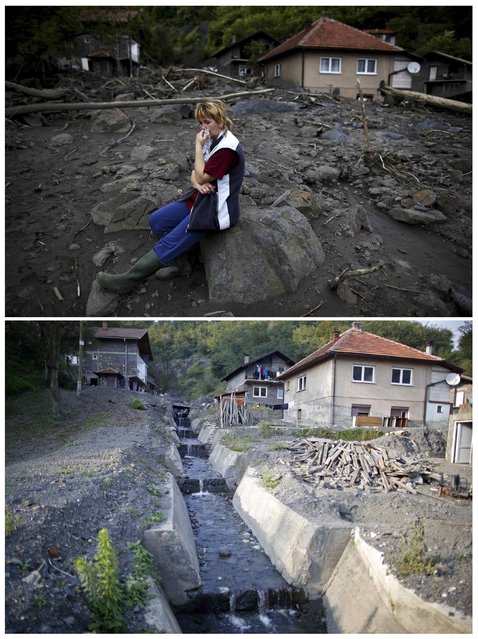
A combination photo shows Fata Kovacevic reacting near her flood-damaged house during floods May 20, 2014 (top) and the same place after floods October 8, 2014 in Topcic Polje. (Photo by Dado Ruvic/Reuters)

A combination photo shows Fata Kovacevic reacting near her flood-damaged house during floods May 20, 2014 (top) and the same place after floods October 8, 2014 in Topcic Polje. (Photo by Dado Ruvic/Reuters)
Details
09 Oct 2014 12:18:00
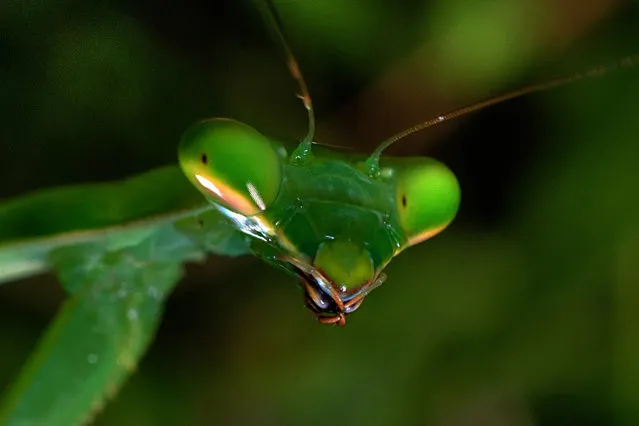
Close Encounter of the Insect Kind: Check out the awesome face on this praying mantis. I can't get over the mouth, it's like something from a science fiction movie. Of all photographic styles macro is definitely my favorite. I am constantly amazed, in every photo that I take, by the intricate level of detail that exists on even the smallest of creatures. It's a stark reminder that a very complex and infinitely beautiful world exists just beyond our human-sized level of perception. Photo taken in Donnybrook, Queensland, Australia. (Photo by Andrew Young/National Geographic Photo Contest

Close Encounter of the Insect Kind: “Check out the awesome face on this praying mantis. I can't get over the mouth, it's like something from a science fiction movie. Of all photographic styles macro is definitely my favorite. I am constantly amazed, in every photo that I take, by the intricate level of detail that exists on even the smallest of creatures. It's a stark reminder that a very complex and infinitely beautiful world exists just beyond our human-sized level of perception. Photo taken in Donnybrook, Queensland, Australia” – Andrew Young. (Photo by Andrew Young/National Geographic Photo Contest via The Atlantic)
Details
24 Sep 2012 09:18:00


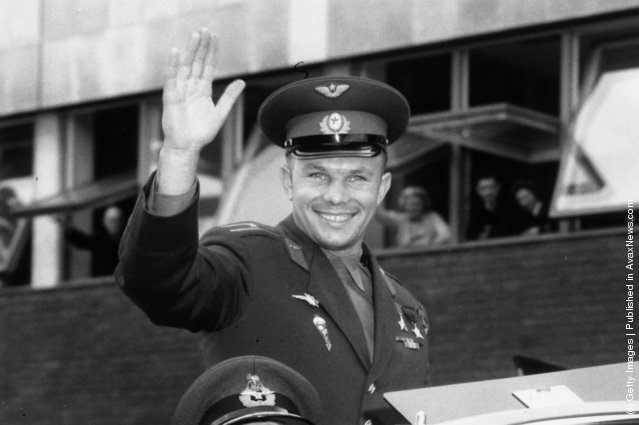
Soviet cosmonaut and the first man to travel in space, Yury Alekseyvich Gagarin (1934–1968) arriving in London for a Russian trade fair. (Photo by Douglas Miller/Getty Images)
Details
11 Apr 2011 10:24:00