Loading...
Done


Smithfield meat porters march on the Home Office, bearing a petition which calls for an end to all immigration into Britain, 25th August 1972. (Photo by Keystone/Hulton Archive/Getty Images)
Details
14 Apr 2011 08:42:00
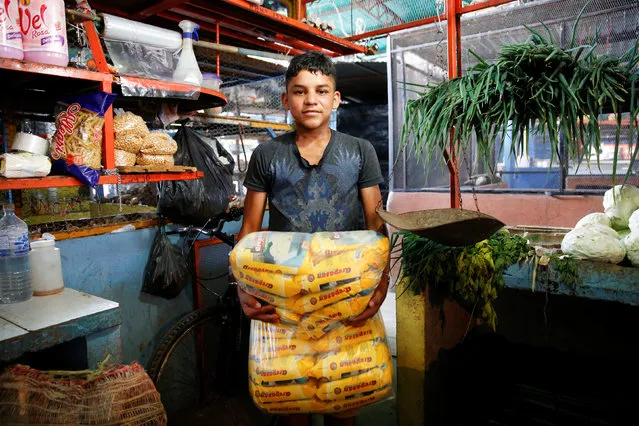
Carlos Cure holds packets of corn flour made in Colombia as he poses for a picture at a stall that sells food and staple items at a market in La Fria, Venezuela, June 2, 2016. (Photo by Carlos Garcia Rawlins/Reuters)

Carlos Cure holds packets of corn flour made in Colombia as he poses for a picture at a stall that sells food and staple items at a market in La Fria, Venezuela, June 2, 2016. (Photo by Carlos Garcia Rawlins/Reuters)
Details
09 Jun 2016 09:09:00
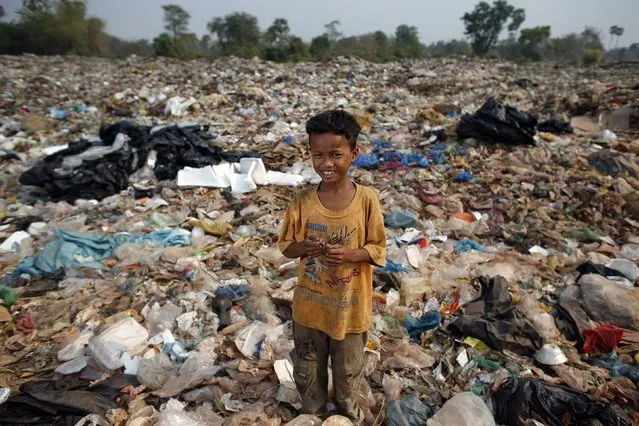
Ty, a 15-year-old boy, poses for a picture while collecting usable items at a landfill dumpsite outside Siem Reap March 19, 2015. Ty, who finished  six-grade primary school, said he makes 5 USD per month working at the dumpsite. (Photo by Athit Perawongmetha/Reuters)

Ty, a 15-year-old boy, poses for a picture while collecting usable items at a landfill dumpsite outside Siem Reap March 19, 2015. Ty, who finished six-grade primary school, said he makes 5 USD per month working at the dumpsite. (Photo by Athit Perawongmetha/Reuters)
Details
22 Mar 2015 11:13:00
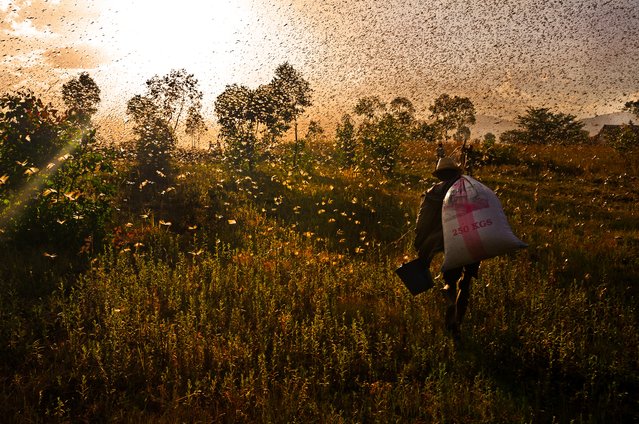
“Locusts & Men”. Oppression, interaction, collaboration. In the life cycle of nature nothing is lost, but the coexistence of different species is sometimes difficult. In Madagascar periodically returns the archaic antagonism between man and the migratory locust, in a circle of life where the two species are looking for space and food for their survival. Photo location: Madagascar, 2013. (Photo and caption by Michele Martinelli/National Geographic Photo Contest)

“Locusts & Men”. Oppression, interaction, collaboration. In the life cycle of nature nothing is lost, but the coexistence of different species is sometimes difficult. In Madagascar periodically returns the archaic antagonism between man and the migratory locust, in a circle of life where the two species are looking for space and food for their survival. At the end of the day a man walks home carrying on his shoulders the heavy bag which contains the locusts captured during the day. The insects provide nutritious meals for the man and his family. Photo location: Madagascar, 2013. (Photo and caption by Michele Martinelli/National Geographic Photo Contest)

ATTENTION! All pictures are presented in high resolution. To see Hi-Res images – just TWICE click on any picture. In other words, click small picture – opens the BIG picture. Click BIG picture – opens VERY BIG picture.
Details
03 Dec 2013 10:59:00
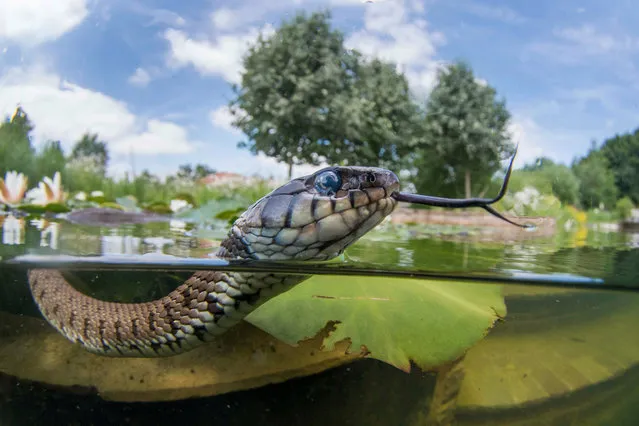
British Waters Wide Angle category runner-up. Grass snake swimming along a garden pond by Jack Perks (UK)in Nottinghamshire, UK. “I’m always on the lookout for unusual freshwater subjects and grass snakes are a species I’ve been after for years. I was told about a pond where the odd grass snake hangs around the lilly pads for frogs. I put my drysuit on and got into the water and could see one slithering along the surface. Slowly making my way towards it with my head only just poking above I got the spilt shot”. (Photo by Jack Perks/Underwater Photographer of the Year 2019)

British Waters Wide Angle category runner-up. Grass snake swimming along a garden pond by Jack Perks (UK)in Nottinghamshire, UK. “I’m always on the lookout for unusual freshwater subjects and grass snakes are a species I’ve been after for years. I was told about a pond where the odd grass snake hangs around the lilly pads for frogs. I put my drysuit on and got into the water and could see one slithering along the surface. Slowly making my way towards it with my head only just poking above I got the spilt shot”. (Photo by Jack Perks/Underwater Photographer of the Year 2019)
Details
28 Feb 2019 00:03:00
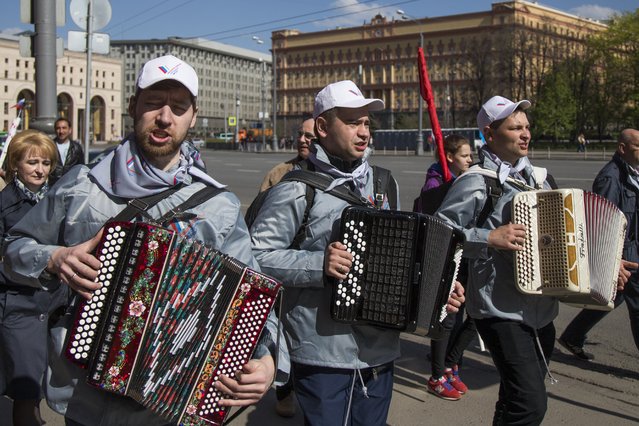
Russians play accordions as they walk near the building of the Federal Security Service (FSB, Soviet KGB successor) in Lubyanskaya Square to mark May Day in Moscow, Russia, Sunday, May 1, 2016. As in Soviet times, about one hundred thousand of cheerful workers paraded across Red Square despite a chilly rain, but instead of red flags with the Communist hammer and sickle, they waved the blue flags of the dominant Kremlin party and the Russian tricolor. (Photo by Alexander Zemlianichenko/AP Photo)


Russians play accordions as they walk near the building of the Federal Security Service (FSB, Soviet KGB successor) in Lubyanskaya Square to mark May Day in Moscow, Russia, Sunday, May 1, 2016. As in Soviet times, about one hundred thousand of cheerful workers paraded across Red Square despite a chilly rain, but instead of red flags with the Communist hammer and sickle, they waved the blue flags of the dominant Kremlin party and the Russian tricolor. (Photo by Alexander Zemlianichenko/AP Photo)
Details
02 May 2016 11:09:00
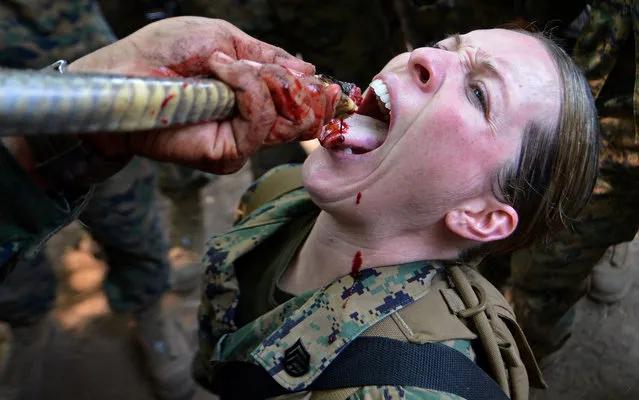
In a military base in the Thai province of Chon Buri February 20 U.S. Marines Navy with Thailand began their studies in jungle survival. The event is held in joint military exercises “Cobra Gold 2013”. During a jungle survival program February 20, 2013 taught by Royal Thai Special Forces in Sannapit, Thailand, U.S. Marines learned to catch cobras and drink their fresh blood, not to mention eat forest insects and pull the heads off of chicken. The training was part of Operation Cobra Gold 13, the 32nd edition of international military exercises hosted by the Thai. According to a U.S. Marines press release, Cobra Gold is the largest exercise of its kind in Asia and incorporates troops from five other nations in addition to the U.S. and Thailand. The Daily Mail reports that the Marines were invited to experience the local custom of drinking cobra blood after being taught to catch and kill cobras in the wild. As CNN notes, Cobra blood is believed to be a panacea and aphrodiasic in parts of Southeast Asia. In Jakarta, vendors can earn over $100 a night selling shots of cobra blood mixed with liquor. (Photo by Pornchai Kittiwongsakul/AFP Photo)

During a jungle survival program February 20, 2013 taught by Royal Thai Special Forces in Sannapit, Thailand, U.S. Marines learned to catch cobras and drink their fresh blood, not to mention eat forest insects and pull the heads off of chicken. The training was part of Operation Cobra Gold 13, the 32nd edition of international military exercises hosted by the Thai. According to a U.S. Marines press release, Cobra Gold is the largest exercise of its kind in Asia and incorporates troops from five other nations in addition to the U.S. and Thailand. The Daily Mail reports that the Marines were invited to experience the local custom of drinking cobra blood after being taught to catch and kill cobras in the wild. As CNN notes, Cobra blood is believed to be a panacea and aphrodiasic in parts of Southeast Asia. In Jakarta, vendors can earn over $100 a night selling shots of cobra blood mixed with liquor. (Photo by Pornchai Kittiwongsakul/AFP Photo)
Details
23 Feb 2013 11:52:00
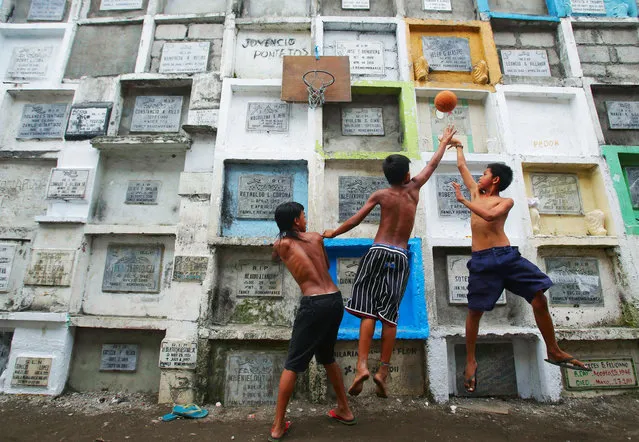
Filipino boys play basketball at an improvised court hooked on multi-layered tombs at a public cemetery in Navotas, north of Manila, Philippines on Thursday Oct. 31, 2013. Filipinos are expected to flock to cemeteries on November 1 to remember their dead as they observe All Saints Day in this predominantly Roman Catholic country. (Photo by Aaron Favila/AP Photo)

Filipino boys play basketball at an improvised court hooked on multi-layered tombs at a public cemetery in Navotas, north of Manila, Philippines on Thursday Oct. 31, 2013. Filipinos are expected to flock to cemeteries on November 1 to remember their dead as they observe All Saints Day in this predominantly Roman Catholic country. (Photo by Aaron Favila/AP Photo)
Details
02 Nov 2013 12:07:00