Loading...
Done
White House Press Secretary Jen Psaki (R) is hugged by current Principal Deputy Press Secretary Karine Jean-Pierre during a press briefing in the Brady Press Briefing Room of the White House in Washington, DC, May 5, 2022, after it was announced Psaki would step down from her role next week and be replaced by Jean-Pierre. US President Joe Biden on May 5, 2022 named Karine Jean-Pierre as the next White House press secretary, the first Black woman to hold the high-profile post. Jean-Pierre, who will also be the first openly LGBTQ+ person in the role, will replace Jen Psaki, under whom she served as deputy, from May 13, according to a White House statement. (Photo by Saul Loeb/AFP Photo)

White House Press Secretary Jen Psaki (R) is hugged by current Principal Deputy Press Secretary Karine Jean-Pierre during a press briefing in the Brady Press Briefing Room of the White House in Washington, DC, May 5, 2022, after it was announced Psaki would step down from her role next week and be replaced by Jean-Pierre. (Photo by Saul Loeb/AFP Photo)
Details
09 May 2022 05:45:00
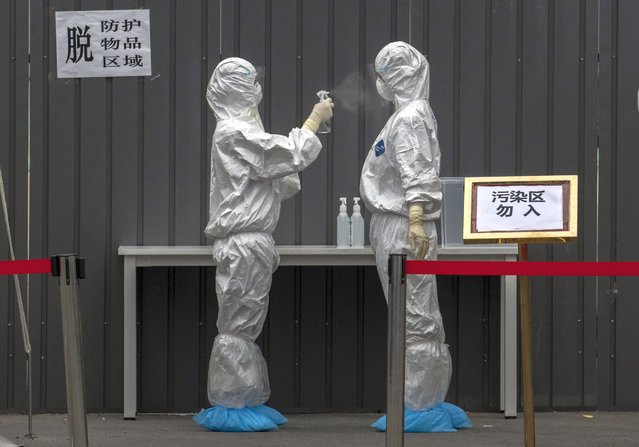
Chinese epidemic control workers wear protective suits as they disinfect each other after performing nucleic acid swab test for COVID-19 on citizens at a government testing site in Xicheng District during an organized tour on June 24, 2020 in Beijing, China. While Chinese government medical officials have said they believe they have controlled the spread, authorities are trying to contain the outbreak linked to the Xinfadi wholesale food market, Beijing's biggest supplier of produce and meat. More than 2.5 million people have undergone nucleic acid tests for COVID-19 at dozens of sites across the city in recent days, with officials using contact tracing to target high and middle risk areas and people who may have had contact with the market or food that came from there. Several neighborhoods have been locked down and a number of other food markets have been closed, The outbreak has triggered fears of a second wave of infection after 56 straight days with no domestically transmitted cases in the capital. (Photo by Kevin Frayer/Getty Images)

Chinese epidemic control workers wear protective suits as they disinfect each other after performing nucleic acid swab test for COVID-19 on citizens at a government testing site in Xicheng District during an organized tour on June 24, 2020 in Beijing, China. While Chinese government medical officials have said they believe they have controlled the spread, authorities are trying to contain the outbreak linked to the Xinfadi wholesale food market, Beijing's biggest supplier of produce and meat. (Photo by Kevin Frayer/Getty Images)
Details
26 Jun 2020 00:01:00
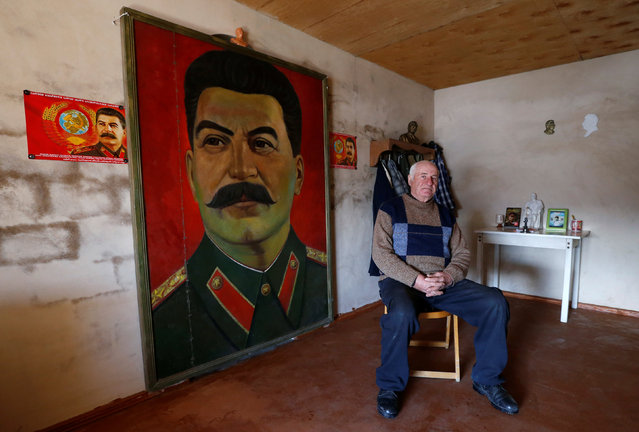
Retired builder Vasili Sidamonidze, 70, poses for a portrait at his home in Gori, Georgia, December 6, 2016. “Unfortunately, Stalin is not popular nowadays. Our people don't respect him. Only we, members of the (Communist) Party, respect him”, Sidamonidze said. “I always try to attend Stalin's birthday anniversaries in Gori. Unfortunately many people don't want to join us even if they live nearby. They look at us from their windows”. Stalin, who was born in Gori in 1878 and died in 1953, is largely reviled today in Georgia, which regained its independence during the 1991 collapse of the Soviet Union. Over the years, his memorials have been dismantled, most recently in 2010 when authorities removed a statue of the dictator from Gori's central square. But Stalin is still revered by a small group of mainly elderly supporters who stress his role in the industrialisation of the Soviet Union and in defeating Nazi Germany in World War Two. Each Dec. 21, a few dozen people mark his birthday by gathering outside a Gori museum dedicated to Stalin, where they make speeches and walk to the square where a 6-meter-high bronze statue of him once stood, calling for it to be reinstated. Opponents say it was a symbol of Moscow's still lingering shadow. In 2008, Russia fought a brief war with Georgia and recognised its breakaway regions of Abkhazia and South Ossetia as independent states. (Photo by David Mdzinarishvili/Reuters)

Retired builder Vasili Sidamonidze, 70, poses for a portrait at his home in Gori, Georgia, December 6, 2016. “Unfortunately, Stalin is not popular nowadays. Our people don't respect him. Only we, members of the (Communist) Party, respect him”, Sidamonidze said. “I always try to attend Stalin's birthday anniversaries in Gori. Unfortunately many people don't want to join us even if they live nearby. They look at us from their windows”. (Photo by David Mdzinarishvili/Reuters)
Details
17 Dec 2016 07:59:00
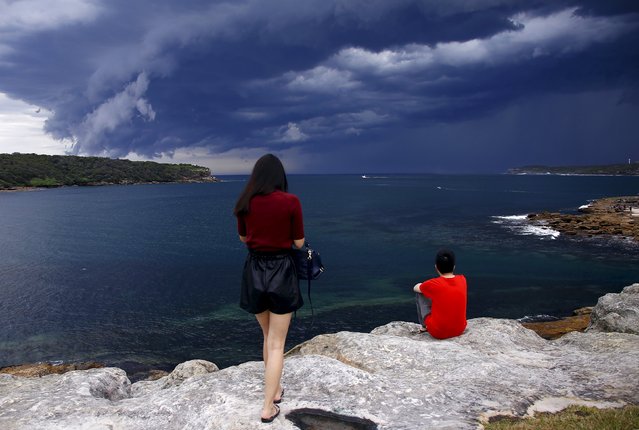
Chinese tourists watch storm clouds moving along the coast towards the city of Sydney, Australia, November 6, 2015. Powerful storms swept across the city on Friday, with the Australian Bureau of Meteorology issuing a warning for severe thunderstorms with large hailstones, heavy rainfall and damaging winds, local media reported. (Photo by David Gray/Reuters)

Chinese tourists watch storm clouds moving along the coast towards the city of Sydney, Australia, November 6, 2015. Powerful storms swept across the city on Friday, with the Australian Bureau of Meteorology issuing a warning for severe thunderstorms with large hailstones, heavy rainfall and damaging winds, local media reported. (Photo by David Gray/Reuters)
Details
08 Nov 2015 08:07:00
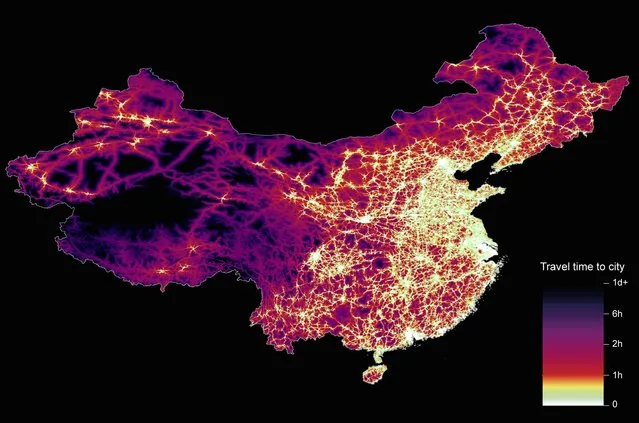
From Britain to China to Mali, new maps showing travel times to the nearest urban centre reveal huge differences between countries. Using Open Street Map and Google, a University of Oxford team have created a visual breakdown that suggests major inequalities when it comes to commuting. Here: China. The dataset used for China was unique as it relied solely on Open Street Map, due to restrictions on accessing Google data. The population is densely concentrated in the east and accessibility is increased, whereas rural provinces in the west remain remote. (Photo by Daniel Weiss/Jennifer Rozier/Malaria Atlas Project/University of Oxford )

From Britain to China to Mali, new maps showing travel times to the nearest urban centre reveal huge differences between countries. Using Open Street Map and Google, a University of Oxford team have created a visual breakdown that suggests major inequalities when it comes to commuting. Here: China. The dataset used for China was unique as it relied solely on Open Street Map, due to restrictions on accessing Google data. The population is densely concentrated in the east and accessibility is increased, whereas rural provinces in the west remain remote. (Photo by Daniel Weiss/Jennifer Rozier/Malaria Atlas Project/University of Oxford)
Details
12 Jan 2018 06:43:00
A model presents a hairstyle creation by stylist Flavia Attard Borg during the Malta Fashion Awards, the climax of Malta Fashion Week, in Valletta, Malta on May 31, 2019. (Photo by Darrin Zammit Lupi/Reuters)

A model presents a hairstyle creation by stylist Flavia Attard Borg during the Malta Fashion Awards, the climax of Malta Fashion Week, in Valletta, Malta on May 31, 2019. (Photo by Darrin Zammit Lupi/Reuters)
Details
03 Jun 2019 00:03:00
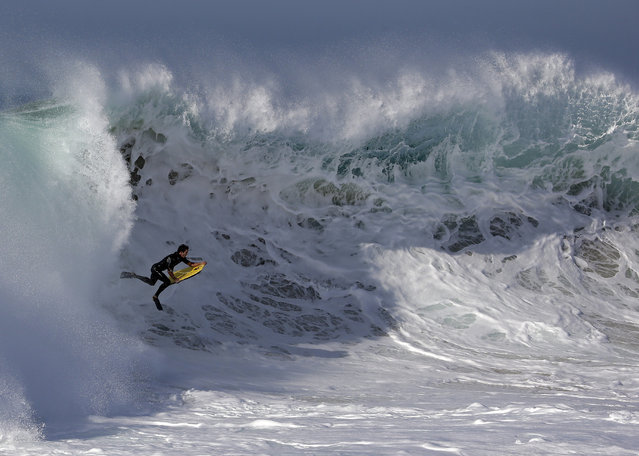
A bogieboarder rides a wave at the wedge in Newport Beach, Calif., Wednesday, August 27, 2014. Southern California beachgoers experienced much higher than normal surf, brought on by Hurricane Marie spinning off the coast of Mexico. (Photo by Chris Carlson/AP Photo)

A bogieboarder rides a wave at the wedge in Newport Beach, Calif., Wednesday, August 27, 2014. Southern California beachgoers experienced much higher than normal surf, brought on by Hurricane Marie spinning off the coast of Mexico. (Photo by Chris Carlson/AP Photo)
Details
28 Aug 2014 10:58:00
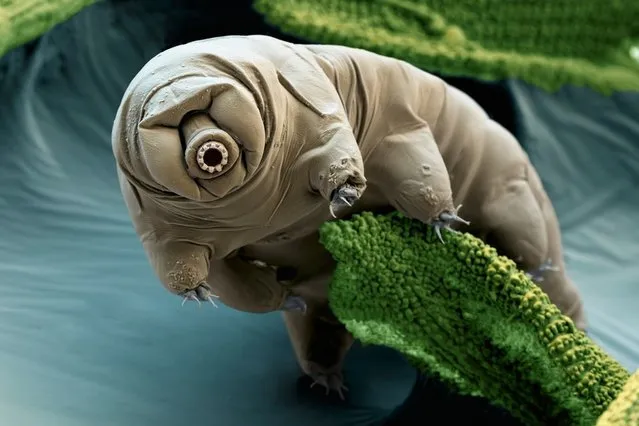
Tardigrades (commonly known as waterbears or moss piglets). (Photo by SPL/East News)

“Tardigrades (commonly known as waterbears or moss piglets) are small, water-dwelling, segmented animals with eight legs. Tardigrades were first discovered in 1773 by Johann August Ephraim Goeze, who called them kleiner Wasserbär, meaning “little water bear” in German. The name Tardigrada means “slow walker” and was given by Lazzaro Spallanzani in 1777. The name water bear comes from the way they walk, reminiscent of a bear's gait. The biggest adults may reach a body length of 1.5 millimetres (0.059 in), the smallest below 0.1 mm. Freshly hatched tardigrades may be smaller than 0.05 mm”. – Wikipedia. Photo: Tardigrades. (Photo by SPL/East News)
Details
26 Sep 2012 09:55:00