Loading...
Done
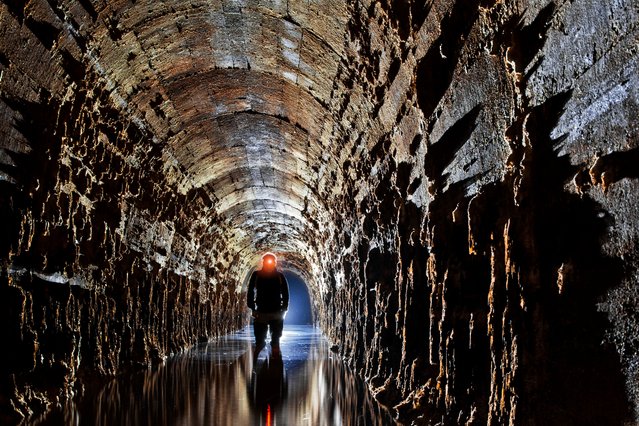
Regenwurmlager, Poland. The Regenwurmlager is an extensive underground fortification area constructed by Germany in 1920s-1940s, now in western Poland, near the city of Międzyrzecz. (Photo by Anna Arinova/Caters News)

Stunning silhouettes under European cities reveal the size and splendor of the continent’s urban foundations. Photographer and content-manager Anna Arinova, 28, from Moscow, captured the awe-inspiring labyrinths in Russia and Germany. Here: Regenwurmlager, Poland. The Regenwurmlager is an extensive underground fortification area constructed by Germany in 1920s-1940s, now in western Poland, near the city of Międzyrzecz. (Photo by Anna Arinova/Caters News)
Details
29 Dec 2016 07:53:00
Political Art By Nadia Khuzina

Russian political artist Nadezhda Khuzina was born December 12, 1982 in the city of Serpukhov, Russia. In 2001 she graduated from Moscow Region Pedagogical College, in 2008 – St. Petersburg Art and Industry Academy. Now Nadezhda Khuzina is living in San Diego, CA. Nadezhda Khuzina “Nadia” has devoted her last paintings to Winter Olympics in Sochi, featuring Russian president Putin in different roles. Vladimir Putin is able to perform any sport – skater and skier, hockey player and snowboarder, such James Bond of Olympics, able to cope with any task. The creative artist is inspired by the image of Russian president, a charismatic man Vladimir Putin
Details
13 Feb 2014 13:31:00
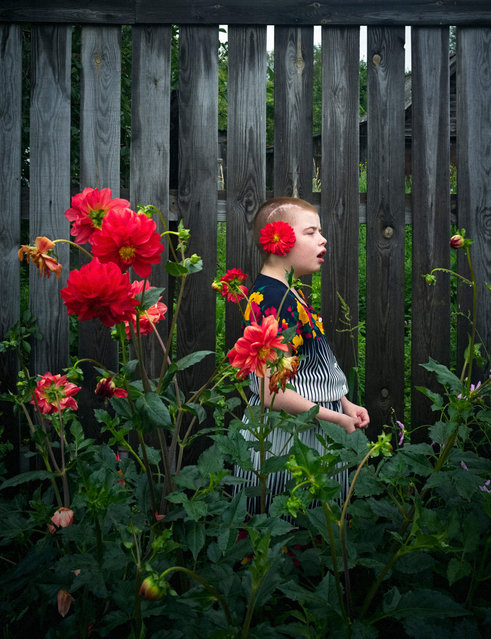
Portrait of a girl from the neuropsychiatric boarding facility for girls. (Photo by Anastasia Rudenko)

“Elat’ma, the Ryazan Oblast region of Russia. This small town is only 300 kilometers (186 miles) from modern Moscow but remains 60 years in the past, dominated by the spirit of socialism. The air of the communist ‘50s can be seen in the town’s architecture, celebrations and other occurrences. But neither its beauty nor its ties to a socialist past brought photographer Anastasia Rudenko to this village. Elat’ma is unique in that it functions as a town for mentally disabled people”. – Michelle Cohan via CNN. (Photo by Anastasia Rudenko)
Details
09 Sep 2014 08:20:00


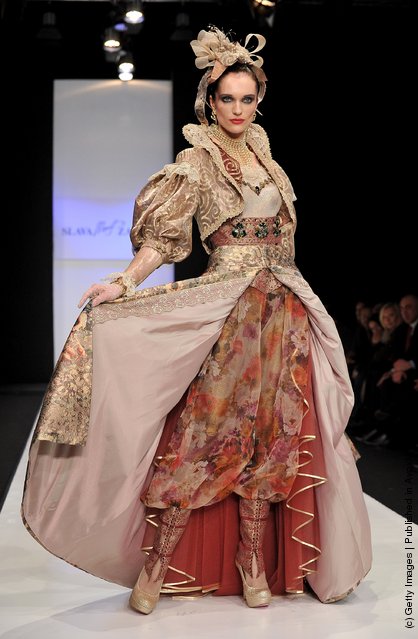
“Vyacheslav Mikhailovich Zaitsev (Russian: Вячеслав Михайлович Зайцев), more commonly known as Slava Zaitsev (Russian: Слава Зайцев), born 2 March 1938 in Ivanovo, Russian Soviet Federative Socialist Republic, is a Russian fashion designer, painter, graphic artist and theatrical costume designer”. – Wikipedia

Photo: A models wears a creation by designer Slava Zaitsev during his fashion show on Day 1 of the Mercedes-Benz Fashion Week Russia Fall/Winter 2011/2012 at the Congress Hall on March 31, 2011 in Moscow, Russia. (Photo by Pascal Le Segretain/Getty Images)
Details
03 Apr 2011 11:29:00
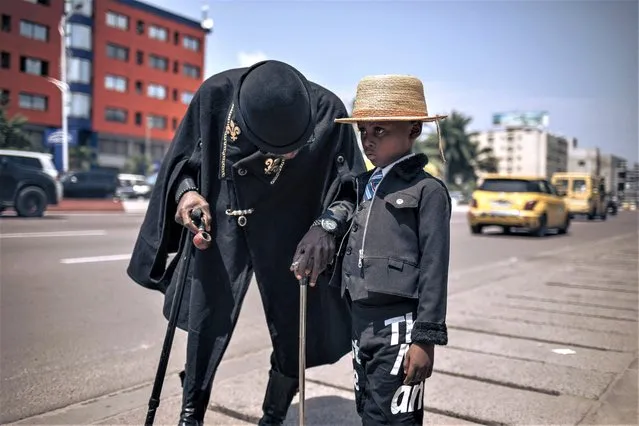
A performer and his son parade during a gathering of sapeurs in Kinshasa, capital of the Democratic Republic of Congo, on February 10, 2023. Flamboyant dandies paraded near the tomb of one of their icons in DR Congo's capital Kinshasa, flaunting coveted designer labels in stark contrast to the grinding poverty surrounding them. Dozens of extravagantly dressed dandies, known locally as sapeurs, turned up on February 10, 2023 to commemorate the death of Stervos Niarcos, a pop star and one of the most famous of Congo's legendary dandies. Niarcos, who died in 1995, epitomises the fanatical pursuit of elegance for many in the abysmally poor central African country.  (Photo by Alexis Huguet/AFP Photo)

A performer and his son parade during a gathering of sapeurs in Kinshasa, capital of the Democratic Republic of Congo, on February 10, 2023. Flamboyant dandies paraded near the tomb of one of their icons in DR Congo's capital Kinshasa, flaunting coveted designer labels in stark contrast to the grinding poverty surrounding them. Dozens of extravagantly dressed dandies, known locally as sapeurs, turned up on February 10, 2023 to commemorate the death of Stervos Niarcos, a pop star and one of the most famous of Congo's legendary dandies. Niarcos, who died in 1995, epitomises the fanatical pursuit of elegance for many in the abysmally poor central African country. (Photo by Alexis Huguet/AFP Photo)
Details
23 Feb 2023 04:35:00
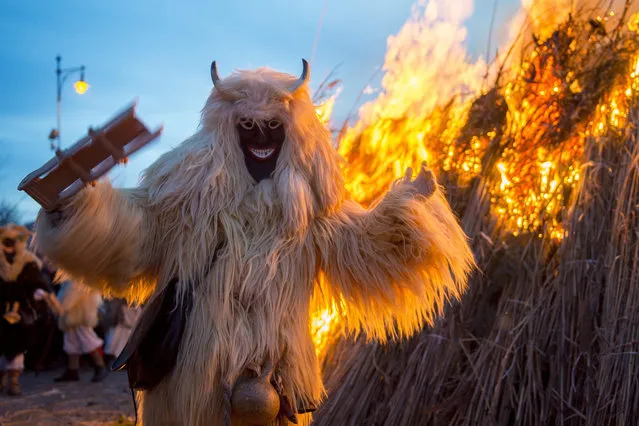
A reveler wearing sheepfur costume is seen in front of a bonfire on which they burn a coffin symbolizing winter during the closing ceremony of the traditional carnival parade in Mohacs, 189 kms south of Budapest, Hungary, 07 February 2016. (Photo by Tamas Soki/EPA)

A reveler wearing sheepfur costume is seen in front of a bonfire on which they burn a coffin symbolizing winter during the closing ceremony of the traditional carnival parade in Mohacs, 189 kms south of Budapest, Hungary, 07 February 2016. The carnival parade of people, the so-called busos, dressed in such costumes and frightening wooden masks, using various noisy wooden rattlers is traditionally held on the seventh weekend before Easter to drive away winter, and is a revival of a legend, which says that ethnic Croats ambushed the Osmanli Turkish troops, who escaped in panic seeing the terrifying figures during the Turkish occupation of Hungary. (Photo by Tamas Soki/EPA)
Details
09 Feb 2016 14:02:00
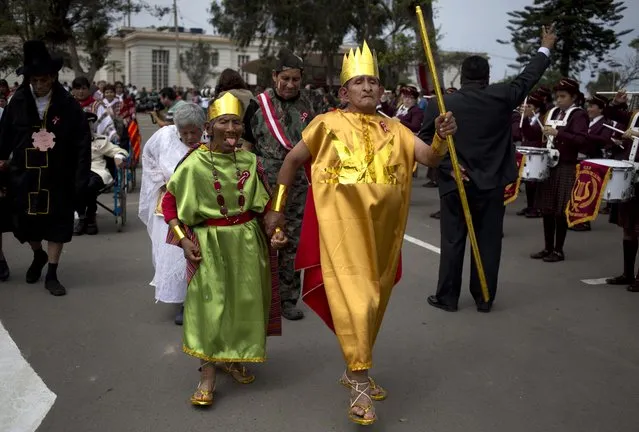
Patients from the Larco Herrera Psychiatric Hospital wear costumes in the likeness of the first governor and founder of the Inca civilization, Manco Capac, right, and his wife Mama Ocllo, during the hospital's Independence Day parade in Lima, Peru, Wednesday, July 22, 2015. (Photo by Martin Mejia/AP Photo)

Patients from the Larco Herrera Psychiatric Hospital wear costumes in the likeness of the first governor and founder of the Inca civilization, Manco Capac, right, and his wife Mama Ocllo, during the hospital's Independence Day parade in Lima, Peru, Wednesday, July 22, 2015. The parade is held on the hospital's campus every year ahead of the Andean nation's official Independence Day celebrations on July 28. (Photo by Martin Mejia/AP Photo)
Details
23 Jul 2015 10:52:00
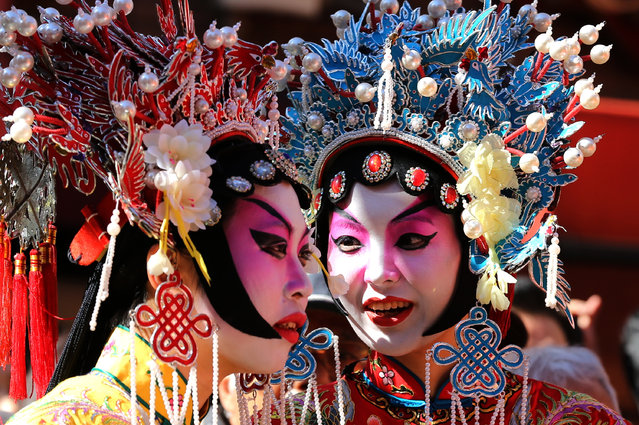
Women dressed in traditional Chinese costumes wait perform in celebration of the Chinese New Year at the Nankinmachi square, China Town on February 8, 2016 in Kobe, Japan. In Nankinmachi, the district known as Kobe Chinatown, tourists enjoyed Chinese food, lion dance and the parade organized to celebrate the Lunar New Year. (Photo by Buddhika Weerasinghe/Getty Images)

Women dressed in traditional Chinese costumes wait perform in celebration of the Chinese New Year at the Nankinmachi square, China Town on February 8, 2016 in Kobe, Japan. In Nankinmachi, the district known as Kobe Chinatown, tourists enjoyed Chinese food, lion dance and the parade organized to celebrate the Lunar New Year. (Photo by Buddhika Weerasinghe/Getty Images)
Details
09 Feb 2016 13:13:00