Loading...
Done
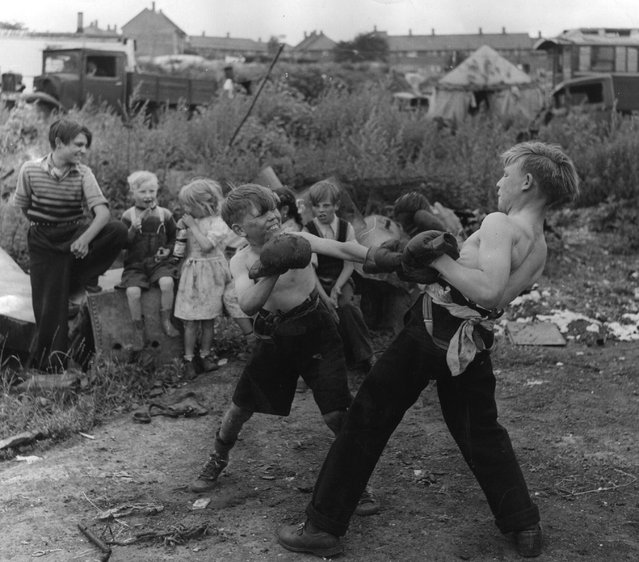
The unromantic gypsies. Children boxing in a gypsy camp in Kent, England on July 1, 1951. Like all boys these gypsy lads like to try their hand at boxing. Encouraged by their friends they fight it out on Corke's Meadow. Few Romanies now live a life of wandering romance. Most are like the three hundred squatters of Corke's Meadow, Kent, which is part of a “gypsy problem” that involves about 100,000 today. Of those about 25,000 can be rightly called gypsies, the rest are Mumpers and Posh-rats and Hobos. Corke's Meadow has both kinds. “Picture Post” cameraman Bert Hardy photographs the Corke's Meadow gypsies in their encampment. (Photo by Hulton-Deutsch Collection/Corbis via Getty Images)

The unromantic gypsies. Children boxing in a gypsy camp in Kent, England on July 1, 1951. Like all boys these gypsy lads like to try their hand at boxing. Encouraged by their friends they fight it out on Corke's Meadow. Few Romanies now live a life of wandering romance. Most are like the three hundred squatters of Corke's Meadow, Kent, which is part of a “gypsy problem” that involves about 100,000 today. Of those about 25,000 can be rightly called gypsies, the rest are Mumpers and Posh-rats and Hobos. Corke's Meadow has both kinds. “Picture Post” cameraman Bert Hardy photographs the Corke's Meadow gypsies in their encampment. (Photo by Hulton-Deutsch Collection/Corbis via Getty Images)
Details
12 Mar 2017 00:01:00
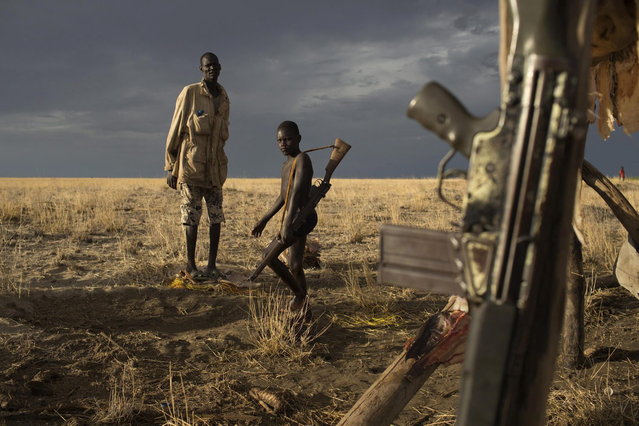
A Turkana man and a boy carrying a gun look on as a G3 battle rifle hangs from a structure used to dry fish at a fishing camp on the shores of Lake Turkana, some kilometres from Todonyang near the Kenya-Ethiopia border in northwestern Kenya October 12, 2013. (Photo by Siegfried Modola/Reuters)

A Turkana man and a boy carrying a gun look on as a G3 battle rifle hangs from a structure used to dry fish at a fishing camp on the shores of Lake Turkana, some kilometres from Todonyang near the Kenya-Ethiopia border in northwestern Kenya October 12, 2013The Turkana are traditionally nomadic pastoralists, but they have seen the pasture that they need to feed their herds suffer from recurring droughts and many have turned to fishing. However, Lake Turkana is overfished, and scarcity of food and pastureland is fuelling long-standing conflict with Ethiopian indigenous Dhaasanac, who have seen grazing grounds squeezed by large-scale government agricultural schemes in southern Ethiopia. The Dhaasanac now venture ever deeper into Kenyan territory in search of fish and grass, clashing with neighbours. Fighting between the communities has a long history, but the conflict has become ever more fatal as automatic weapons from other regional conflicts seep into the area. While the Turkana region is short of basics like grass and ground-water, it contains other resources including oil reserves and massive, newly discovered underground aquifers. (Photo by Siegfried Modola/Reuters)
Details
05 Dec 2013 12:08:00
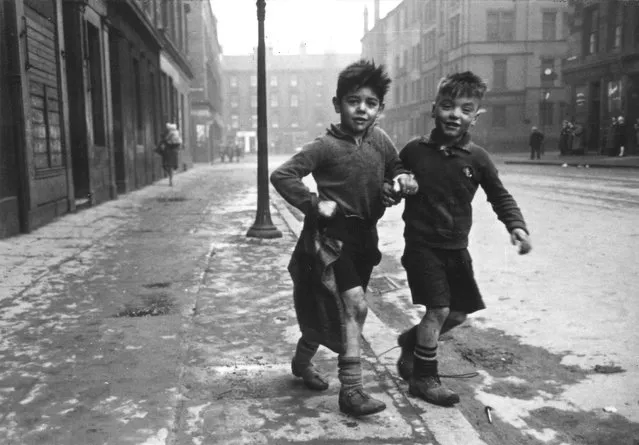
Two boys in the Gorbals area of Glasgow, UK on January 31, 1948. The Gorbals tenements were built quickly and cheaply in the 1840s, providing housing for Glasgow's burgeoning population of industrial workers. Conditions were appalling; overcrowding was standard and sewage and water facilities inadequate. The tenements housed about 40,000 people with up to eight family members sharing a single room, 30 residents sharing a toilet and 40 sharing a tap. By the time this photograph was taken 850 tenements had been demolished since 1920. Redevelopment of the area began in the late 1950s and the tenements were replaced with a modern tower block complex in the sixties. (Photo by Bert Hardy/Getty Images)

Two boys in the Gorbals area of Glasgow, UK on January 31, 1948. The Gorbals tenements were built quickly and cheaply in the 1840s, providing housing for Glasgow's burgeoning population of industrial workers. Conditions were appalling; overcrowding was standard and sewage and water facilities inadequate. The tenements housed about 40,000 people with up to eight family members sharing a single room, 30 residents sharing a toilet and 40 sharing a tap. By the time this photograph was taken 850 tenements had been demolished since 1920. Redevelopment of the area began in the late 1950s and the tenements were replaced with a modern tower block complex in the sixties. (Photo by Bert Hardy/Getty Images)
Details
09 Mar 2017 00:03:00
Military Woman Part 3

'Military woman' is a constantly updated gallery of images of women wearing uniform: military, police and so on. We truly hope that our beloved visitors won't remain passive and will take part in this project making it even more interesting! Note that all the images featured in the gallery are taken from publically available sources: their copyright belongs to their respective creators and the trade mark to the owners. ...

See also:Part 1 _ Part 2
Details
11 Mar 2015 10:29:00
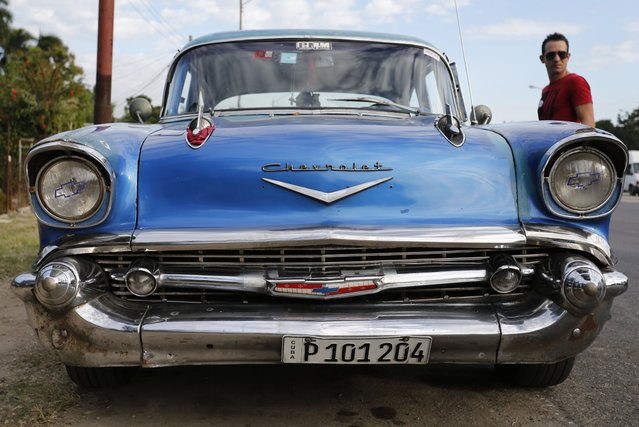
In this December 19, 2014 photo, a man stands beside his 1957 Chevrolet Bel-Air car in Havana, Cuba.  U.S. car sales have been banned in Cuba since 1959. Cubans have been have been forced to patch together Fords, Chevrolets and Chryslers that date back to before Fidel Castro's revolution which can make it appear like the country is stuck in a 1950s time warp. (Photo by Desmond Boylan/AP Photo)

In this December 19, 2014 photo, a man stands beside his 1957 Chevrolet Bel-Air car in Havana, Cuba. U.S. car sales have been banned in Cuba since 1959. Cubans have been have been forced to patch together Fords, Chevrolets and Chryslers that date back to before Fidel Castro's revolution which can make it appear like the country is stuck in a 1950s time warp. Since the Communist economic system isn't likely to change soon, many of those cars will have to stay on the road for years. (Photo by Desmond Boylan/AP Photo)
Details
26 Dec 2014 15:35:00
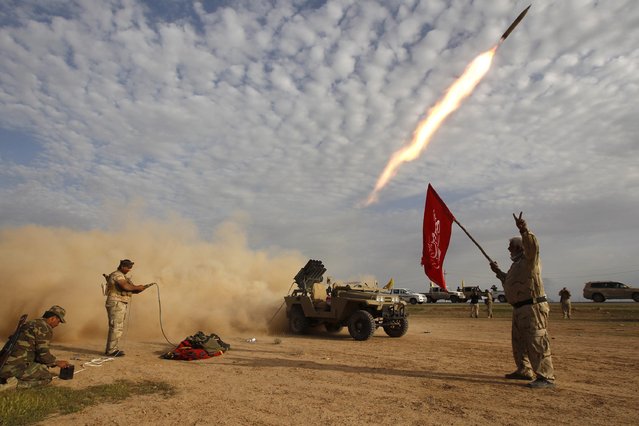
Shi'ite fighters launch a rocket during clashes with Islamic State militants on the outskirts of al-Alam March 8, 2015. Thaier Al-Sudani: “It was me and a few other Iraqi journalists working for local outlets. (Photo by Thaier Al-Sudani/Reuters)

Shi'ite fighters launch a rocket during clashes with Islamic State militants on the outskirts of al-Alam March 8, 2015. Thaier Al-Sudani: “It was me and a few other Iraqi journalists working for local outlets. We went to the frontlines in coordination with the Iraqi government forces and supporting militias. The press officer would come in the morning and take us to the frontline in a convoy. Whenever an area was won from Islamic State, the fighters would chant and pray and show victory signs. Most of the areas we were in didn't have residents, so after the battle they would resemble ghost towns; nothing but burnt cars and charred bodies of Islamic State fighters. Al-Alam was an exception as it had some residents who chanted for the government forces after their victory”. (Photo by Thaier Al-Sudani/Reuters)
Details
14 Mar 2015 14:33:00
British tourists snap a cheeky selfie with a monkey at the Ubud Monkey Forest in Bali, Indonesia, August 4, 2015. George Benton, 22, from Paignton, Devon was visiting the Sacred Monkey Forest Sanctuary in Ubud, Bali whilst traveling with his girlfriend Chloe when the couple snapped a surprise shot with Balinese long-tailed monkey using a “selfie stick”. (Photo by George Benton/Splash News)

British tourists snap a cheeky selfie with a monkey at the Ubud Monkey Forest in Bali, Indonesia, August 4, 2015. George Benton, 22, from Paignton, Devon was visiting the Sacred Monkey Forest Sanctuary in Ubud, Bali whilst traveling with his girlfriend Chloe when the couple snapped a surprise shot with Balinese long-tailed monkey using a “selfie stick”. “We couldn't believe our luck when we looked back at the photos, he looked straight into the camera!” said George, who went on to reward the cheeky chap with a banana for giving the couple such a memorable photo. (Photo by George Benton/Splash News)
Details
05 Aug 2015 14:41:00
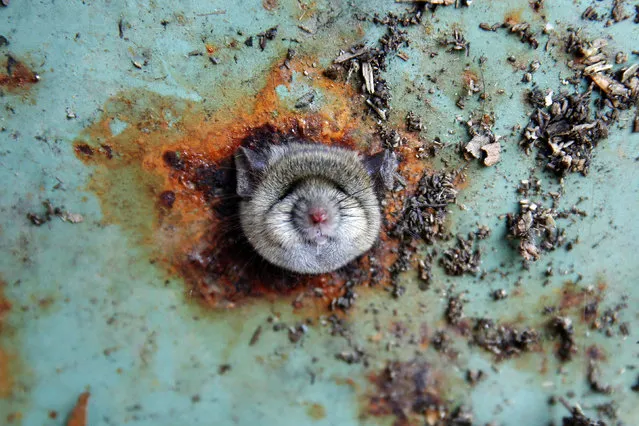
A rat's head rests as it is constricted in an opening in the bottom of a garbage can in the Brooklyn borough of New York, U.S., October 18, 2016. (Photo by Lucas Jackson/Reuters)

A rat's head rests as it is constricted in an opening in the bottom of a garbage can in the Brooklyn borough of New York, U.S., October 18, 2016. The Brooklyn rat was saved on Tuesday after getting its head stuck in the dumpster while scavenging for food, according to the New York Daily News. As the rat was scurrying around the bottom of the trash can, it came across a few ventilation holes. The hungry creature poked his head into one of them, but to its dismay couldn't get back out,Reuters photographer Lucas Jackson told the Daily News. Jackson was able to take some adorable photos of the rat's unfortunate situation before it was rescued. (Photo by Lucas Jackson/Reuters)
Details
19 Oct 2016 12:26:00