Loading...
Done
A ballet dancer stretches backstage during Nacho Duato's “The Nutcracker” at the Mikhailovsky Theatre in St. Petersburg, Russia November 21, 2015. (Photo by Grigory Dukor/Reuters)

A ballet dancer stretches backstage during Nacho Duato's “The Nutcracker” at the Mikhailovsky Theatre in St. Petersburg, Russia November 21, 2015. For theatregoers in St Petersburg, Nacho Duato's “The Nutcracker” demonstrates the global appeal of a Christmas classic. When the curtain rises at the Mikhailovsky Theatre, among the oldest opera and ballet houses in Russia, it's the culmination of hundreds of hours of toil and sweat by dancers, costume makers, set designers and musicians playing the famous score by Pyotr Tchaikovsky. (Photo by Grigory Dukor/Reuters)
Details
12 Dec 2015 08:05:00
Gemma, right, and Joanne in their home in Angeles City. (Photo by Hannah Reyes Morales/The Washington Post)

Typhoon Yolanda – also known as Haiyan – struck the central part of the country November 8, 2013, leaving at least 6,300 people dead and over four million displaced. A month after Typhoon Haiyan, the United Nations Population Fund estimates that 5,000 women were subjected to sеxual violence. A study by the Health and Human Rights online publication shows the majority of young girls and women in Manila’s sеx industry come from poverty-stricken areas – such as Leyte, Samar, Cebu and southern Mindanao – and enter trafficking through force, deception, economic desperation and psychological manipulation. (Photo by Hannah Reyes Morales/The Washington Post)
Details
01 May 2017 09:59:00
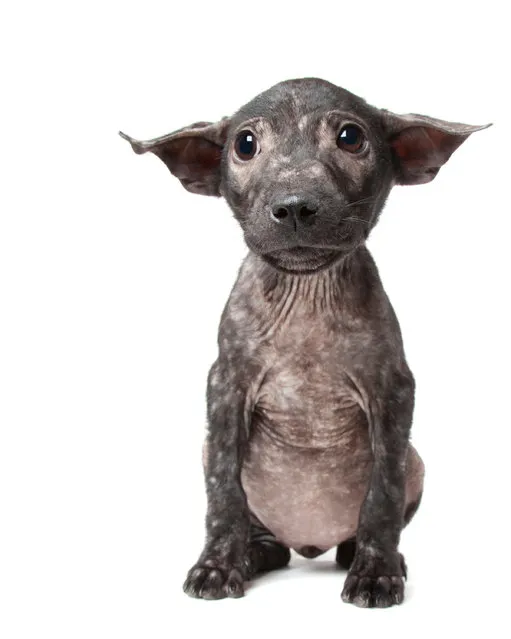
“Bali Pip”. Bali street dog. Had the skin condition mange. (Photo by Alex Cearns/The Guardian)

For her book “Perfect Imperfection”, the Australian pet photographer Alex Cearns set out to capture the personalities of animals who adapt to their damaged or different bodies without complaint. Part of the proceeds from sales of Perfect Imperfection go to the Australian Animal Cancer Foundation. Here: “Bali Pip”. Bali street dog. Had the skin condition mange. (Photo by Alex Cearns/The Guardian)
Details
06 Apr 2018 00:03:00
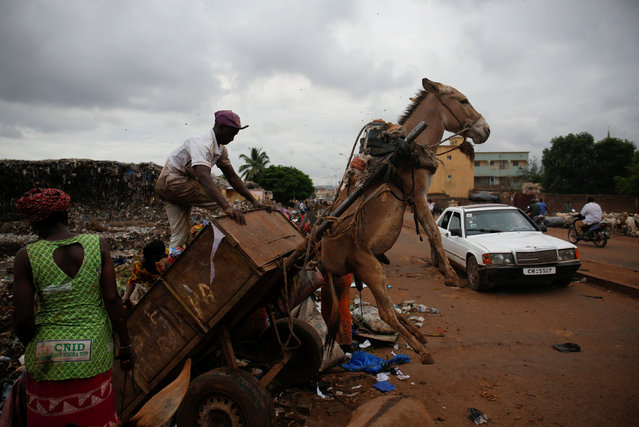
A waste picker unloads garbage at a waste transfer station in Bamako, Mali, August 19, 2018. In the Malian capital of Bamako, donkey carts driven by young men like 19-year-old Arouna Diabate play a vital role battling the fast-growing city's waste problem. Every morning before dawn, Diabate hitches his donkey to a cart and sets off on his rounds, going door-to-door to collect household garbage which he delivers to a local waste transfer station for a monthly salary of around $35. “I won't be picking up trash with a donkey cart for the rest of my life, but for now people appreciate us because we help clean up the homes of Bamako”, Diabate said. (Photo by Luc Gnago/Reuters)

A waste picker unloads garbage at a waste transfer station in Bamako, Mali, August 19, 2018. In the Malian capital of Bamako, donkey carts driven by young men like 19-year-old Arouna Diabate play a vital role battling the fast-growing city's waste problem. Every morning before dawn, Diabate hitches his donkey to a cart and sets off on his rounds, going door-to-door to collect household garbage which he delivers to a local waste transfer station for a monthly salary of around $35. “I won't be picking up trash with a donkey cart for the rest of my life, but for now people appreciate us because we help clean up the homes of Bamako”, Diabate said. (Photo by Luc Gnago/Reuters)
Details
18 Sep 2018 00:01:00
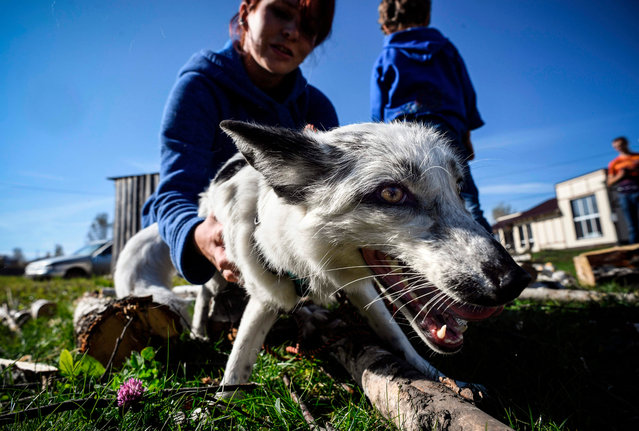
Tatyana Abramova, 33, plays with her home fox Plombir at her countryside house outside Siberian city of Novosibirsk on September 12, 2020. The official start of the Soviet experiment to better understand the domestication of animals by humans began in 1959, and was initiated by geneticists Dmitri Beliaiev and Lioudmila Trout on a farm in Akademgorodok, the scientific center of excellence in Siberia. Their primary objective was to domesticate foxes, to understand how the ancestor of wolves, another canine, evolved into a loyal and loving dog. And understand what this domestication tells us about the genetic evolution of species. (Photo by Alexander Nemenov/AFP Photo)

Tatyana Abramova, 33, plays with her home fox Plombir at her countryside house outside Siberian city of Novosibirsk on September 12, 2020. The official start of the Soviet experiment to better understand the domestication of animals by humans began in 1959, and was initiated by geneticists Dmitri Beliaiev and Lioudmila Trout on a farm in Akademgorodok, the scientific center of excellence in Siberia. Their primary objective was to domesticate foxes, to understand how the ancestor of wolves, another canine, evolved into a loyal and loving dog. And understand what this domestication tells us about the genetic evolution of species. (Photo by Alexander Nemenov/AFP Photo)
Details
25 Oct 2020 00:05:00
A fire-eater of the “Diables de Terrassa” performs during Sitges' little “Festa Major”, “Santa Tecla” in Sitges, Spain on September 19, 2016. This celebration brings together some of Catalonia’s most emblematic festive traditions. The central axis of the celebrations is the traditional parade, made up of “big-head” carnival figures and characters who dance to music played on different traditional instruments. One of the most popular events is the Correfoc or fire-running, which is also the closing event of the fiesta. The people run and jump over characters dressed up as devils and dragons, carrying fire. (Photo by Matthias Oesterle/ZUMA Press/Splash News)

A fire-eater of the “Diables de Terrassa” performs during Sitges' little “Festa Major”, “Santa Tecla” in Sitges, Spain on September 19, 2016. This celebration brings together some of Catalonia’s most emblematic festive traditions. The central axis of the celebrations is the traditional parade, made up of “big-head” carnival figures and characters who dance to music played on different traditional instruments. One of the most popular events is the Correfoc or fire-running, which is also the closing event of the fiesta. The people run and jump over characters dressed up as devils and dragons, carrying fire. (Photo by Matthias Oesterle/ZUMA Press/Splash News)
Details
20 Sep 2016 09:28:00
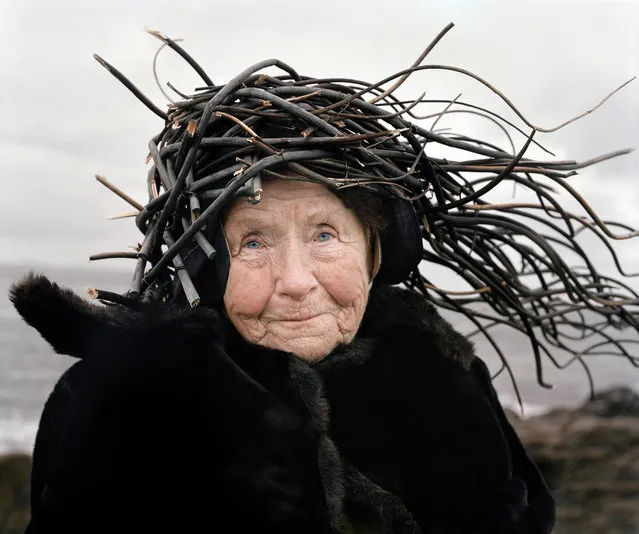
Eyes As Big As Plates – Norway And Finland

Eyes as Big as Plates is a whimsical series by Finnish photographer Riitta Ikonen and Norwegian photographer Karoline Hjorth that features senior citizens donning organic materials like twigs and grass. Ikonen says that the collaborative project originally began as "a play on characters and protagonists from Norwegian folklore" but has since evolved into a collection of images exploring "mental landscapes" that reflect a return of body to nature with the use of scavenged materials.
Details
08 Apr 2013 09:53:00


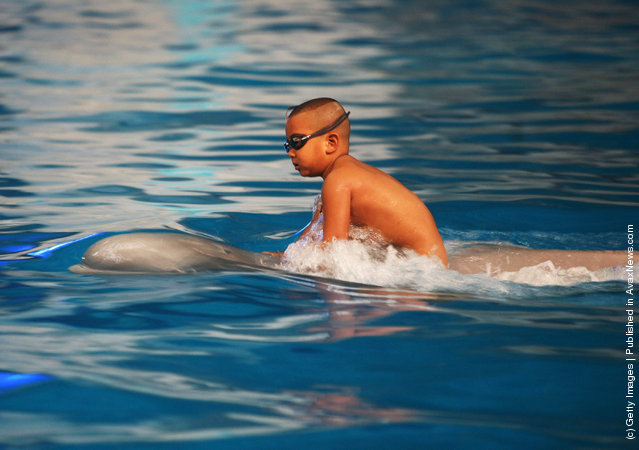
Four-year-old Chinese boy Huang Yang plays with five-year-old beluga whale Xiao Xin at the Qingdao Ocean World on November 3, 2007 in Qingdao of Shandong Province, China. Huang Yang began swimming as a baby and fell in love with the whale after watching its performance. On the International Children's Day, June 1 this year, the Qingdao Ocean World has made the boy's dream come true when they allowed Huang Yang to swim with the beluga whale. (Photo by China Photos/Getty Images)
Details
09 May 2011 11:37:00