Loading...
Done
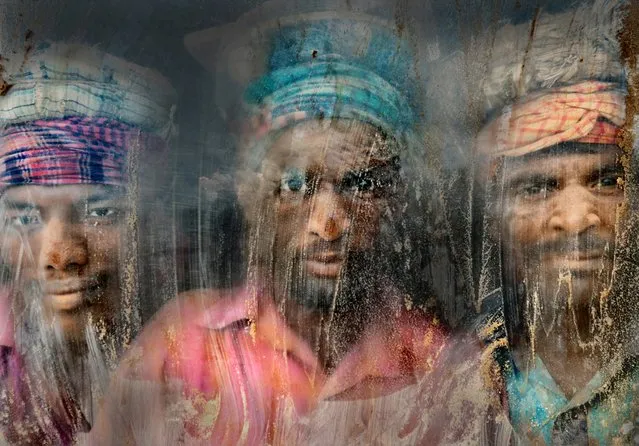
Gravel Workmen of Chittagong, Bangladesh, by Faisal Azim. Gravel workmen look through a glass window at a gravel-crushing yard in Chittagong. Full of dust and sand, it is an extremely unhealthy environment for working, but still hundreds of people work here for their livelihoods. (Photo by Faisal Azim/2016 Atkins CIWEM Environmental Photographer of the Year)

From Tibetan monks playing basket ball with ice thawing high up in the Himalayas, to the pollution that hides behind the Taj Mahal, here’s pick from 60 exceptional environmental photographs, by photographers and filmmakers from 70 countries, that will go on show at the Royal Geographical Society in London from 29 June to 21 August. The winners will be announced on 28 June. Here: Gravel Workmen of Chittagong, Bangladesh, by Faisal Azim. Gravel workmen look through a glass window at a gravel-crushing yard in Chittagong. Full of dust and sand, it is an extremely unhealthy environment for working, but still hundreds of people work here for their livelihoods. (Photo by Faisal Azim/2016 Atkins CIWEM Environmental Photographer of the Year)
Details
01 Jun 2016 12:25:00
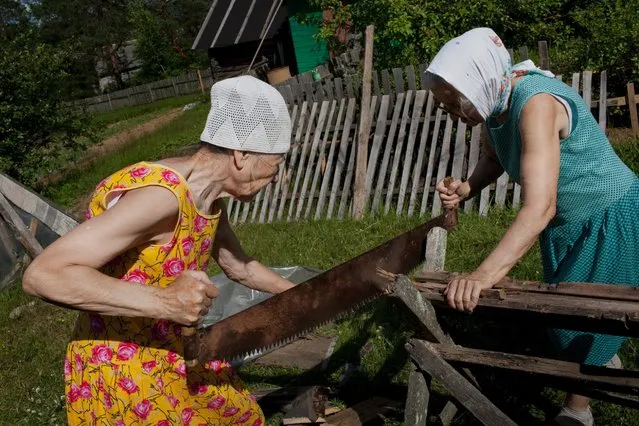
“Two-Handed Saw, 2014”. “Most of the neighbors have switched to power tools to run their households, the buzz of chain saws and weed-whackers overpowering the quieter sounds of country life, but my aunts hold on to the two-handed saw that's decades old, the sickle and scythe that need to be sharpened and polished after each use, the old axe that's becoming heavier each year. Each of these objects is familiar, holding memories of their brother, who succumbed to cancer a few years ago, of days before my grandfather lost his vision in the 50's, of busier days and longer futures”, Sablin told. (Photo by Nadia Sablin)

In northwest Russia, in a small village called Alekhovshchina, Nadia Sablin's aunts spend the warmer months together in the family home and live as the family has always lived, chopping wood to heat the house and making their own clothes. Sablin's book of photographs, “Aunties: The Seven Summers of Alevtina and Ludmila”, is published by Duke University Press. Here: “Two-Handed Saw, 2014”. (Photo by Nadia Sablin)
Details
25 Feb 2016 12:12:00
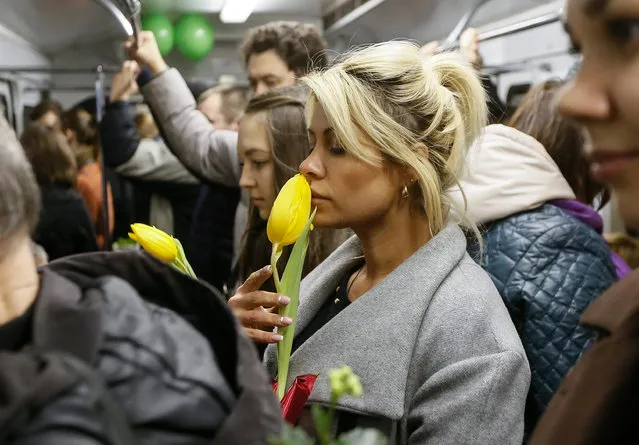
Female metro passengers hold flowers presented to them by metro workers, prior to International Women's Day in Kiev, Ukraine, 02 March 2016. (Photo by Sergey Dolzhenko/EPA)

Female metro passengers hold flowers presented to them by metro workers, prior to International Women's Day in Kiev, Ukraine, 02 March 2016. The hustle and bustle of the morning commute is broken up by an unexpected surprise. The first passengers to step on the train receive – a warm welcome and a pot of flowers. One woman says, “It's very nice. All the running around and then you're given a flower, it's not often. It's very nice. I'm going to take care of this flower”. International Women's Day first emerged from the activities of labour movements at the turn of the twentieth century, in North America and across Europe, it is celebrated on March 08 in many countries around the world. (Photo by Sergey Dolzhenko/EPA)
Details
03 Mar 2016 11:34:00
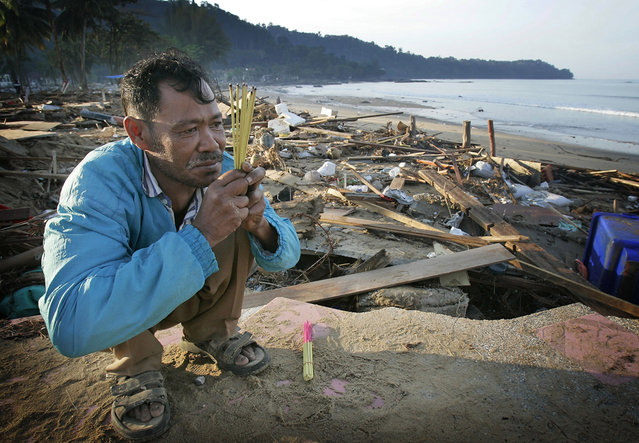
In this December 29, 2004 file photo, Kusol Wetchakul offers prayers for the soul of his sister, at dawn along the beach near Khao Lak, Thailand.  Wetchakul's sister was swept out to sea and believed drowned as she sold goods to tourists on the popular tourist beach just north of Phuket. (Photo by David Longstreath/AP Photo)

In this December 29, 2004 file photo, Kusol Wetchakul offers prayers for the soul of his sister, at dawn along the beach near Khao Lak, Thailand. Wetchakul's sister was swept out to sea and believed drowned as she sold goods to tourists on the popular tourist beach just north of Phuket. Friday marks the 10th anniversary of one of the deadliest natural disasters in world history: a tsunami, triggered by a massive earthquake off the Indonesian coast, leaving more than 230,000 people dead in 14 countries and causing about $10 billion in damage. (Photo by David Longstreath/AP Photo)
Details
26 Dec 2014 15:16:00
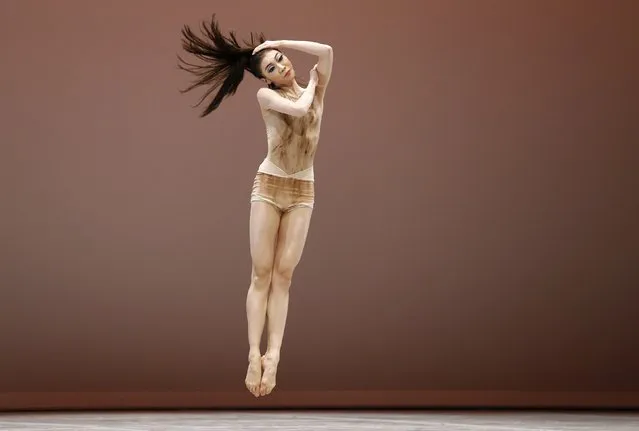
Park Ji-soo of South Korea performs her contemporary variation during the final of the 43rd Prix de Lausanne at the Beaulieu Theatre in Lausanne February 7, 2015. (Photo by Denis Balibouse/Reuters)

Park Ji-soo of South Korea performs her contemporary variation during the final of the 43rd Prix de Lausanne at the Beaulieu Theatre in Lausanne February 7, 2015. The Prix de Lausanne is an annual international dance competition for dancers aged 15 to 18. A total of 67 participants from 18 countries were selected from 300 applicants to take part in this year's week-long competition, from which the jury has shortlisted 20 finalists to compete for Saturday's finals. Six of this year's finalists will be awarded a one-year all expenses paid scholarship at one of the Prix de Lausanne's partner schools or companies, among the most prestigious in the world. (Photo by Denis Balibouse/Reuters)
Details
09 Feb 2015 12:01:00
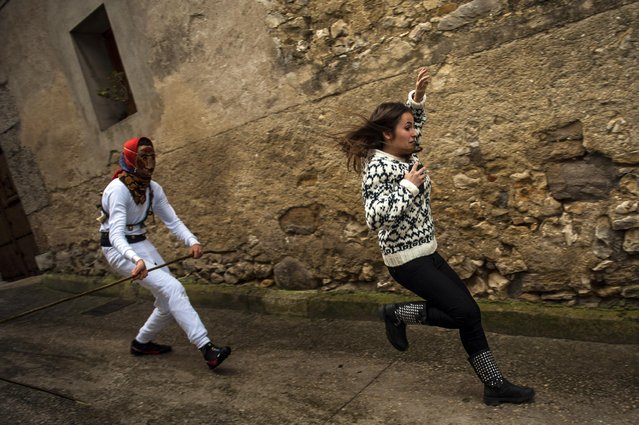
In this photo taken on Sunday, February 15, 2015 a girl runs away from a “Mamuxarro” during the carnival, in the small town of Unanu, northern Spain. While Rio de Janeiro may boast the world’s most famous carnival, the festive period of masquerades and wild and colorful costumes that precedes the Christian religious season of Lent is also a permanent and popular fixture for celebration in Spain and Portugal, with each country having its own strange and unique way of doing it. (Photo by Alvaro Barrientos/AP Photo)

In this photo taken on Sunday, February 15, 2015 a girl runs away from a “Mamuxarro” during the carnival, in the small town of Unanu, northern Spain. In the northern Spanish ancient village of Unamu, people dress up as “Mamuxarro”, folkloric figures in white with a red sash and a metal mask to cover their faces as they pursue townsfolk with sticks. According to custom, their “victims” (usually young women) must kneel and kiss the mamuxarro’s knee after he makes the sign of the cross on their forehead. (Photo by Alvaro Barrientos/AP Photo)
Details
22 Feb 2015 10:51:00
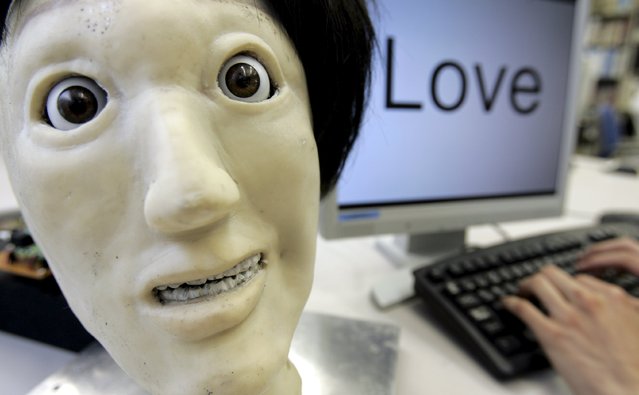
A humanoid robot named Kansei, meaning “sensibility” in Japanese, makes a facial expression depicting “happiness”, next to the word “Love” during a demonstration at a laboratory of Meiji University's Robot and Science Institute in Kawasaki, south of Tokyo in this June 4, 2007 file photo. (Photo by Yuriko Nakao/Reuters)

A humanoid robot named Kansei, meaning “sensibility” in Japanese, makes a facial expression depicting “happiness”, next to the word “Love” during a demonstration at a laboratory of Meiji University's Robot and Science Institute in Kawasaki, south of Tokyo in this June 4, 2007 file photo. Three-fourths of robot installations over the next decade are expected to be concentrated in four areas: transportation equipment, including the automotive sector; computer and electronic products; electrical equipment and machinery. Labor costs have climbed in countries such as China that have been popular for outsourcing production, while technological advances for robots allow them to be more flexible and perform more tasks. (Photo by Yuriko Nakao/Reuters)
Details
17 Apr 2015 09:39:00
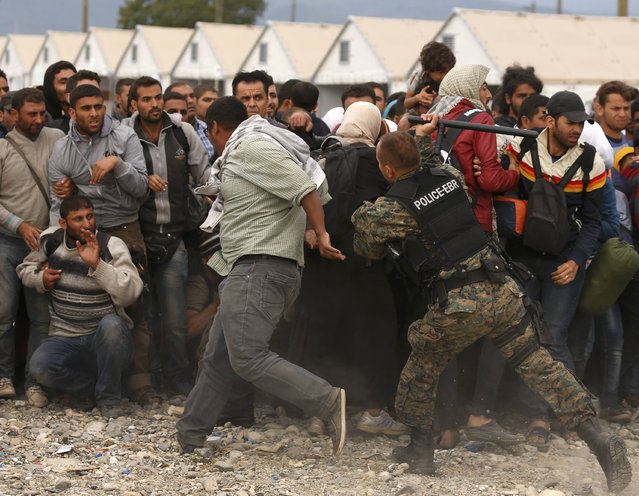
A policer officer hits a man with a baton as he tries to maintain order while migrants wait for trains at a temporary camp near Gevgelija, Macedonia, September 7, 2015.  Several thousand migrants in Macedonia boarded trains on Sunday to travel north after spending a night in a provisional camp. (Photo by Stoyan Nenov/Reuters)

A policer officer hits a man with a baton as he tries to maintain order while migrants wait for trains at a temporary camp near Gevgelija, Macedonia, September 7, 2015. Several thousand migrants in Macedonia boarded trains on Sunday to travel north after spending a night in a provisional camp. Macedonia has organised trains twice a day to the north border where migrants cross into Serbia to make their way to Hungary. Since June, Macedonian authorities have said that more than 60,000 migrants have entered the country, and around 1,500 entered just in one day, mainly refugees from Syria. (Photo by Stoyan Nenov/Reuters)
Details
09 Sep 2015 12:55:00