Loading...
Done


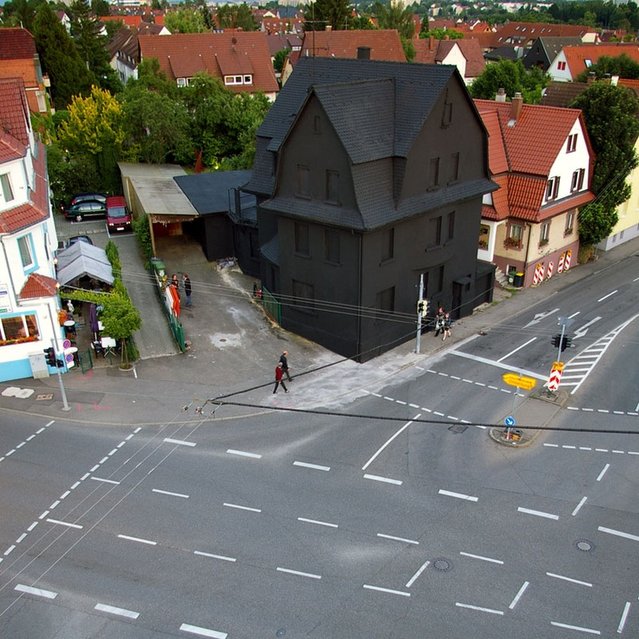
Haus in Schwarz (House in Black) was a 2008 public art piece by artists Erik Sturm and Simon Jung (previously) in the city center of Möhringen, Germany. The piece was meant as a farewell to the building which was slated for demolition, with the matte black paint acting as a sort of final curtain to an exterior that had recently been used by numerous street artists, shown bellow.
Details
10 Oct 2013 11:47:00
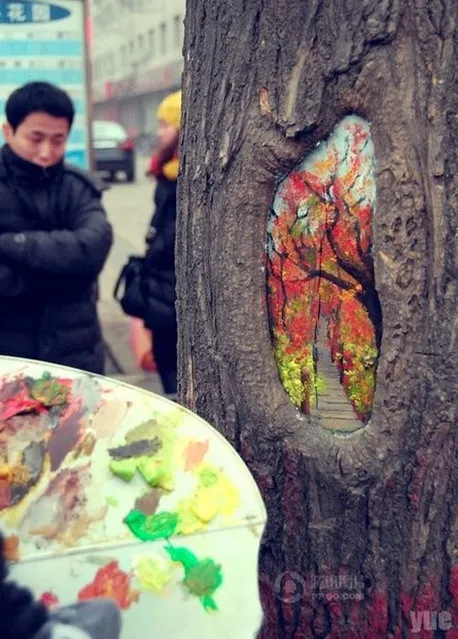
Spectacular Tree By Wang Yue

Wang Yue, a senior at Dalian Industry University, uses her paintbrush to turn ugly tree holes into lovely views in Shijiazhuang, capital city of Hebei Province.
Details
06 Jul 2013 16:48:00
Leisure day on the Avenida Brasil. (Photo by Elisângela Leite/Horniman Museum)

An exhibition at London’s Horniman Museum by three photographers from Brazil’s largest favela, Maré, shows us their unique vision of Rio de Janeiro. Here: Leisure day on the Avenida Brasil. (Photo by Elisângela Leite/Horniman Museum)
Details
03 May 2016 13:13:00
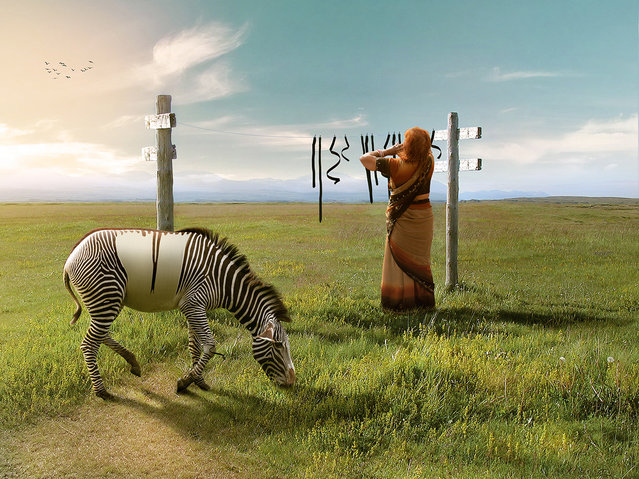
Surreal Drawing By Anil Saxena (Video)

Anil Saxena from Mumbay, India creates amazing photo manipulations using Photoshop. These surreal photos will truly amaze you. Anil started out doing conventional darkroom photo composition and retouching them before moving these skills over to Photoshop.
Details
16 Nov 2016 06:05:00
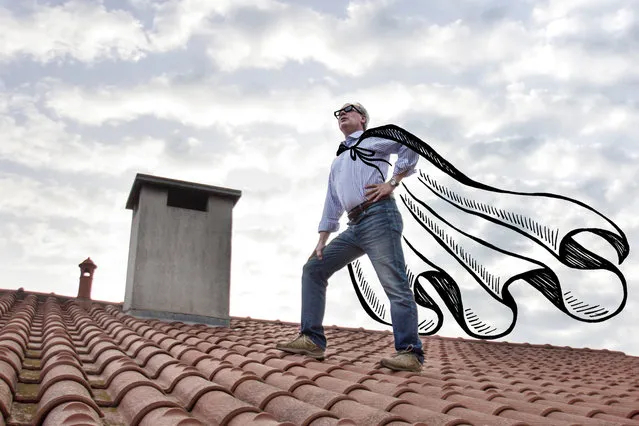
Dad Superhero By Giulia Pex

Italian photographer and illustrator Giulia Pex has made a statement to the world using her dual crafts. She declared boldly “Dad, You Are My Favorite Superhero” by taking a series of family photographs of her father in ordinary settings.
Details
11 May 2014 11:40:00
Zhao Deli waves as he pilots his self-made “flying scooter” in Dongguan, Guangdong Province, China, 12 August 2018 (issued 16 August 2018). Inspired by a cartoon he watched as a child, Zhao Deli sold off his apartment in pursuit of his dream of building a flying scooter. (Photo by Aleksandar Plavevski/EPA/EFE)

Zhao Deli waves as he pilots his self-made “flying scooter” in Dongguan, Guangdong Province, China, 12 August 2018 (issued 16 August 2018). Inspired by a cartoon he watched as a child, Zhao Deli sold off his apartment in pursuit of his dream of building a flying scooter. (Photo by Aleksandar Plavevski/EPA/EFE)
Details
06 Sep 2018 00:05:00
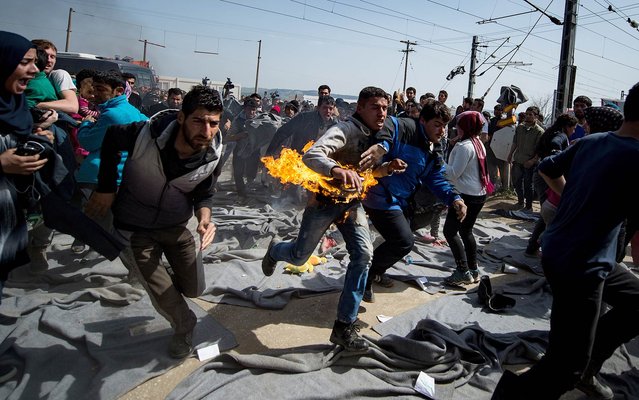
A man runs after he tried to put himself on fire during a protest at a makeshift camp at the Greek-Macedonian border near the village of Idomeni on March 22, 2016. Greece will not be able to start sending refugees back to Turkey from March 20, 2016, the government said, as the country struggles to implement a key deal aimed at easing Europe's migrant crisis. The numbers are daunting: officials said as of Saturday there were 47,500 migrants in Greece, including 8,200 on the islands and 10,500 massed at the Idomeni camp on the Macedonian border. (Photo by Andrej Isakovic/AFP Photo)

A man runs after he tried to put himself on fire during a protest at a makeshift camp at the Greek-Macedonian border near the village of Idomeni on March 22, 2016. Greece will not be able to start sending refugees back to Turkey from March 20, 2016, the government said, as the country struggles to implement a key deal aimed at easing Europe's migrant crisis. The numbers are daunting: officials said as of Saturday there were 47,500 migrants in Greece, including 8,200 on the islands and 10,500 massed at the Idomeni camp on the Macedonian border. (Photo by Andrej Isakovic/AFP Photo)
Details
23 Mar 2016 12:25:00
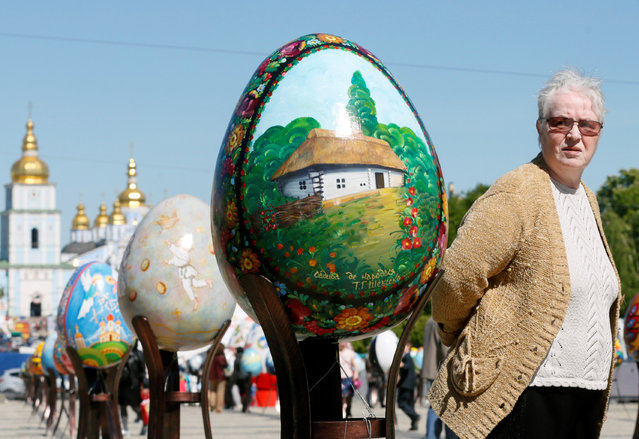
A woman looks at traditional Ukrainian Easter eggs “Pysanka”, installed as part of the upcoming celebrations of Easter, in central Kiev, Ukraine, April 29, 2016. A pysanka is a Ukrainian Easter egg, decorated with traditional Ukrainian folk designs using a wax-resist (batik) method. The word pysanka comes from the verb pysaty, “to write”, as the designs are not painted on, but written with beeswax. Many other eastern European ethnic groups decorate eggs using wax resist for Easter. These include the Belarusians, Bulgarians, Croats, Czechs, Hungarians, Lithuanians, Poles, Romanians, Serbs, Slovaks, Slovenes and Sorbs. (Photo by Valentyn Ogirenko/Reuters)

A woman looks at traditional Ukrainian Easter eggs “Pysanka”, installed as part of the upcoming celebrations of Easter, in central Kiev, Ukraine, April 29, 2016. A pysanka is a Ukrainian Easter egg, decorated with traditional Ukrainian folk designs using a wax-resist (batik) method. The word pysanka comes from the verb pysaty, “to write”, as the designs are not painted on, but written with beeswax. Many other eastern European ethnic groups decorate eggs using wax resist for Easter. These include the Belarusians, Bulgarians, Croats, Czechs, Hungarians, Lithuanians, Poles, Romanians, Serbs, Slovaks, Slovenes and Sorbs. (Photo by Valentyn Ogirenko/Reuters)
Details
30 Apr 2016 09:00:00