Russian fashion model Irina Shayk bares it all while getting ready for the Rio Carnival parade in Brazil early March 2025. (Photo by irinashayk/Instagram)
North Korean children wave to people on a Chinese tourist boat on the banks of Yalu River near the Chongsong county of North Korea, opposite the Chinese border city of Dandong, May 8, 2011. (Photo by Jacky Chen/Reuters)
An offering of a dried baby llama and fake U.S. burn in honor of Pachamama, or Mother Earth, during a New Year ritual on Turriturrini Mountain on the outskirts of Huarina, Bolivia, Friday, June 21, 2024. Aymara Indigenous communities are celebrating the Andean New Year 5,532 or “Willka Kuti” which translates to “Return of the sun” in Aymara. (Photo by Juan Karita/AP Photo)
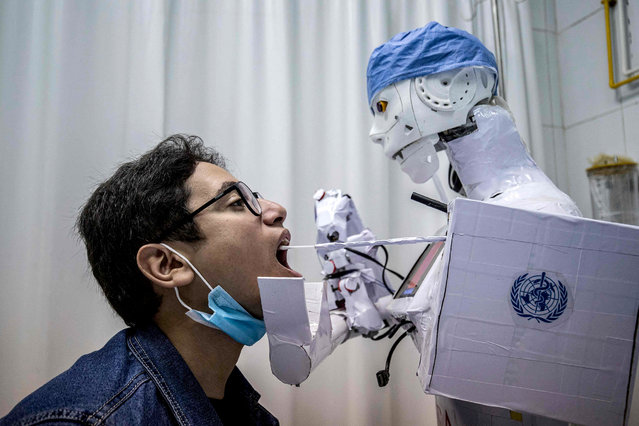
A prong extending from a remote-controlled robot prototype approaches the mouth of a volunteer to extract a throat swab sample, as part of a self-funded project to assist physicians in running tests on suspected COVID-19 coronavirus patients in a bid to limit human exposure to disease-carriers, at a private hospital in Egypt's Nile delta city of Tanta, on March 20, 2021. (Photo by Khaled Desouki/AFP Photo)
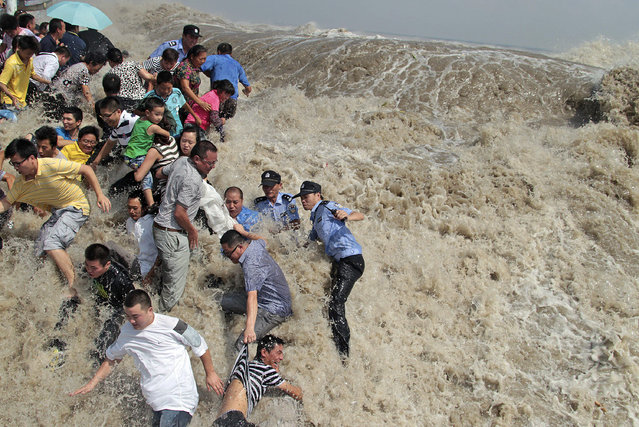
Policemen and residents run as waves from a tidal bore surge past a barrier on the banks of Qiantang River in Haining, Zhejiang province August 31, 2011. As Typhoon Nanmadol approaches eastern China, the tides and waves in Qiantang River recorded its highest level in 10 years, local media reported. (Photo by Reuters/China Daily)
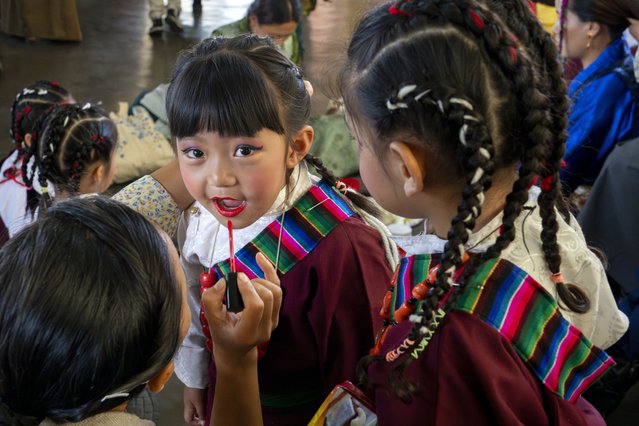
A young exiled Tibetan girl gets her lips painted by her teacher before she performs a traditional dance at an event to celebrate the 89th birthday of Tibetan spiritual leader the Dalai Lama at the Tsuglakhang temple in Dharamshala, India, Saturday, July 6, 2024. (Photo by Ashwini Bhatia/AP Photo)
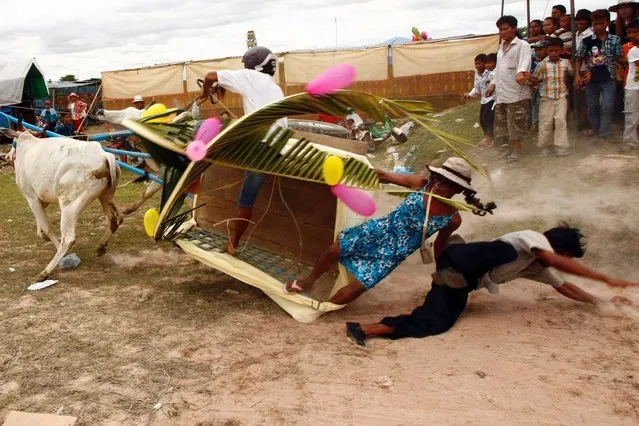
Local villagers fall onto the ground from an ox-cart as they ride to rid evil spirits from their village at Pring Ka-ek village, Cambodi. (Photo by Heng Sinith/AP Photo)
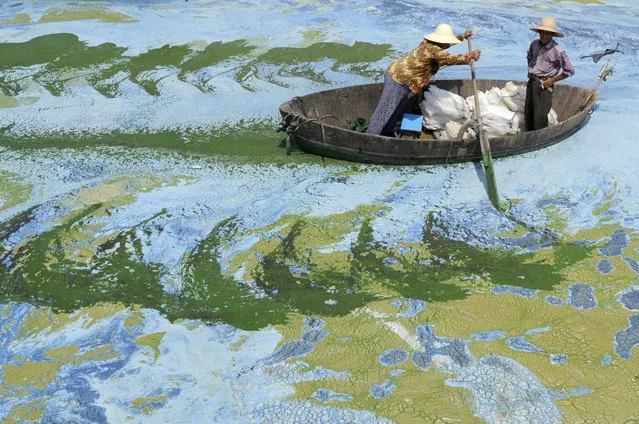
Growing cities, overuse of fertilizers and factory wastewater have degraded China's water supplies to the extent that half the nation's rivers and lakes are severely polluted. China aims to spend $850 billion to improve filthy water supplies over the next decade, but even such huge outlays may do little to reverse damage caused by decades of pollution and overuse in Beijing's push for rapid economic growth. Photo: Fishermen row a boat in the algae-filled Chaohu Lake in Hefei, Anhui province, June 19, 2009. (Photo by Jianan Yu/Reuters)