Indian actress Ananya Panday poses for pictures on the red carpet on the day of the wedding of Anant Ambani and Radhika Merchant in Mumbai, India, on July 12, 2024. (Photo by Francis Mascarenhas/Reuters)
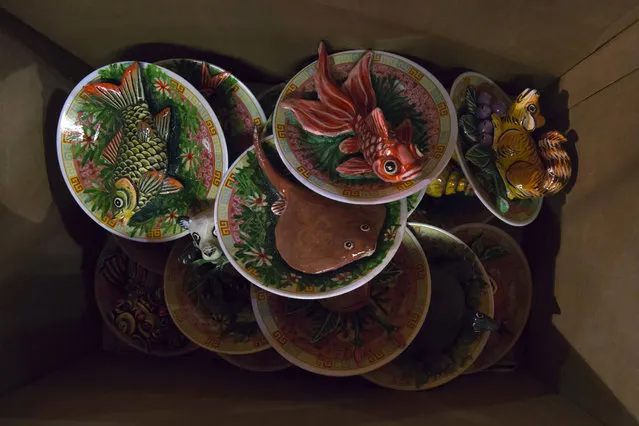
In this August 31, 2017, photo, mock fish are displayed to offer to the ancestors during the “Hungry Ghost Festival” in Hong Kong. Countless hungry and restless ghosts are roaming Hong Kong, and the world, to visit their living ancestors, at least according to Chinese convention. In traditional Chinese belief, the seventh month of the lunar year is reserved for the Hungry Ghost festival, or Yu Lan, a raucous celebration marked by feasts and music. (Photo by Kin Cheung/AP Photo)
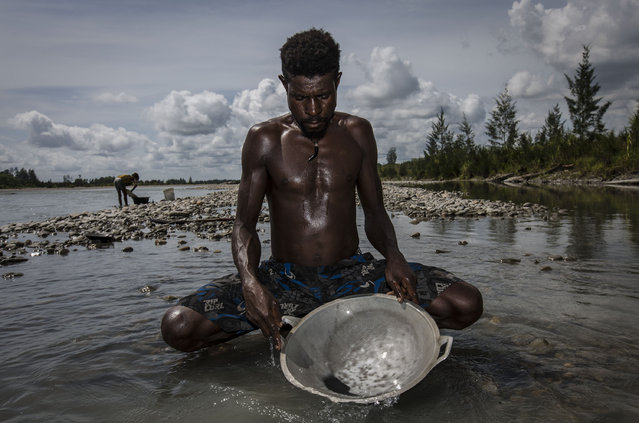
A illegal gold miner of Kamoro people, Tinus, pan for gold on February 4, 2017 in Timika, Papua Province, Indonesia. Indonesia produces over 70 billion dollars in gold a year and is home to the largest gold mine and the third largest copper mine in the world, the Grasberg mine, which is located at West Papua. (Photo by Ulet Ifansasti/Getty Images)
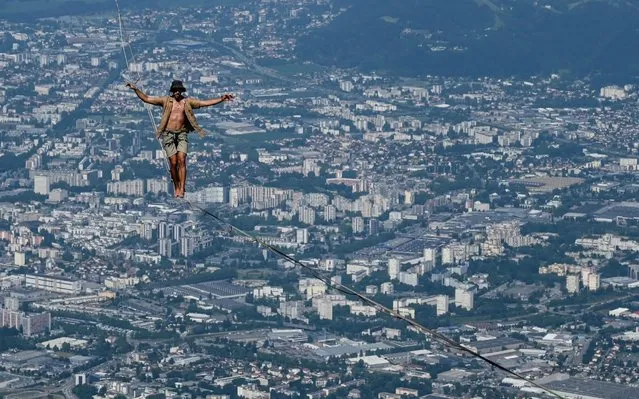
A man walks on a slackline during the 7th edition of the European “Marmotte Highline Project” (MHP) festival in Lans-en-Vercors, near Grenoble, eastern France, on July 4, 2019. The event, during which the participants will be able to evolve on the various highlines located in the Regional Natural Park of Vercors, takes place until July 7, 2019. (Photo by Philippe Desmazes/AFP Photo)
A visitor takes a selfie with a backdrop of sunflowers in full bloom at the E-World Sunflower Garden in Daegu, 237 kilometers southeast of Seoul, South Korea, 13 July 2024. (Photo by Yonhap/EPA)
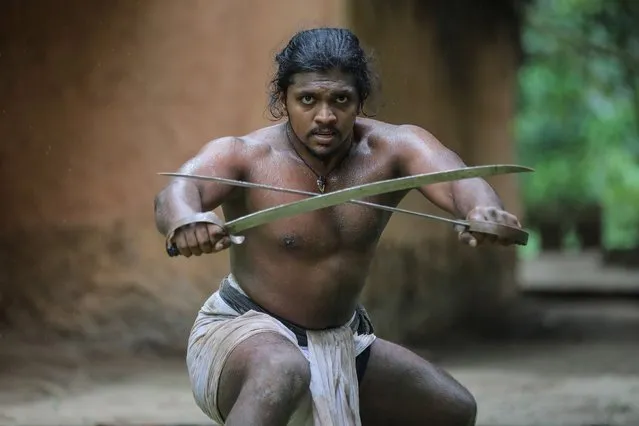
A student of the Sri Lankan ancient martial art “Angampora” performs during a practice session at the angam maduwa or fighting field, in Korathota, a suburb of Colombo, Sri Lanka, 07 September 2022. Sri Lanka's ancient martial art, Angampora, is thought to be thousands of years old. Anga translates to “body parts” and Angampora is a fighting art that uses body parts. Martial arts practitioners in Angampora were mostly in the king's service, and they were tasked with protecting the king and his kingdom. Angampora was practiced in secret for most centuries because the British, who colonized Sri Lanka, banned it in 1818 after seeing it as a threat. (Photo by Chamila Karunarathne/EPA/EFE)