Loading...
Done
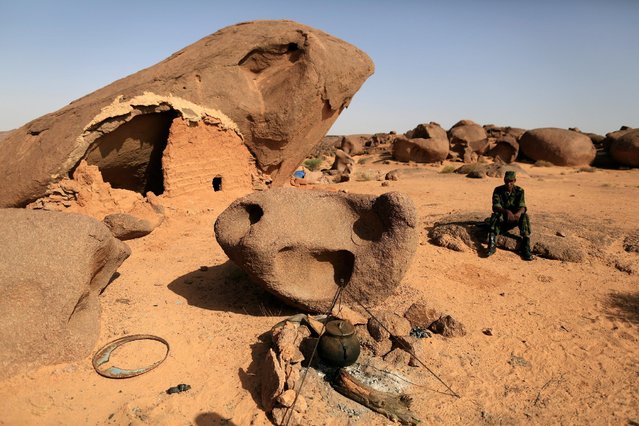
A Polisario fighter sits on a rock at a forward base on the outskirts of Tifariti, Western Sahara, September 9, 2016. At a rocky outpost in Western Sahara, a new generation of soldiers who have never known war are mobilising as tensions resurface in one of Africa's oldest disputes after a quarter century of uneasy peace. Young Sahrawi troops man new desert posts for the Polisario Front, which for more than 40 years has sought independence for the vast desert region - first in a guerrilla war against Morocco and then politically since a ceasefire deal in 1991. Now a standoff with Morocco, which controls the majority of Western Sahara, is renewing pressure for a diplomatic solution to ensure foot soldiers don't return to fighting as the last generation of commanders once did. The standoff since August has brought Moroccan and Polisario forces within 200 metres of each other in a narrow strip of land near the Mauritanian border. Rich in phosphate, Western Sahara has been contested since 1975 when Spanish colonial powers left. Morocco claimed the territory and fought the 16-year war with Polisario. (Photo by Zohra Bensemra/Reuters)

A Polisario fighter sits on a rock at a forward base on the outskirts of Tifariti, Western Sahara, September 9, 2016. At a rocky outpost in Western Sahara, a new generation of soldiers who have never known war are mobilising as tensions resurface in one of Africa's oldest disputes after a quarter century of uneasy peace. (Photo by Zohra Bensemra/Reuters)
Details
04 Nov 2016 12:09:00
Chinese artist Zhou Jie takes a nap on an unfinished iron wire bed, one of her sculpture works, after lunch at Beijing Now Art Gallery, in Beijing August 11, 2014. Zhou started her art project titled “36 Days” on August 9, in which she would live inside an exhibition hall with an unfinished iron wire bed, some iron wire sculptures in the shape of stuffed animal dolls, a certain amount of food and her mobile phone, for 36 days. (Photo by Jason Lee/Reuters)

Chinese artist Zhou Jie takes a nap on an unfinished iron wire bed, one of her sculpture works, after lunch at Beijing Now Art Gallery, in Beijing August 11, 2014. Zhou started her art project titled “36 Days” on August 9, in which she would live inside an exhibition hall with an unfinished iron wire bed, some iron wire sculptures in the shape of stuffed animal dolls, a certain amount of food and her mobile phone, for 36 days. The entire process is open to visitors and she may also interact with them, according to Zhou. (Photo by Jason Lee/Reuters)
Details
22 Aug 2014 12:04:00
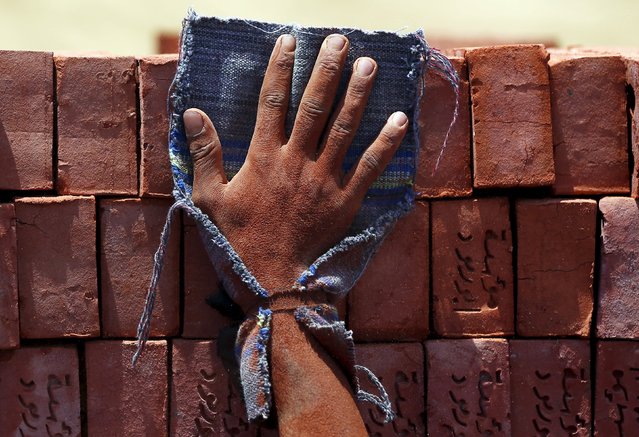
A hand of a labourer pushes bricks at a traditional brick factory in Arab Mesad district of Helwan, northeast of Cairo, May 14, 2015. (Photo by Amr Abdallah Dalsh/Reuters)

A hand of a labourer pushes bricks at a traditional brick factory in Arab Mesad district of Helwan, northeast of Cairo, May 14, 2015. About 45 labourers are employed at the brick factory and most work 10 hours a day. Adult workers earn a daily wage of 70 Egyptian pounds ($9) and child workers earn 40 Egyptian pounds ($5). The labourers, who are usually temporary or seasonally employed in Egypt's brick-making industry, experience unsafe work conditions, according to local media. (Photo by Amr Abdallah Dalsh/Reuters)
Details
19 May 2015 11:37:00
A firefighter breaks down after the World Trade Center buildings collapsed September 11, 2001

“The September 11 attacks (called September 11, September 11th or 9/11), were a series of four coordinated suicide attacks against targets in New York City and the Washington, D.C. area on September 11, 2001. On that morning, 19 terrorists from the Islamist militant group al-Qaeda hijacked four passenger jets. The hijackers intentionally crashed two planes into the Twin Towers of the World Trade Center in New York City; both towers collapsed within two hours. Hijackers crashed a third plane into the Pentagon in Arlington, Virginia. When passengers attempted to take control of the fourth plane, United Airlines Flight 93, it crashed into a field near Shanksville, Pennsylvania, preventing it from reaching its intended target in Washington, D.C. Nearly 3,000 died in the attacks”. – Wikipedia

Photo: A firefighter breaks down after the World Trade Center buildings collapsed September 11, 2001 after two hijacked airplanes slammed into the twin towers in a terrorist attack. (Photo by Mario Tama/Getty Images)

Details
10 Sep 2011 12:33:00
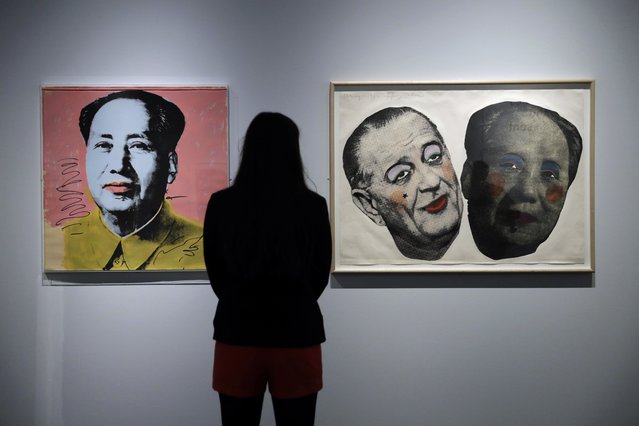
A British Museum representative poses for photographs next to Andy Warhol's “Mao”, left, and Jim Dine's “Drag: Johnson and Mao” which feature in “The American Dream: pop to the present” exhibition during a media photocall at the British Museum in London, Monday, March 6, 2017. (Photo by Matt Dunham/AP Photo)

A British Museum representative poses for photographs next to Andy Warhol's “Mao”, left, and Jim Dine's “Drag: Johnson and Mao” which feature in “The American Dream: pop to the present” exhibition during a media photocall at the British Museum in London, Monday, March 6, 2017. The exhibition, which opens to the public from March 9 and runs until June 18, charts modern and contemporary print making. (Photo by Matt Dunham/AP Photo)
Details
09 Mar 2017 00:00:00
Auxiliary Territorial Service (ATS) plotters at work at Coastal Artillery Headquarters in Dover, December 1942. (Photo by Ted Dearberg/IWM/PA Wire)

Auxiliary Territorial Service (ATS) plotters at work at Coastal Artillery Headquarters in Dover, December 1942. The Auxiliary Territorial Service was the women's branch of the British Army during the Second World War. It was formed on 9 September 1938, initially as a women's voluntary service, and existed until 1 February 1949, when it was merged into the Women's Royal Army Corps. The ATS had its roots in the Women's Auxiliary Army Corps (WAAC), which was formed in 1917 as a voluntary service. During the First World War its members served in a number of jobs including clerks, cooks, telephonists and waitresses. The WAAC was disbanded after four years in 1921. (Photo by Ted Dearberg/IWM/PA Wire)
Details
13 Jul 2017 07:52:00
Kawakanih Yawalapiti, 9, Upper Xingu region of Mato Grosso, Brazil, 2018: Kawakanih lives with her tribe, the Yawalapiti, in Xingu national park, a preserve in the Amazon basin of Brazil. The Yawalapiti collect seeds to preserve species unique to their ecosystem, which lies between the rain forest and savannah. Kawakanih’s diet is simple, consisting mainly of fish, cassava, porridge, fruit and nuts. “It takes five minutes to catch dinner”, says Kawakanih. “When you’re hungry, you just go to the river with your net”. (Photo by Gregg Segal/The Guardian)

Photographer Gregg Segal travelled the world to document children and the food they eat in a week. Partly inspired by the increasing problems of childhood obesity, he tracked traditional regional diets as yet unaffected by globalisation, and ironically, found that the healthiest diets were often eaten by the least well off. (Photo by Gregg Segal/The Guardian)
Details
03 Jul 2019 00:03:00


“The McDonnell Douglas KC-10 Extender is an air-to-air tanker aircraft in service with the United States Air Force derived from the civilian DC-10-30 airliner. The KC-10 was the second consecutive McDonnell Douglas transport aircraft to be selected by the US Air Force following the C-9 Nightingale. The similar KDC-10 is in service with the Royal Netherlands Air Force.”

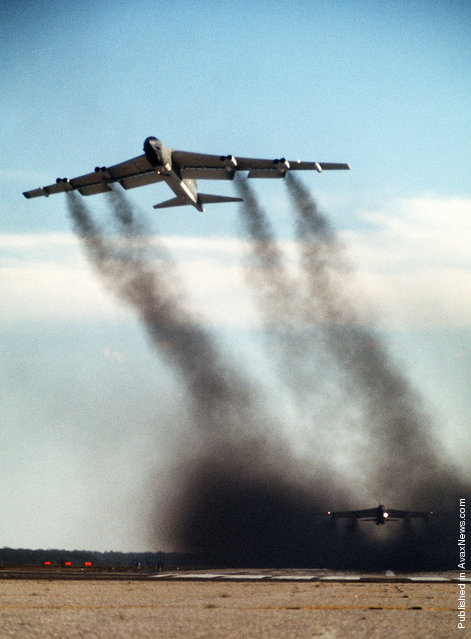
Photo: A B-52G Stratofortress aircraft takes off with another B-52G close behind. Three cells of six B-52 and KC-10 Extender aircraft will takeoff seconds apart under combat conditions during the minimum interval takeoff exercise. The exercise is a part of an operational readiness inspection by the Strategic Air Command Inspector General Team. (Photo by USAF). 1998
Details
15 Mar 2011 09:23:00