Loading...
Done


“Space Exploration Technologies Corp. (SpaceX) is an American space transport company founded by PayPal co-founder Elon Musk. It has developed the Falcon 1 and Falcon 9 rockets, both of which are built with a goal of being reusable launch vehicles. SpaceX is also developing the Dragon spacecraft to be carried to orbit by Falcon 9 launch vehicles. SpaceX designs, tests and fabricates the majority of their components in-house, including the Merlin, Kestrel, and Draco rocket engines. In December 2010, SpaceX became the first private company to successfully launch, orbit and recover a spacecraft (a Dragon)”. – Wikipedia

Photo: Elon Musk, CEO of Space Exploration Technologies Corp, speaks during a news conference at the National Press Club April 5, 2011 in Washington, DC. Elon Musk, CEO of Space Exploration Technologies Corp (SpaceX) and Tesla Motors, held the news conference to announce SpaceX's Falcon Heavy rocket which could complete missions to the International Space Station and Moon and should be ready for use by the end of 2012. (Photo by Brendan Smialowski/Getty Images)
Details
06 Apr 2011 09:05:00


“Body blading (also known as buggy rollin') is an extreme sport that involves descending down a slope while wearing a flexible aerodynamic plastic roller suit that has wheels on the feet, knees, torso, and arms. This suit was created by Jean-Yves Blondeau, and he is one of the premier body bladers. Body blading is similar to roller blading, and in fact a body blader often starts out using the rollers on their feet in the same fashion as roller blades in order to gain initial speed, but then the rider generally assumes a position laying on the stomach facing down the hill. A body blader is capable of reaching very high speeds. Maneuverability is achieved by moving the body into various positions to change direction”. – Wikipedia

Photo: French designer Jean-Yves Blondeau demonstrates his “Buggy Rollin” suit during a performance on August 16, 2007 in Beijing, China. Blondeau is able to roll along in any position and can achieve high speeds wearing the suit. (Photo by China Photos/Getty Images)
Details
29 Jun 2011 11:00:00
The Lun-class Ekranoplane was used by the Soviet Navy starting in 1987, and wasn't retired until the late 1990s, after the Soviet Union's fall. (Igor113)

“The Lun-class ekranoplan (NATO reporting name Duck) was a ground effect vehicle (GEV) designed by Rostislav Evgenievich Alexeev and used by the Soviet and Russian navies from 1987 until sometime in the late 1990s. It “flew” using the lift generated by the ground effect of its large wings when close to the surface of the water – about four metres or less. Although they might look similar and/or have related technical characteristics, ekranoplans like the Lun are not aircraft, seaplanes, hovercraft, or hydrofoils – ground effect is a separate technology altogether. The International Maritime Organization classifies these vehicles as maritime ships. The name Lun comes from the Russian for harrier”. – Wikipedia (Photo by Igor113)
Details
08 Aug 2014 10:51:00
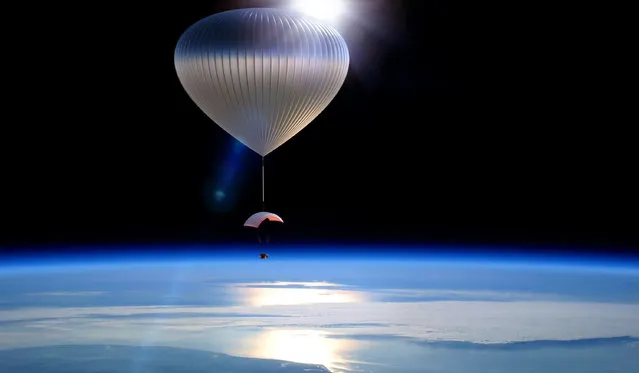
This undated image provided by World View shows World View capsule and balloon spacecraft that will rise to 100,000 feet above Earth for passengers to see the curvature of the planet and the blackness of space. (Photo by World View via AP Photo)

This undated image provided by World View shows World View capsule and balloon spacecraft that will rise to 100,000 feet above Earth for passengers to see the curvature of the planet and the blackness of space. Space tourism companies are employing designs including winged vehicles, vertical rockets with capsules and high-altitude balloons. While developers envision ultimately taking people to orbiting habitats, the moon or beyond, the immediate future involves short flights into or near the lowest reaches of space without going into orbit. (Photo by World View via AP Photo)
Details
15 Feb 2016 10:28:00
Moonlight illuminates sandstone buttes in the Valley of the Gods in the proposed Bear Ears National Monument near Mexican Hat, Utah, USA, 12 November 2016. (Photo by Jim Lo Scalzo/EPA)

Moonlight illuminates sandstone buttes in the Valley of the Gods in the proposed Bear Ears National Monument near Mexican Hat, Utah, USA, 12 November 2016. In October 2015, a coalition of five Indian nations, including the Hopi, Ute, and Navajo, formally proposed the monument, attempting to preserve the parcel's 100,000 archeological sites from ongoing looting and grave robbing. Less than two months before handing over the White House to President Elect Trump, President Obama must decide if it's worth the political capital to designate Bear Ears a national monument. (Photo by Jim Lo Scalzo/EPA)
Details
07 Dec 2016 11:53:00
The monument of Ilirska Bistrica was designed by Janez Lenassi and built in 1965. It is dedicated to Slovenian soldiers that fell in World War II. (Photo by Jan Kempenaers)

The brutalist war memorials found throughout the former Yugoslavia were weird enough when they were built in the 1960s and 70s. Today, separated by the end of an architectural movement and the disintegration of the country, they seem almost alien. Belgian photographer Jan Kempenaers treats them purely as artistic objects in his book, “Spomenik”, named for the Serb-Croat word for monument. Known for photographing geographical oddities, Kempenaers was captivated by the spomenik after seeing them in an art encyclopedia. After hearing that many had been destroyed or abandoned, he set out to record what was left. (Photo by Jan Kempenaers)
Details
18 Aug 2014 09:07:00
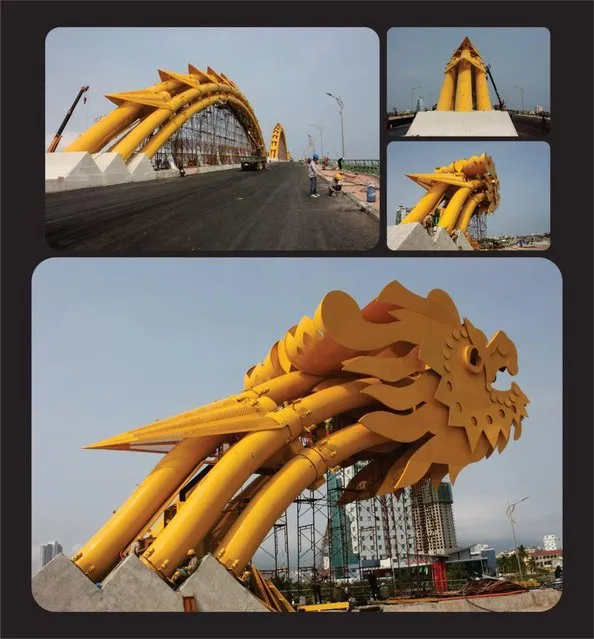
Dragon Bridge Over The River Hang

The Dragon Bridge (Vietnamese: Cầu Rồng) is a bridge over the River Hàn at Da Nang, Vietnam. Construction of the bridge began on 19 July 2009 (the same day as the inauguration of the nearby Thuận Phước Bridge) when the Prime Minister of Vietnam Nguyen Tan Dung and many high-ranking government officials attended the groundbreaking ceremony. Dragon Bridge is 666m long, 37.5m wide and has six lanes for traffic. It opened to traffic on March 29, 2013, at a cost os nearly VND 1.5 trillion dong (US$88m). The bridge was designed by the US-based Ammann & Whitney Consulting Engineers with Louis Berger Group. Construction was undertaken by Company No. 508, an affiliate of Civil Construction Engineering Corporation No.5, and Bridge Company No. 75.
Details
01 Jan 2014 08:41:00
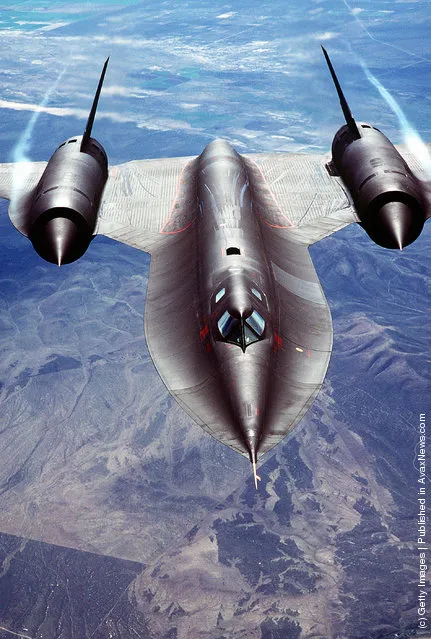
A U.S. Air Force SR-71A, also known as the Blackbird, is put through it's paces during a test flight

“The Lockheed SR-71 “Blackbird” was an advanced, long-range, Mach 3+ strategic reconnaissance aircraft. It was developed as a black project from the Lockheed A-12 reconnaissance aircraft in the 1960s by the Lockheed Skunk Works. Clarence “Kelly” Johnson was responsible for many of the design's innovative concepts. During reconnaissance missions the SR-71 operated at high speeds and altitudes to allow it to outrace threats. If a surface-to-air missile launch was detected, the standard evasive action was simply to accelerate and outrun the missile”. – Wikipedia

Photo: A U.S. Air Force SR-71A, also known as the “Blackbird”, is put through it's paces during a test flight over Beale Air Force Base in California. The aircraft is a strategic reconnaissance plane by Lockheed and is the world's fastest and highest flying operational aircraft. (Photo by Getty Images)
Details
07 Sep 2011 12:17:00