Loading...
Done
An American white pelican takes flight on the island of Petatan in the municipality of Cojumatlan de Regules, Michoacan state, Mexico on February 23, 2024. The island becomes home to the pelicans during the winter, when they travel from the north of the United States and the south of Canada to the warmer waters of Lake Chapala in Mexico. The birds are a tourist attraction and people gather on the island's boardwalk to feed them and watch them fly. (Photo by Enrique Castro/AFP Photo)

An American white pelican takes flight on the island of Petatan in the municipality of Cojumatlan de Regules, Michoacan state, Mexico on February 23, 2024. The island becomes home to the pelicans during the winter, when they travel from the north of the United States and the south of Canada to the warmer waters of Lake Chapala in Mexico. The birds are a tourist attraction and people gather on the island's boardwalk to feed them and watch them fly. (Photo by Enrique Castro/AFP Photo)
Details
24 May 2025 02:21:00


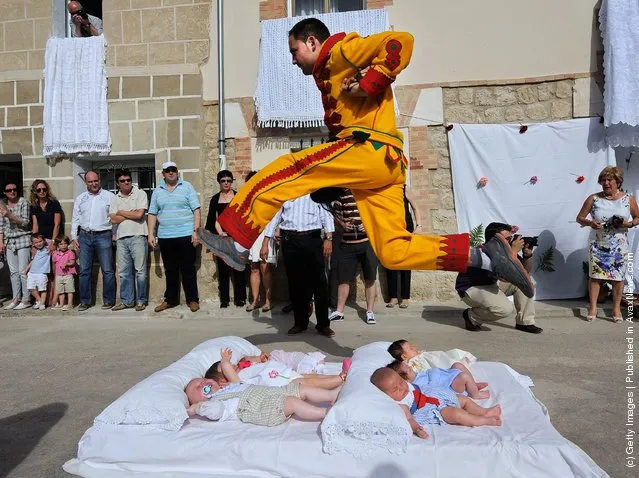
“Baby jumping (El Colacho) is a traditional Spanish practice dating back to 1620 that takes place annually to celebrate the Catholic feast of Corpus Christi in the village of Castrillo de Murcia near Burgos. During the act – known as El Salto del Colacho (the devil's jump) or simply El Colacho – men dressed as the Devil (known as the Colacho) jump over babies born during the previous twelve months of the year who lie on mattresses in the street. ... The festival has been rated as one of the most dangerous in the world”. – Wikipedia

Photo: A man representing the devil leaps over babies during the festival of El Colacho on June 26, 2011 in Castrillo de Murcia near Burgos, Spain. The festival, held on the first Sunday after Corpus Cristi, represents the devil taking away original sin from the newly born babies by leaping over them. (Photo by Denis Doyle/Getty Images)
Details
27 Jun 2011 09:20:00
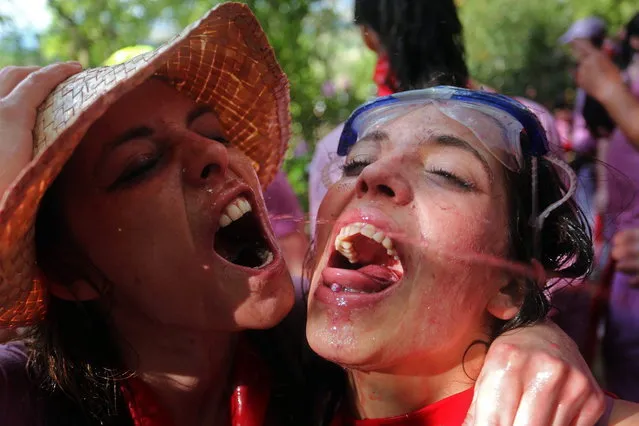
Revelers drink wine as they take part in the “Battle of Wine” (La batalla del vino de Haro), a wine fight, during the Haro Wine Festival, in Haro, in the northern province of La Rioja on June 29, 2014. More than nine thousand locals and tourists threw around 130.000 litres of wine at each other during the Haro Wine Festival, according to local media. (Photo by Cesar Manso/AFP Photo)

Revelers drink wine as they take part in the “Battle of Wine” (La batalla del vino de Haro), a wine fight, during the Haro Wine Festival, in Haro, in the northern province of La Rioja on June 29, 2014. More than nine thousand locals and tourists threw around 130.000 litres of wine at each other during the Haro Wine Festival, according to local media. (Photo by Cesar Manso/AFP Photo)
Details
30 Jun 2014 12:34:00
This November 11, 2014 aerial photo, shows a deforested area dotted with blue tarps, marking the area where miners reside, and craters filled with water, caused by illegal gold mining activities, in La Pampa, in Peru's Madre de Dios region. (Photo by Rodrigo Abd/AP Photo)

This November 11, 2014 aerial photo, shows a deforested area dotted with blue tarps, marking the area where miners reside, and craters filled with water, caused by illegal gold mining activities, in La Pampa, in Peru's Madre de Dios region. Less than a month before Peru plays host to global climate talks, the government sent a battalion of police into southeastern jungles to dismantle illegal gold-mining mining camps. Peru's anti-illegal mining czar, retired army Gen. Augusto Soto, marched the men to the wasteland known as La Pampa, where 50,000 hectares of rainforest have been obliterated in the past six years. (Photo by Rodrigo Abd/AP Photo)
Details
21 Nov 2014 12:35:00
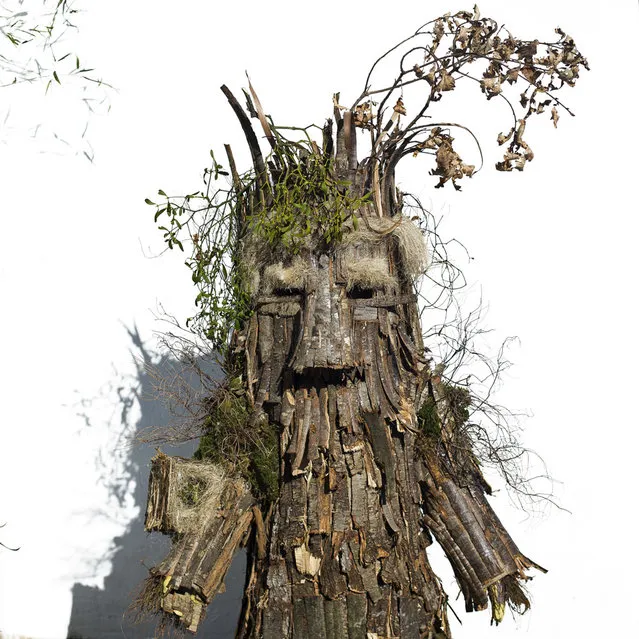
A man dressed as a  “Trapajon”, representing entities of nature, poses for a picture after taking part in the Vijanera Festival in Silio, northern Spain, Sunday, Jan. 6, 2013. The Vijanera masquerade, of pre-Roman origin, is the first carnival of the year in Europe symbolizing the triumph of good over evil and involving the participation of crowds of residents wearing different masks, animal skins and brightly colored clothing with its own complex function and symbolism and becoming the living example of the survival of archaic cults to nature. (Photo by Daniel Ochoa de Olza/AP Photo)

A man dressed as a “Trapajon”, representing entities of nature, poses for a picture after taking part in the Vijanera Festival in Silio, northern Spain, Sunday, Jan. 6, 2013. The Vijanera masquerade, of pre-Roman origin, is the first carnival of the year in Europe symbolizing the triumph of good over evil and involving the participation of crowds of residents wearing different masks, animal skins and brightly colored clothing with its own complex function and symbolism and becoming the living example of the survival of archaic cults to nature. (Photo by Daniel Ochoa de Olza/AP Photo)
Details
19 Jan 2013 13:01:00
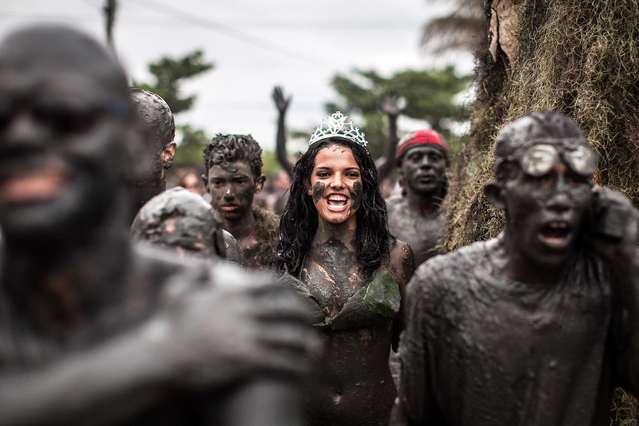
Revelers participate in the traditional Bloco da Lama (Mud block) carnival in Parati, Rio de Janeiro State, Brazil, on February 9, 2013. The event, which was begun by two men in a playful manner in 1986, has now become a traditional carnival in which participants disguised as primitives with rags, lianas or skulls and bones, dive in the mud. (Photo by Victor Moriyama/AFP Photo)

Revelers participate in the traditional Bloco da Lama (Mud block) carnival in Parati, Rio de Janeiro State, Brazil, on February 9, 2013. The event, which was begun by two men in a playful manner in 1986, has now become a traditional carnival in which participants disguised as primitives with rags, lianas or skulls and bones, dive in the mud. (Photo by Victor Moriyama/AFP Photo)
Details
12 Feb 2013 14:10:00
Revellers enjoy the atmosphere during the opening day or “Chupinazo” of the San Fermin Running of the Bulls fiesta on July 6, 2015 in Pamplona, Spain. The annual Fiesta de San Fermin, made famous by the 1926 novel of US writer Ernest Hemmingway entitled “The Sun Also Rises”, involves the daily running of the bulls through the historic heart of Pamplona to the bull ring. (Photo by Pablo Blazquez Dominguez/Getty Images)

Revellers enjoy the atmosphere during the opening day or “Chupinazo” of the San Fermin Running of the Bulls fiesta on July 6, 2015 in Pamplona, Spain. The annual Fiesta de San Fermin, made famous by the 1926 novel of US writer Ernest Hemmingway entitled “The Sun Also Rises”, involves the daily running of the bulls through the historic heart of Pamplona to the bull ring. (Photo by Pablo Blazquez Dominguez/Getty Images)
Details
07 Jul 2015 12:08:00
Cuban girls dressed as nurses and a lizard wait for their turn to dance during a visit by the Gay Men's Chorus of Washington in Havana July 13, 2015. The choir made its first appearance on July 12, 2015 in Cuba as part of a tour that will include a dozen concerts in the context of the restoration of relations between the island and the United States. (Photo by Enrique de la Osa/Reuters)

Cuban girls dressed as nurses and a lizard wait for their turn to dance during a visit by the Gay Men's Chorus of Washington in Havana July 13, 2015. The choir made its first appearance on July 12, 2015 in Cuba as part of a tour that will include a dozen concerts in the context of the restoration of relations between the island and the United States. (Photo by Enrique de la Osa/Reuters)
Details
22 Jul 2015 12:19:00