Loading...
Done
A competitor poses on the catwalk during the Miss Bumbum Brazil 2017 pageant in Sao Paulo on November 07, 2017. (Photo by Nelson Almeida/AFP Photo)

A competitor poses on the catwalk during the Miss Bumbum Brazil 2017 pageant in Sao Paulo on November 07, 2017. Fifteen candidates are competing in the annual pageant to select the Brazil's sexiest female rear end. (Photo by Nelson Almeida/AFP Photo)
Details
14 Nov 2017 08:09:00
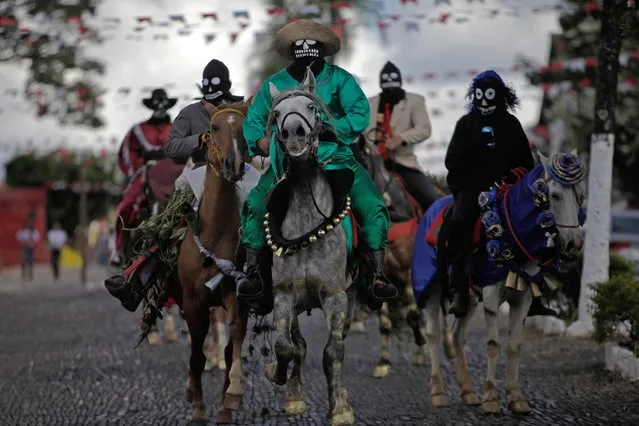
Masked men ride in a morning procession as part of the “Cavalhadas” festival in Pirenopolis, Brazil, Sunday, May 19, 2013. The popular festival is a tradition that was introduced in the 1800's by a Portuguese priest to mark the the ascension of Christ. The 3-day festival reenacts the Christian knights' medieval defeat of the Moors. (Photo by Eraldo Peres/AP Photo)

Masked men ride in a morning procession as part of the “Cavalhadas” festival in Pirenopolis, Brazil, Sunday, May 19, 2013. The popular festival is a tradition that was introduced in the 1800's by a Portuguese priest to mark the the ascension of Christ. The 3-day festival reenacts the Christian knights' medieval defeat of the Moors. (Photo by Eraldo Peres/AP Photo)
Details
22 May 2013 08:49:00
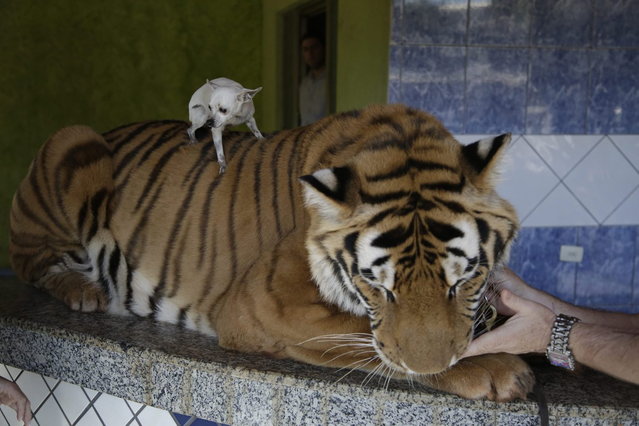
The Borges' family pet dog, Little, is placed on the back of Tom, their tiger, for a photo to be taken, in Maringa, Brazil, Friday, September 27, 2013. The Brazilian family is now locked in a legal dispute for the big cats, they have eight tigers and two lions, with federal wildlife officials working to take them away. While Borges does have a license to raise the animals, Brazilian wildlife officials say he illegally bred the cats, creating a public danger. (Photo by Renata Brito/AP Photo)

“Ary Borges and his family live in southern Brazil like most families the Borges' love animals and have an array of cats living in their home. The only difference between the cats owned by the Borges family and the cat that is cuddled up on your lap as you read this is the Borges' cats weigh over 700 pounds and could kill you just as soon as look at you. The Borges family shares their home with nine tigers, two lionesses, a chimp and a Chihuahua”. – Amanda Schiavo via Latin Times. Photo: The Borges' family pet dog, Little, is placed on the back of Tom, their tiger, for a photo to be taken, in Maringa, Brazil, Friday, September 27, 2013. (Photo by Renata Brito/AP Photo)

Details
04 Oct 2013 11:51:00
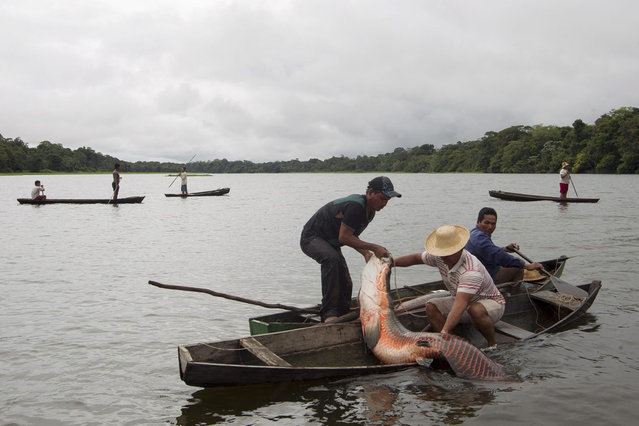
Villagers from the Porto Novo community load into their canoes arapaima or pirarucu, the largest freshwater fish species in South America and one of the largest in the world, while fishing in Poco Fundo lake along a branch of the Solimoes river, one of the main tributaries of the Amazon, in the Mamiraua nature reserve near Fonte Boa about 600 km (373 miles) west of Manaus, November 26, 2013. (Photo by Bruno Kelly/Reuters)

Villagers from the Porto Novo community load into their canoes arapaima or pirarucu, the largest freshwater fish species in South America and one of the largest in the world, while fishing in Poco Fundo lake along a branch of the Solimoes river, one of the main tributaries of the Amazon, in the Mamiraua nature reserve near Fonte Boa about 600 km (373 miles) west of Manaus, November 26, 2013. Catching the arapaima, a fish that is sought after for its meat and is considered by biologists to be a living fossil, is only allowed once a year by Brazil's environmental protection agency. The minimum size allowed for a fisherman to keep an arapaima is 1.5 meters (4.9 feet). (Photo by Bruno Kelly/Reuters)
Details
17 Dec 2013 08:03:00
A man and his dog wade through a flooded road in Vila Velha, Espirito Santo state, Brazil, on December 27, 2013. At least 44 people have died and more than 60,000 have been left homeless following torrential rains over the past few weeks in southeast Brazil. (Photo by Yasuyoshi Chiba/AFP Photo)

A man and his dog wade through a flooded road in Vila Velha, Espirito Santo state, Brazil, on December 27, 2013. At least 44 people have died and more than 60,000 have been left homeless following torrential rains over the past few weeks in southeast Brazil. (Photo by Yasuyoshi Chiba/AFP Photo)
Details
30 Dec 2013 10:25:00
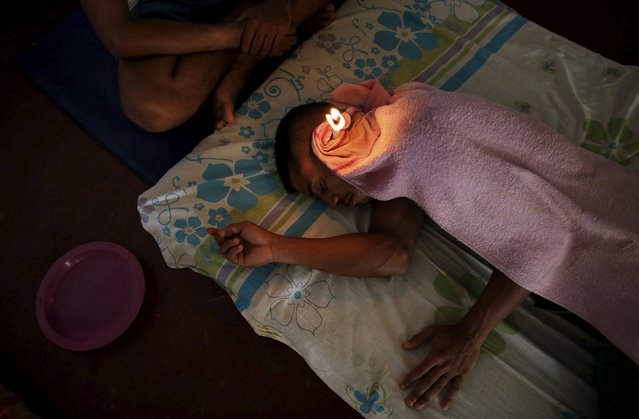
An inmate (L) tends to a fellow prisoner while performing ear candling during an alternative therapy session as part of the ACUDA programme, at a complex of ten prisons in Porto Velho, Rondonia State, Brazil, August 27, 2015. Ear candling, which involves inserting a hollow cone-shaped device into the ear canal and lighting the exposed end, is believed by practitioners to draw out earwax. According to ACUDA the therapy is beneficial for the inmates' emotional health. (Photo by Nacho Doce/Reuters)

An inmate (L) tends to a fellow prisoner while performing ear candling during an alternative therapy session as part of the ACUDA programme, at a complex of ten prisons in Porto Velho, Rondonia State, Brazil, August 27, 2015. Ear candling, which involves inserting a hollow cone-shaped device into the ear canal and lighting the exposed end, is believed by practitioners to draw out earwax. According to ACUDA the therapy is beneficial for the inmates' emotional health. (Photo by Nacho Doce/Reuters)
Details
30 Oct 2015 08:00:00
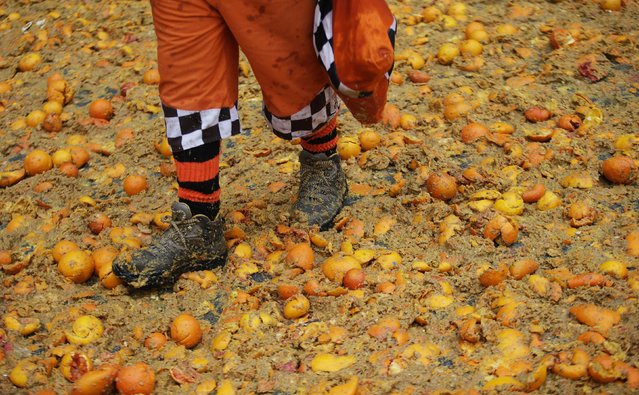
A member of a rival team walks during an annual carnival battle with oranges in the northern Italian town of Ivrea February 15, 2015. Dressed up as Middle Age kings' guards, a group of men ride in a horse-drawn carriage and pelt “foot soldiers” with oranges as thousands of people gather to re-enact a Middle Age battle when the townsfolk of Ivrea overthrew an evil king. (Photo by Max Rossi/Reuters)

A member of a rival team walks during an annual carnival battle with oranges in the northern Italian town of Ivrea February 15, 2015. Dressed up as Middle Age kings' guards, a group of men ride in a horse-drawn carriage and pelt “foot soldiers” with oranges as thousands of people gather to re-enact a Middle Age battle when the townsfolk of Ivrea overthrew an evil king. In a strange twist, instead of swords and cross bows, these days the weapons of choice are oranges. (Photo by Max Rossi/Reuters)
Details
16 Feb 2015 13:06:00
Caporal dancers perform during the carnival celebrations in Oruro, Bolivia, Saturday February 14, 2015. The Carnival of Oruro which is a religious festival dating back more than 2000 years in an ongoing pagan-catholic blend of religious practice in the region, and is one of UNESCO's Masterpieces of the Oral and Intangible Heritage of Humanity. (Photo by Juan Karita/AP Photo)

Caporal dancers perform during the carnival celebrations in Oruro, Bolivia, Saturday February 14, 2015. The Carnival of Oruro which is a religious festival dating back more than 2000 years in an ongoing pagan-catholic blend of religious practice in the region, and is one of UNESCO's Masterpieces of the Oral and Intangible Heritage of Humanity. (Photo by Juan Karita/AP Photo)
Details
17 Feb 2015 12:25:00