Loading...
Done
Master Sergey Suprun uses a portable radio set as he stands near a rotary dredge which works on the coal face of the Borodinsky opencast colliery, near the Siberian town of Borodino, east of Krasnoyarsk, Russia October 27, 2015. The Borodinsky colliery, 9 km (5.6 miles) long and more than 100 meters (328 feet) deep, annually produces more than 20 million tons of coal and is considered to be the biggest opencast coal mine in Russia, according to official representatives. (Photo by Ilya Naymushin/Reuters)

Master Sergey Suprun uses a portable radio set as he stands near a rotary dredge which works on the coal face of the Borodinsky opencast colliery, near the Siberian town of Borodino, east of Krasnoyarsk, Russia October 27, 2015. The Borodinsky colliery, 9 km (5.6 miles) long and more than 100 meters (328 feet) deep, annually produces more than 20 million tons of coal and is considered to be the biggest opencast coal mine in Russia, according to official representatives. (Photo by Ilya Naymushin/Reuters)
Details
31 Oct 2015 08:01:00
Riot police stand guard behind a fire as refinery workers hold a blockade of the oil depot of Douchy-Les-Mines to protest against the government's proposed labour reforms, on May 25, 2016. Refinery workers stepped up strikes that threaten to paralyse France weeks ahead of the Euro 2016 tournament as the government moved to break their blockades, escalating a three-month tug-of-war over labour reforms. (Photo by François L.O./AFP Photo)

Riot police stand guard behind a fire as refinery workers hold a blockade of the oil depot of Douchy-Les-Mines to protest against the government's proposed labour reforms, on May 25, 2016. Refinery workers stepped up strikes that threaten to paralyse France weeks ahead of the Euro 2016 tournament as the government moved to break their blockades, escalating a three-month tug-of-war over labour reforms. (Photo by François L.O./AFP Photo)
Details
26 May 2016 13:02:00
In this January 12, 2016 photo, an abandoned boat lies on the dried up lake bed of Lake Poopo, on the outskirts of Untavi, Bolivia. Drought caused by the recurrent El Nino meteorological phenomenon is considered the main driver of the lake's demise. Along with glacial melting, authorities say another factor is the diversion of water from Poopo's tributaries, mostly for mining but also for agriculture. (Photo by Juan Karita/AP Photo)

In this January 12, 2016 photo, an abandoned boat lies on the dried up lake bed of Lake Poopo, on the outskirts of Untavi, Bolivia. Drought caused by the recurrent El Nino meteorological phenomenon is considered the main driver of the lake's demise. Along with glacial melting, authorities say another factor is the diversion of water from Poopo's tributaries, mostly for mining but also for agriculture. (Photo by Juan Karita/AP Photo)
Details
21 Jan 2016 12:33:00
A man takes a selfie next to a flooded street due to the overflowing of the Mapocho river during heavy rains in Santiago on April 17, 2016. Four million people in Santiago were without tap water Sunday after unusually heavy rain pounding central Chile triggered landslides that fouled the city's water supply and forced the closure of the world's biggest copper mine, officials said. (Photo by Martin Bernetti/AFP Photo)

A man takes a selfie next to a flooded street due to the overflowing of the Mapocho river during heavy rains in Santiago on April 17, 2016. Four million people in Santiago were without tap water Sunday after unusually heavy rain pounding central Chile triggered landslides that fouled the city's water supply and forced the closure of the world's biggest copper mine, officials said. (Photo by Martin Bernetti/AFP Photo)
Details
18 Apr 2016 10:05:00
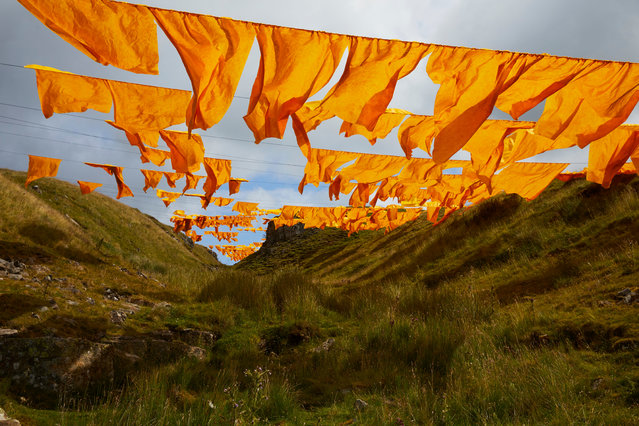
Monumental landscape artwork “Hush” by installation artist Steve Messam hangs in the moors of Teesdale on July 18, 2019 in Barnard Castle, England. The outdoor installation is inspired by the geology, mining history and landscape of the area. It hangs over Bales Hush, a deep gauge in the terrain created when miners flushed the area with water to reveal the geological riches below. Hundreds of metres of recyclable saffron yellow fabric blow in the wind. (Photo by Christopher Thomond/The Guardian)

Monumental landscape artwork “Hush” by installation artist Steve Messam hangs in the moors of Teesdale on July 18, 2019 in Barnard Castle, England. The outdoor installation is inspired by the geology, mining history and landscape of the area. It hangs over Bales Hush, a deep gauge in the terrain created when miners flushed the area with water to reveal the geological riches below. Hundreds of metres of recyclable saffron yellow fabric blow in the wind. (Photo by Christopher Thomond/The Guardian)
Details
20 Jul 2019 00:03:00
A visitor is dwared between the wheels of BelAZ 450-ton dump truck (L) and BelAZ 360-ton dump truck (R) at the plant of Belarusian manufacturer of heavy trucks and equipment for earthmoving, BelAZ, in Zhodino, some 55 km from Minsk, Belarus, 27 August 2019. The company mostly delivers its products to CIS mining companies, mainly from Russia and Ukraine. (Photo by Tatyana Zenkovich/EPA/EFE/Rex Features/Shutterstock)

A visitor is dwared between the wheels of BelAZ 450-ton dump truck (L) and BelAZ 360-ton dump truck (R) at the plant of Belarusian manufacturer of heavy trucks and equipment for earthmoving, BelAZ, in Zhodino, some 55 km from Minsk, Belarus, 27 August 2019. The company mostly delivers its products to CIS mining companies, mainly from Russia and Ukraine. (Photo by Tatyana Zenkovich/EPA/EFE/Rex Features/Shutterstock)
Details
29 Aug 2019 00:05:00
A juvenile blackcap is recorded in the soft light of morning at Minorca, UK, a former open-cast mine near Moira in the National Forest on June 18, 2025. Dr Heather Gilbert, research and evidence manager, checks mist nets among wildflowers and young trees as part of long-term monitoring that shows bird numbers have increased by 48 per cent over 30 years. (Photo by Rod Kirkpatrick/RKP Photography)

A juvenile blackcap is recorded in the soft light of morning at Minorca, UK, a former open-cast mine near Moira in the National Forest on June 18, 2025. Dr Heather Gilbert, research and evidence manager, checks mist nets among wildflowers and young trees as part of long-term monitoring that shows bird numbers have increased by 48 per cent over 30 years. (Photo by Rod Kirkpatrick/RKP Photography)
Details
29 Jun 2025 03:58:00
Dromedaries and donkeys are used to transport the salt. (Photo by Joel Santos/Barcroft Images)

Unforgiving temperatures of up to 60℃ (140℉) beat down on these saltminers on a daily basis. The mines, situated in the Afar Triangle in Ethiopia, stretch across 38,000 sq miles and at their lowest point are more than 300ft below sea level. Joel Santos travelled to capture the area’s dry, brutal beauty. Here: Dromedaries and donkeys are used to transport the salt. (Photo by Joel Santos/Barcroft Images)
Details
24 Aug 2016 11:31:00