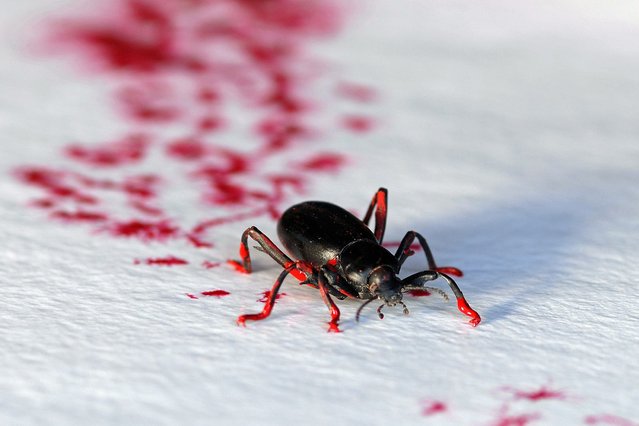
An artist has discovered a bizarre way to create his work – by coating the feet of insects with paint who then crawl across the canvas creating intricate pieces of art. (Photo by Caters News)
In this Thursday, February 19, 2015 photo, participants at a seminar on edible insects taste a Cricket Consomme at Le Cordon Bleu cooking school in Bangkok, Thailand. A group of chefs and food scientists at the esteemed French school's branch in Bangkok spent the week simmering, sautéing and grilling insects to extract innovative flavors they say could open a new frontier for the world of gastronomy. (Photo by Sakchai Lalit/AP Photo)
A menacing swarm of locusts that entered southern Israel earlier this week has been largely smitten, according to the Israeli government and local reports. But some of the insects' ilk may be back later this week. (Photo by Eliyahu Hershkovitz)
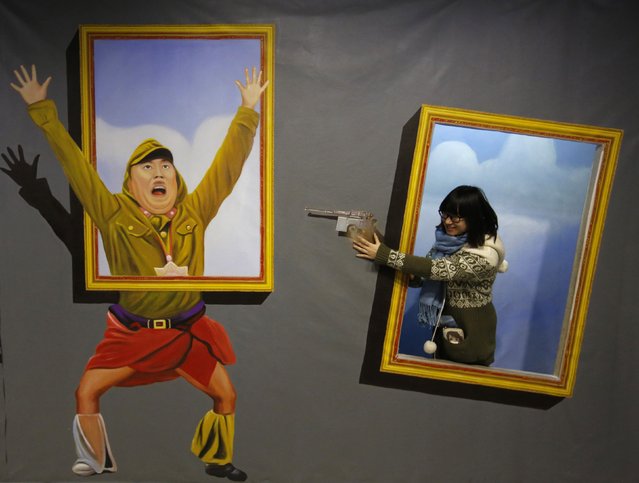
A visitor poses for a photograph in front of a 3D painting depicting a Japanese Imperial army soldier at a 3D art gallery in Beijing January 16, 2015. (Photo by Kim Kyung-Hoon/Reuters)
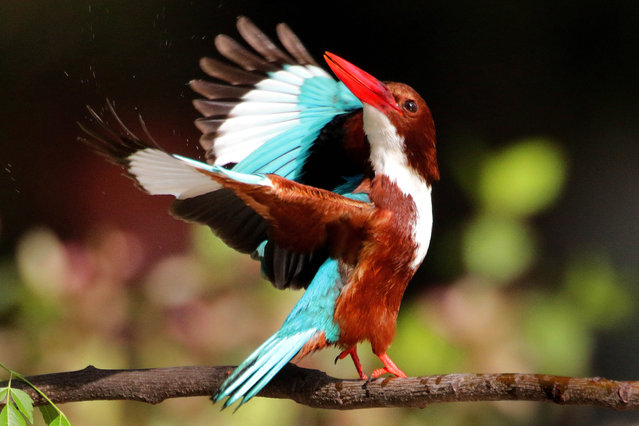
A white-throated kingfisher (Halcyon smyrnensis) sits over a tree in a field in Lahore, Pakistan, 26 March 2021. The most familiar Kingfisher species can be observed perched on branches or walls while on the lookout for grubs, insects and even fish in streams or garden ponds. (Photo by Rahat Dar/EPA/EFE)
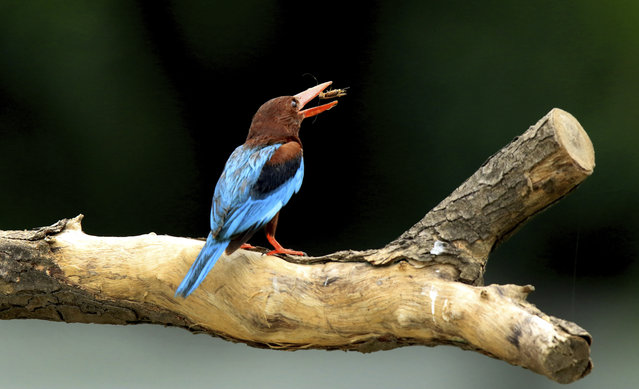
A common kingfisher sits on a branch of a tree after catching an insect in Allahabad, India, Sunday, July 9, 2017. The common kingfisher is a highly territorial bird that has to eat nearly sixty percent of its bodyweight every day. (Photo by Rajesh Kumar Singh/AP Photo)
A sales assistant poses for photographs with a mealworm cookie in Seoul, South Korea, August 8, 2016. Insect-eating, or entomophagy, has long been common in much of the world, including South Korea, where boiled silky worm pupae, or beondegi, are a popular snack. Now, South Korea is looking to expand its insect industry as a source of agricultural income. (Photo by Kim Hong-Ji/Reuters)
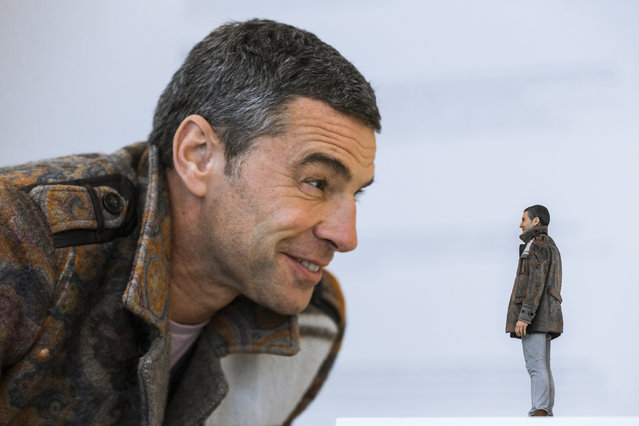
Customer Andreas Kroker looks at a 3D-printed figure of himself at the Twinkind 3D printing studio in Berlin, December 13, 2013. A 3D-printed likeness is produced by taking a 360 degree photographic scan of a person, which is then rendered into a 3D digital model and retouched to meet the requirements for printing. The printing machine uses this digital model to produce a high-resolution solid figure. Twinkind co-founder Timo Schaedel said, people often come to the session well-groomed, with fresh hair-cuts and their best clothes, “just as they used to do in the past, when they had their portrait taken in a photo studio”. (Photo by Thomas Peter/Reuters)