Loading...
Done
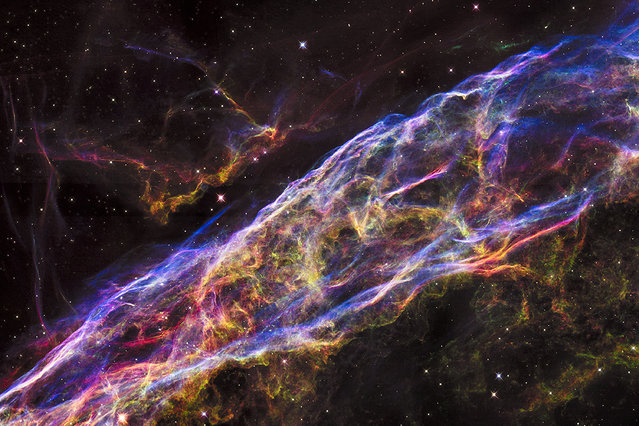
A small section of the expanding remains of the Veil Nebula, a massive star that exploded about 8,000 years ago. The entire nebula is 110 light-years across, covering six full moons on the sky as seen from Earth, and resides about 2,100 light-years away in the constellation Cygnus, the Swan. (Photo by Reuters/NASA/ESA/Hubble)

A small section of the expanding remains of the Veil Nebula, a massive star that exploded about 8,000 years ago. The entire nebula is 110 light-years across, covering six full moons on the sky as seen from Earth, and resides about 2,100 light-years away in the constellation Cygnus, the Swan. (Photo by Reuters/NASA/ESA/Hubble)
Details
29 Feb 2016 11:30:00
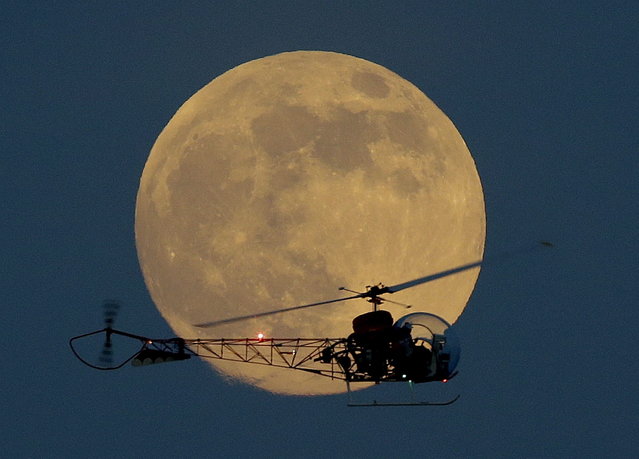
The moon is seen in its waxing gibbous stage as it rises behind the helicopter from the original Batman television show, which people can ride at the New Jersey State Fair, Saturday, June 22, 2013, in East Rutherford, N.J. The moon, which will reach its full stage on Sunday, is expected to be 13.5 percent closer to earth during a phenomenon known as supermoon. (Photo by Julio Cortez/AP Photo)

The moon is seen in its waxing gibbous stage as it rises behind the helicopter from the original Batman television show, which people can ride at the New Jersey State Fair, Saturday, June 22, 2013, in East Rutherford, N.J. The moon, which will reach its full stage on Sunday, is expected to be 13.5 percent closer to earth during a phenomenon known as supermoon. (Photo by Julio Cortez/AP Photo)
Details
24 Jun 2013 12:17:00
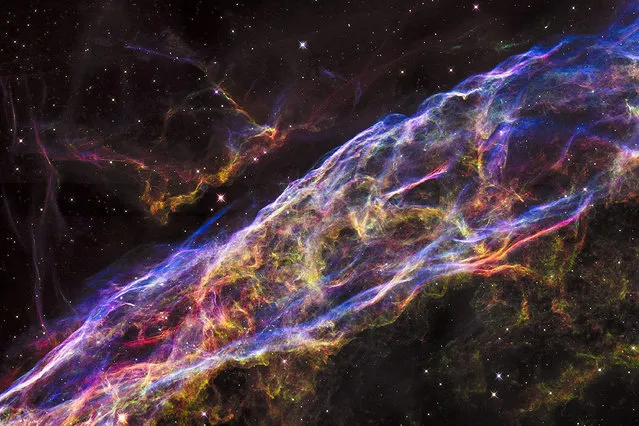
A small section of the expanding remains of the Veil Nebula, a massive star that exploded about 8,000 years ago. The entire nebula is 110 light-years across, covering six full moons on the sky as seen from Earth, and resides about 2,100 light-years away in the constellation Cygnus, the Swan. Image taken by NASA's Hubble Space Telescope. Released September 24, 2015. (Photo by Reuters/NASA/ESA/Hubble Heritage Team)

A small section of the expanding remains of the Veil Nebula, a massive star that exploded about 8,000 years ago. The entire nebula is 110 light-years across, covering six full moons on the sky as seen from Earth, and resides about 2,100 light-years away in the constellation Cygnus, the Swan. Image taken by NASA's Hubble Space Telescope. Released September 24, 2015. (Photo by Reuters/NASA/ESA/Hubble Heritage Team)
Details
10 Dec 2015 08:01:00
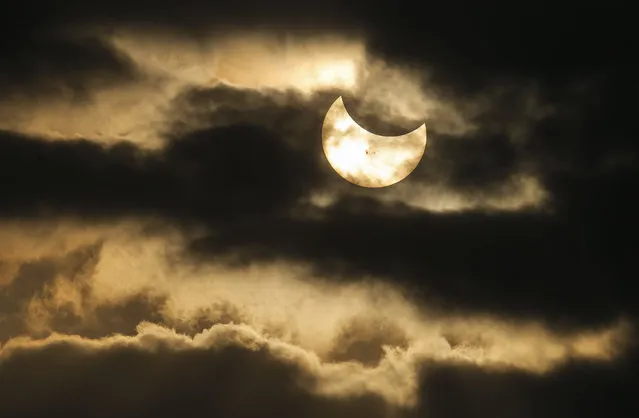
A partial solar eclipse is seen in a break in the clouds during rush hour in downtown Wichita Kan., Thursday, Oct. 23, 2014. (AP Photo/The Wichita Eagle, Travis Heying)

A partial solar eclipse is seen in a break in the clouds during rush hour in downtown Wichita Kan., Thursday, October 23, 2014. A partial eclipse occurs when the moon covers a portion of the sun as seen from the Earth. (AP Photo/The Wichita Eagle, Travis Heying)
Details
24 Oct 2014 12:38:00
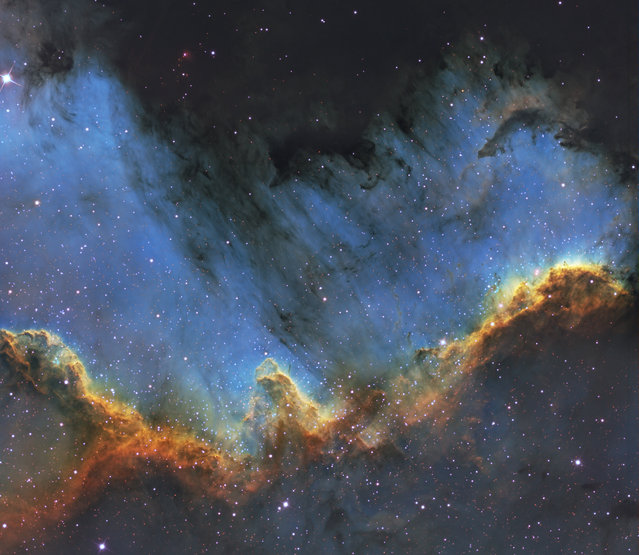
The Cygnus Wall is in the southern  area of NGC7000 also known as the North America Nebula. It is approximately 1800 light years from Earth, and is in the constellation Cygnus. The Wall is an energized shock front and contains the most concentrated star formations in the nebula. The size of the North America Nebula is about 4 full moons. (Bill Snyder)

Amateur astronomer Bill Snyder has been involved with astrophotography since 2007. Photo: The Cygnus Wall is in the southern area of NGC7000 also known as the North America Nebula. It is approximately 1800 light years from Earth, and is in the constellation Cygnus. The Wall is an energized shock front and contains the most concentrated star formations in the nebula. The size of the North America Nebula is about 4 full moons. (Photo and caption by Bill Snyder)
Details
30 Oct 2013 09:15:00
 Refractions In Water Drops By Markus Reugels

German photographer Markus Reugels. Using large satellite photos as a backdrop and a high speed camera he captures the background’s refraction through water drops. The perfectly timed shots result in these spherical representations of the Earth, Moon and Jupiter. See much more of his work here and also here. Thanks Markus for sharing your work with Colossal!
Details
21 Feb 2013 11:00:00


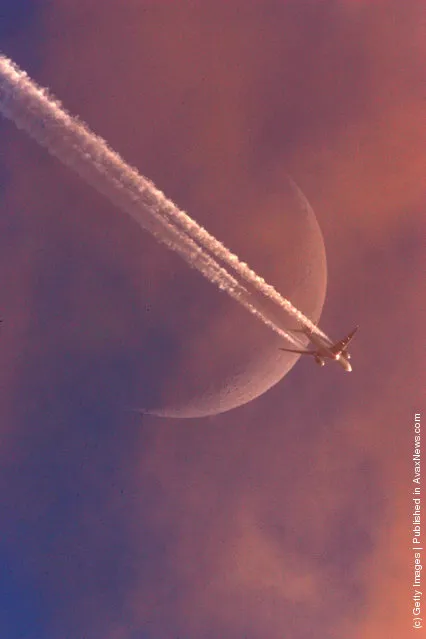
“Contrails (short for “condensation trails”) or vapour trails are artificial clouds that are the visible trails of condensed water vapour made by the exhaust of aircraft engines. As the hot exhaust gases cool in the surrounding air they may precipitate a cloud of microscopic water droplets or, if the air is cold enough, tiny ice crystals”. – Wikipedia

Photo: An airplane leaves a vapor trail as it flies in front of he moon on January 17, 2007 above Hanover, Germany. (Photo by Alexander Hassenstein/Getty Images)
Details
04 Jul 2011 10:39:00
Sculpture By Ervin Loranth Herve

There are not many sculptures in the world that were purposely made to be grotesque, especially on such a large scale. Thus, a Hungarian artist Ervin Loránth Hervé has apparently decided that there isn’t enough horror in this world and created the Feltépve – a sculpture of a stone giant ripping apart the earth in order to break free. However, when we look from another perspective this sculpture might depict a grouchy giant trying to cover himself with a blanket of earth so that everyone would leave him alone. The latter interpretation of this sculpture was probably not intended by the sculptor; however, the way the arms of the giant are positioned makes it look as if it was truly the case.
Details
04 Nov 2014 11:49:00