Loading...
Done
Priest, Valamo Monastery, Karelia, Russia (then Finland), 1930s. Father Venerius with a birchbark basket. (Photo by Einar Erici)

“Einar Erici (1885–1965) was a physician by profession, working at a tuberculosis hospital in Stockholm, even running a private medical practice. He was by then the most renowned Swedish expert of church organs and organ builders, and his archival collection is today held by the Swedish National Heritage Board. This archive includes mostly writings, such as letters and manuscripts for published articles and essays, but also more than 2 000 black and white photos – original prints, glass plates and film negatives”. – Swedish National Heritage Board

Photo: Priest, Valamo Monastery, Karelia, Russia (then Finland), 1930s. Father Venerius with a birchbark basket. (Photo by Einar Erici)
Details
09 Dec 2012 11:41:00
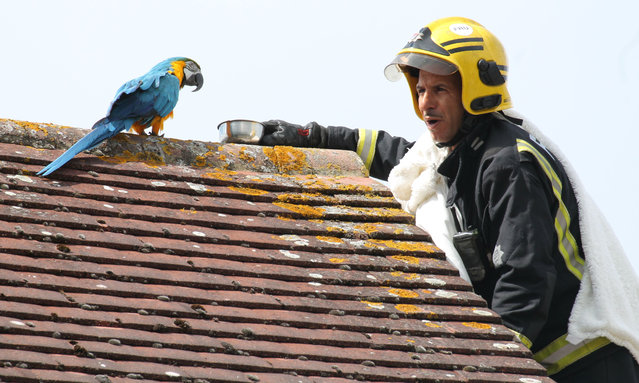
A parrot stuck on a roof for three days greeted firefighters sent to its aid on August 13, 2018 with a four-letter tirade. Jessie, the multi-lingual Macaw, flipped the bird after escaping from her owner's home in Edmonton, north London, UK. When she could not be lured down from a neighbour's roof, firefighters were called out and told to tell the bird “I love you” – to which Jessie replied “I love you back”. But she then ruffled her would-be rescuers' feathers by telling them to “f**k off” before flying off to another nearby rooftop. The foul-mouthed pet also speaks Turkish and Greek according to its owner, but had its own choice words in English for the rescue team. As Jessie wasn't injured, the firefighters, who had been called in by the RSPCA, left her on her perch. The parrot was later reunited with its owner. (Photo by Rex Features/Shutterstock)

A parrot stuck on a roof for three days greeted firefighters sent to its aid on August 13, 2018 with a four-letter tirade. Jessie, the multi-lingual Macaw, flipped the bird after escaping from her owner's home in Edmonton, north London, UK. When she could not be lured down from a neighbour's roof, firefighters were called out and told to tell the bird “I love you” – to which Jessie replied “I love you back”. But she then ruffled her would-be rescuers' feathers by telling them to “f**k off” before flying off to another nearby rooftop. The foul-mouthed pet also speaks Turkish and Greek according to its owner, but had its own choice words in English for the rescue team. As Jessie wasn't injured, the firefighters, who had been called in by the RSPCA, left her on her perch. The parrot was later reunited with its owner. (Photo by Rex Features/Shutterstock)
Details
14 Aug 2018 08:23:00
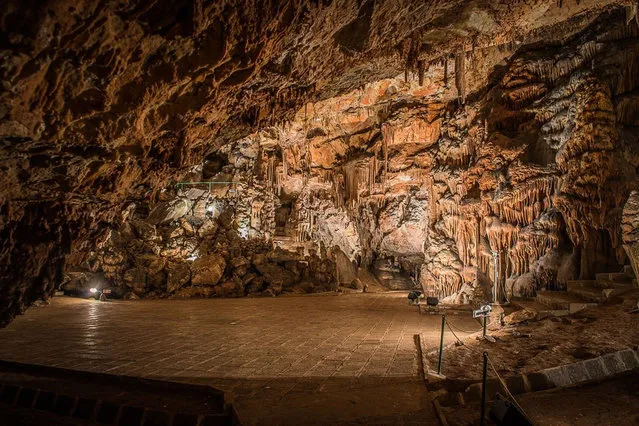
Saeva Dupka Cave

Saeva dupka (Bulgarian: Съева дупка) is a cave in Northern Bulgaria near the village of Brestnitsa, Lovech Province (43°2′N 24°11′E). Its five halls and 400 metres of corridors offer some of the most beautiful cave formations in the country. Besides that the cave has hosted many Choral music performances, thanks to the excellent acoustic conditions. Saeva dupka was named after two brothers Seyu and Sae who used it as a hiding place during the Ottoman occupation of Bulgaria. Recent excavations have showed the cave was inhabited since Roman times. Currently Saeva dupka is one of the 100 Tourist Sites of Bulgaria.
Details
20 Feb 2013 11:30:00
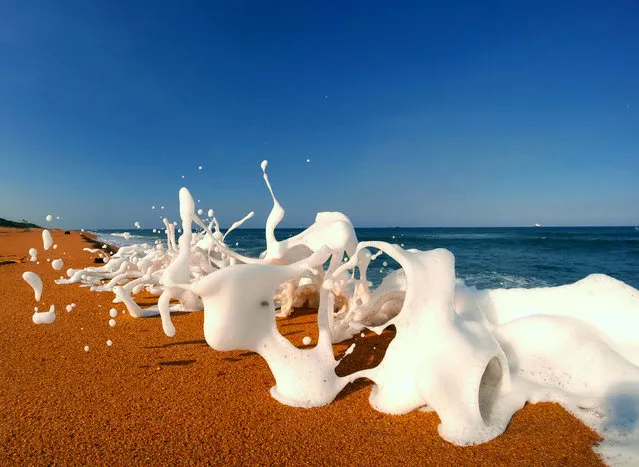
Foam party: Marck captured this moment in time from the shore on July, 30, 2015, in Durban, South Africa. (Photo by Marck Botha/Barcroft Media)

Beautiful seascapes capture the “raw power” of waves rising and crashing in the Indian Ocean. The stunning photos were taken off the coast of Durban in South Africa, and show formations from above and below the surface. Surfer and photographer Marck Botha took the images between April and July, and has always had a passion for the ocean. Here: Marck captured this moment in time from the shore on July, 30, 2015, in Durban, South Africa. (Photo by Marck Botha/Barcroft Media)
Details
30 Jan 2016 13:46:00
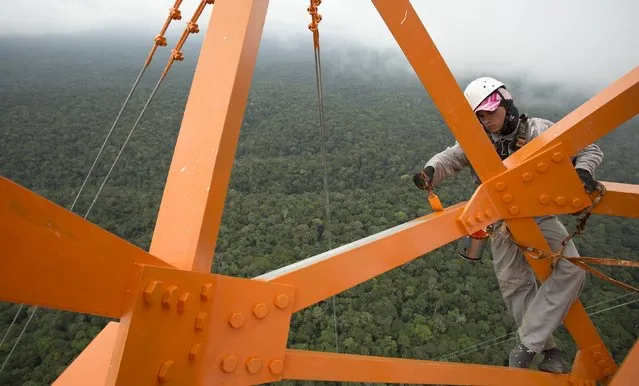
A worker paints the Amazon Tall Tower Observatory (ATTO) in Sao Sebastiao do Uatuma in the middle of the Amazon forest in Amazonas state January 10, 2015. (Photo by Bruno Kelly/Reuters)

A worker paints the Amazon Tall Tower Observatory (ATTO) in Sao Sebastiao do Uatuma in the middle of the Amazon forest in Amazonas state January 10, 2015. The Amazon Tall Tower Observatory is a project of Brazil's National Institute of Amazonian Research and Germany's Max Planck Institute and will be equipped with high-tech instruments and an observatory to monitor relationships between the jungle and the atmosphere from next July. According to the institutes, ATTO will gather data on heat, water, carbon gas, winds, cloud formation and weather patterns. (Photo by Bruno Kelly/Reuters)
Details
14 Jan 2015 12:39:00
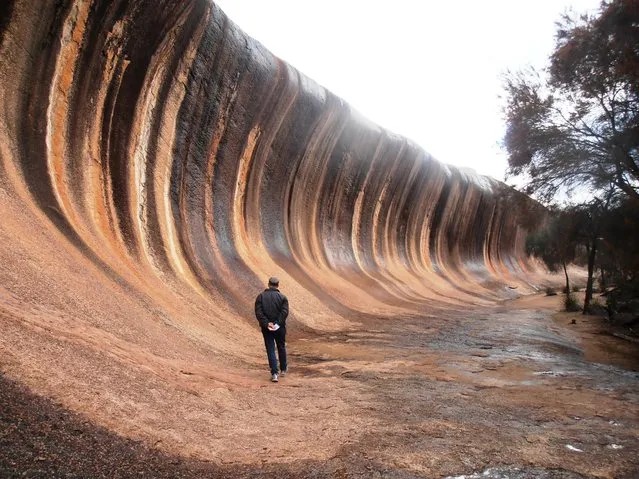
Wave Rock, Arizona

Wave Rock is a natural rock formation that is shaped like a tall breaking ocean wave. The "wave" is about 14 m (46 ft) high and around 110 m (360 ft) long. It forms the north side of a solitary hill, which is known as “Hyden Rock”. This hill, which is a granite inselberg, lies about 3 km (2 mi) east of the small town of Hyden and 296 km (184 mi) east-southeast of Perth, Western Australia. Wave Rock and Hyden Rock are part of a 160 ha (395-acre) nature reserve, Hyden Wildlife Park.
Details
12 Aug 2014 10:21:00
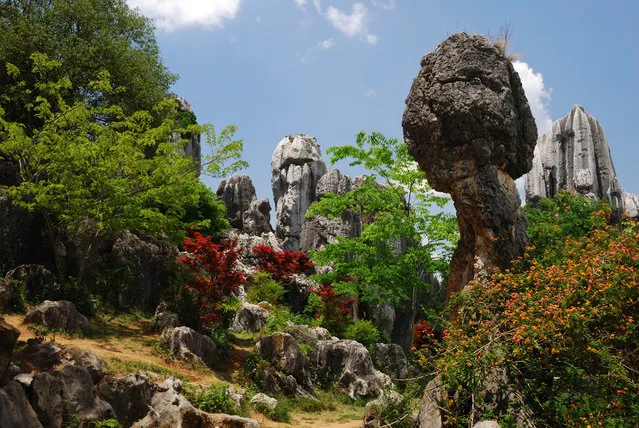
Shilin Stone Forest

The Stone Forest or Shilin is a notable set of limestone formations located in Shilin Yi Autonomous County, Yunnan Province, People's Republic of China, near Shilin approximately 120 km (75 mi) from the provincial capital Kunming. The tall rocks seem to emanate from the ground in the manner of stalagmites, with many looking like petrified trees thereby creating the illusion of a forest made of stone. Since 2007, two parts of the site, the Naigu Stone Forest (乃古石林) and Suogeyi Village (所各邑村), have been UNESCO World Heritage Sites as part of the South China Karst.
Details
27 Sep 2013 10:03:00
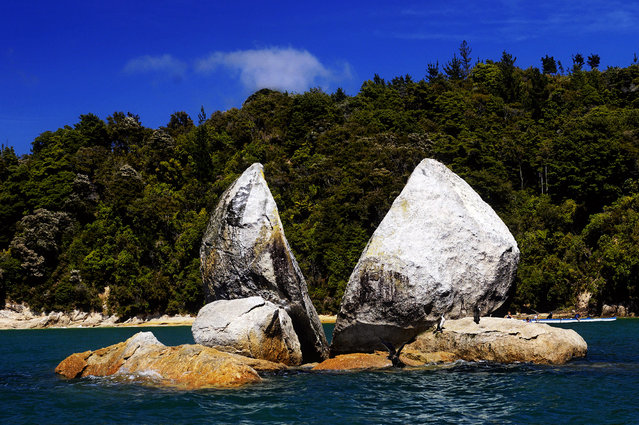
Split Apple Rock

Split Apple Rock is a geological rock formation in The Tasman Bay off the northern coast of the South Island of New Zealand. Made of granite, it is in the shape of an apple which has been cut in half. It is a popular tourist attraction in the waters of the Tasman Sea approximately 50 metres off the coast between Kaiteriteri and Marahau. The rock sits in shallow water at low tide and is accessible by wading. It is also a point of interest for the many tourist boats and pleasure craft which operate along the shores of the Abel Tasman National Park. The cleft to produce two sides of the 'apple' was a natural occurrence. It is unknown when this happened and therefore the cleaving of the rock has attracted mythological explanations.
Details
19 Oct 2013 10:58:00