Loading...
Done
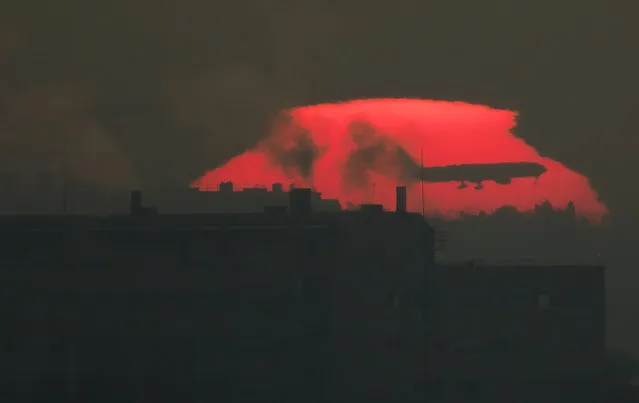
An airplane is silhouetted at sunrise, seen from the suburb of Saint-Cloud, near Paris, France, 08 December 2016. Paris is undergoing a third day pollution spike, prompting the city to limit vehicle circulation. (Photo by Ian Langsdon/EPA)

An airplane is silhouetted at sunrise, seen from the suburb of Saint-Cloud, near Paris, France, 08 December 2016. Paris is undergoing a third day pollution spike, prompting the city to limit vehicle circulation. (Photo by Ian Langsdon/EPA)
Details
09 Dec 2016 11:58:00
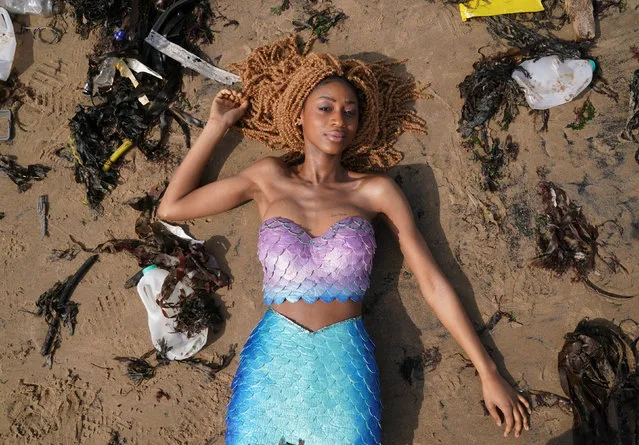
Chisanga Mwila dressed as Ariel from The Little Mermaid on Cullercoats beach, Newcastle on Tuesday, May 9, 2023 ahead of the 2023 live-action remake of the film as part of an awareness campaign from sustainable toilet paper company Oceans highlighting the negative impact of marine pollution on the British coastline. (Photo by Owen Humphreys/PA Wire)

Chisanga Mwila dressed as Ariel from The Little Mermaid on Cullercoats beach, Newcastle on Tuesday, May 9, 2023 ahead of the 2023 live-action remake of the film as part of an awareness campaign from sustainable toilet paper company Oceans highlighting the negative impact of marine pollution on the British coastline. (Photo by Owen Humphreys/PA Wire)
Details
14 Jul 2023 02:29:00
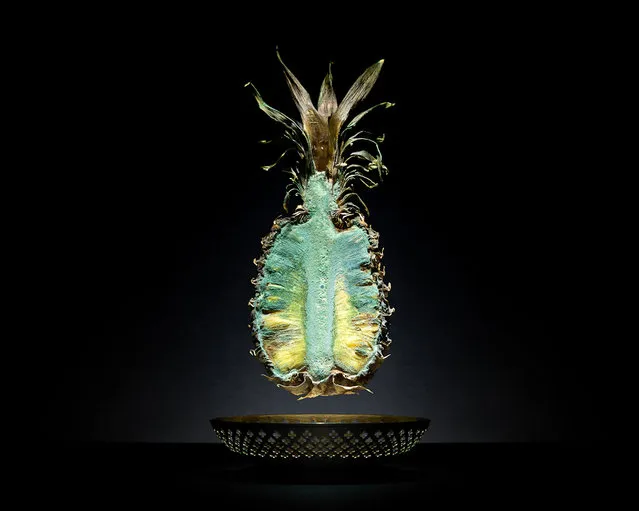
Pineapple

“One Third” – a project on food waste by an Austrian photography Klaus Pichler. According to a UN study one third of the world's food goes to waste – the largest part thereof in the industrialized nations of the global north. Equally, 925 million people around the world are threatened by starvation. The series “One Third” describes the connection between individual wastage of food and globalized food production.

Photo: Pineapple. Place of production: Guayaquil, Ecuador. Cultivation method: Outdoor plantation • Time of harvest: All- season. Transporting distance: 10.666 km (linear distance) • Means of transportation: Aircraft, truck. Carbon footprint (total) per kg: 11,94 kg • Water requirement (total) per kg: 360 l. Price: 2,10 € / kg. (Photo by Klaus Picher)
Details
02 May 2012 11:01:00
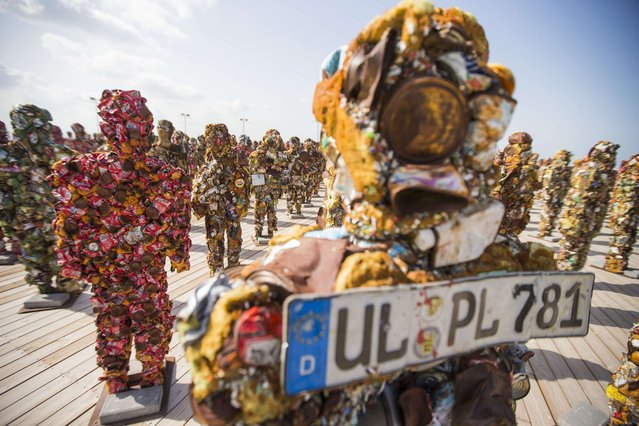
A general view shows sculptures made of waste material titled “Trash People” by German Artist HA Schult (unseen), on April 2, 2014 in Ariel Sharon Park, in the suburbs of Tel Aviv. Hundreds of human-size figures constructed from 20 tons of recycled material, including iron, glass, computer parts, cans and more, will dominate the sky line of Tel-Aviv city and be placed in the park. (Photo by Jack Guez/AFP Photo)

A general view shows sculptures made of waste material titled “Trash People” by German Artist HA Schult (unseen), on April 2, 2014 in Ariel Sharon Park, in the suburbs of Tel Aviv. Hundreds of human-size figures constructed from 20 tons of recycled material, including iron, glass, computer parts, cans and more, will dominate the sky line of Tel-Aviv city and be placed in the park. (Photo by Jack Guez/AFP Photo)
Details
03 Apr 2014 10:53:00
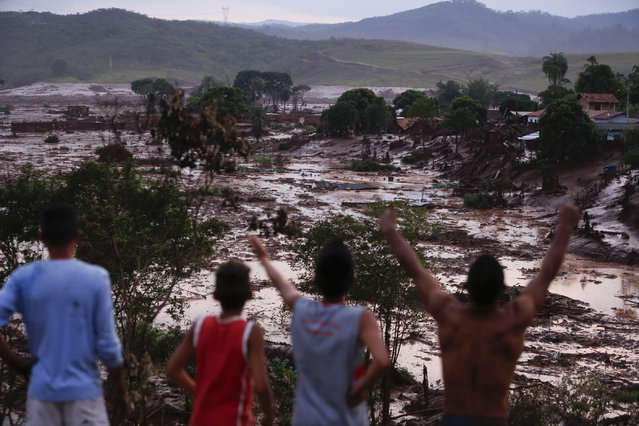
Photo taken on November 5, 2015 shows flood in Bento Rodrigues, a town in the southeastern Brazilian state of Minas Gerais, after a dam at a mining waste site burst early Thursday. An iron ore tailings dam in the southeast Brazilian state of Minas Gerais collapsed Thursday, killing at least 15 people, according to local media reports. (Photo by Agencia Estado/Xinhua Press/Corbis)

Photo taken on November 5, 2015 shows flood in Bento Rodrigues, a town in the southeastern Brazilian state of Minas Gerais, after a dam at a mining waste site burst early Thursday. An iron ore tailings dam in the southeast Brazilian state of Minas Gerais collapsed Thursday, killing at least 15 people, according to local media reports. (Photo by Agencia Estado/Xinhua Press/Corbis)
Details
08 Nov 2015 08:02:00
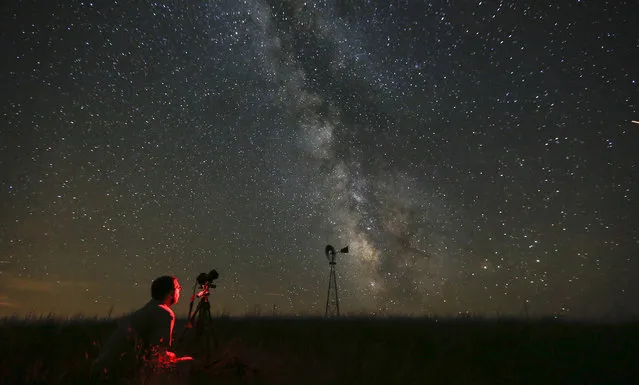
In this Wednesday, July 23, 2014 file photo, Omaha photographer Lane Hickenbottom photographs the night sky in a pasture near Callaway, Neb. With no moon in the sky, the Milky Way was visible to the naked eye. More than one-third of the world’s population can no longer see the Milky Way because of man-made lights, according to a scientific paper by Light Pollution Science and Technology Institute's Fabio Falchi and his team members, published on Friday, June 10, 2016. (Photo by Travis Heying/The Wichita Eagle via AP Photo)

In this Wednesday, July 23, 2014 file photo, Omaha photographer Lane Hickenbottom photographs the night sky in a pasture near Callaway, Neb. With no moon in the sky, the Milky Way was visible to the naked eye. More than one-third of the world’s population can no longer see the Milky Way because of man-made lights, according to a scientific paper by Light Pollution Science and Technology Institute's Fabio Falchi and his team members, published on Friday, June 10, 2016. (Photo by Travis Heying/The Wichita Eagle via AP Photo)
Details
11 Jun 2016 12:37:00
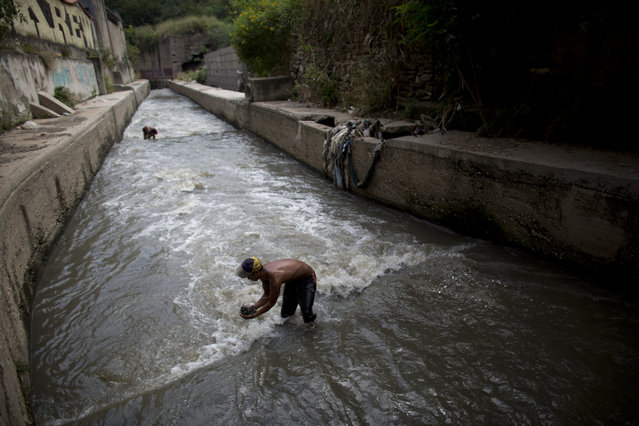
In this November 30, 2017 photo, Douglas scoops up mud from the bottom of the polluted Guaire River, in search of gold and anything valuable he can sell, in Caracas, Venezuela. Some stretches of the river smell of sewer while others emit a toxic odor of fuel, a stench that stays in ones nose for hours after leaving the water. (Photo by Ariana Cubillos/AP Photo)

In this November 30, 2017 photo, Douglas scoops up mud from the bottom of the polluted Guaire River, in search of gold and anything valuable he can sell, in Caracas, Venezuela. Some stretches of the river smell of sewer while others emit a toxic odor of fuel, a stench that stays in ones nose for hours after leaving the water. (Photo by Ariana Cubillos/AP Photo)
Details
11 Jan 2018 07:35:00
This Thursday, January 22, 2015 photo made with a long exposure shows the glow from a Noctiluca scintillans algal bloom along the seashore in Hong Kong. The luminescence, also called Sea Sparkle, is triggered by farm pollution that can be devastating to marine life and local fisheries, according to University of Georgia oceanographer Samantha Joye. (Photo by Kin Cheung/AP Photo)

This Thursday, January 22, 2015 photo made with a long exposure shows the glow from a Noctiluca scintillans algal bloom along the seashore in Hong Kong. The luminescence, also called Sea Sparkle, is triggered by farm pollution that can be devastating to marine life and local fisheries, according to University of Georgia oceanographer Samantha Joye. Noctiluca itself does not produce neurotoxins like other similar organisms do. But its role as both prey and predator tends can eventually magnify the accumulation of toxins in the food chain, according to R. Eugene Turner at Louisiana State University. (Photo by Kin Cheung/AP Photo)
Details
23 Jan 2015 13:12:00