Loading...
Done
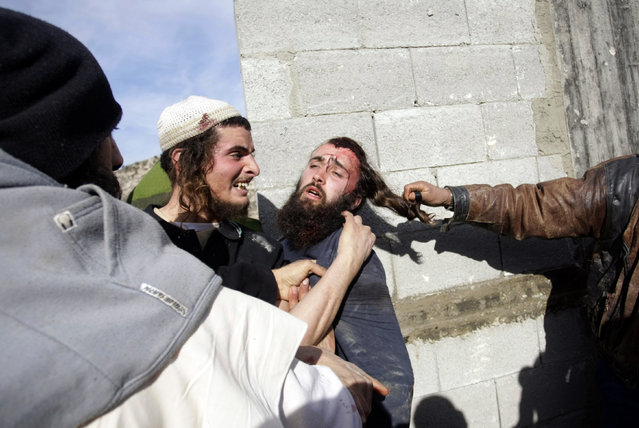
Palestinians hit injured Israeli settlers, center, detained by Palestinian villagers in a building under construction near the West Bank village of Qusra, southeast of the city of Nablus, Tuesday, January 7, 2014. (Photo by Nasser Ishtayeh/AP Photo)

Palestinians hit injured Israeli settlers, center, detained by Palestinian villagers in a building under construction near the West Bank village of Qusra, southeast of the city of Nablus, Tuesday, January 7, 2014. Palestinians held more than a dozen Israeli settlers for about two hours Tuesday in retaliation for the latest in a string of settler attacks on villages in the area, witnesses said. The military said the chain of events apparently began after Israeli authorities removed an illegally built structure in Esh Kodesh, a rogue Israeli settlement in the area. In recent years, militant settlers have often responded to any attempts by the Israeli military to remove parts of dozens of rogue settlements, or outposts, by attacking Palestinians and their property. The tactic, begun in 2008, is known as “price tag”. (Photo by Nasser Ishtayeh/AP Photo)
Details
10 Jan 2014 11:32:00
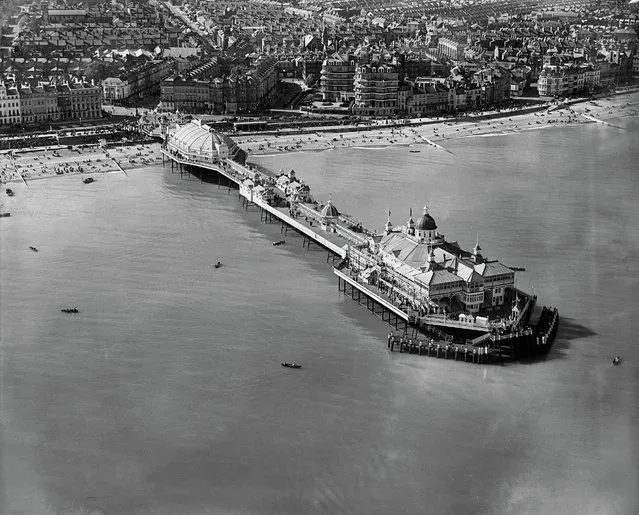
While the lido was described as bringing “modernism to the masses” on the British coast it was just the latest example of a trend that had been developing since Victorian times – transforming seaside towns into resorts for leisure and entertainment. In the latter half of the nineteenth century, the fashion was for local authorities to build great piers stretching from the promenade out into the sea

While the lido was described as bringing “modernism to the masses” on the British coast it was just the latest example of a trend that had been developing since Victorian times – transforming seaside towns into resorts for leisure and entertainment. In the latter half of the nineteenth century, the fashion was for local authorities to build great piers stretching from the promenade out into the sea. The Eastbourne Pier, pictured here in May 1931, was erected between 1866 and 1870 to an ingenious design by Eugenius Birch, which saw the structure sitting on special cups allowing the supporting struts to “move” in bad weather. Arranged on the pier's 1,000-foot length were kiosks, a theatre, a ballroom and a camera obscura. 1931. (Photo by Aerofilms Collection via “A History of Britain From Above”)
Details
25 Feb 2014 12:59:00
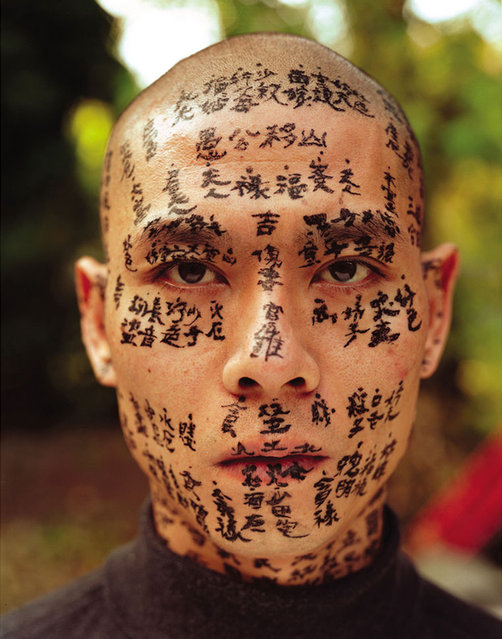
Family Tree By Zhang Huan

All the people we meet, all the things we know, and all of our experiences shape our souls, forever marking our faces. This was probably the main idea of the performance piece created by Chinese artist Zhang Huan, in which his face was painted over by three calligraphers with the names of people he knew, personal stories, and random thoughts. Truly, it amazing just how much we can find out about a person just by looking at their face. Surely, not everyone has the ability to see into the soul of the person just by looking at their face, but those that do can easily see the person’s personality, their intelligence, and sometimes even get glimpse into their past. Though it sounds like magic to people who don’t have this ability, it is completely true. Somehow, our mind can pick up on the miniscule changes of the facial structure and figure out the dominant facial expressions of that person. (Photo by Zhang Huan)
Details
23 Nov 2014 12:47:00
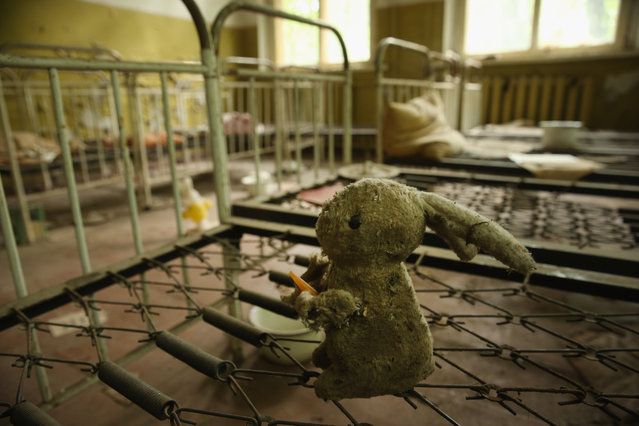
A stuffed rabbit doll sits among children's beds standing in the abandoned kindergarten of Kopachi village located inside the Chernobyl Exclusion Zone on September 29, 2015 near Chornobyl, Ukraine. Kopachi, a village that before 1986 had a population of 1,114, lies only a few kilometers south of the former Chernobyl nuclear power plant, where in 1986 workers inadvertantly caused reactor number four to explode, creating the worst nuclear accident in history. Radiation fallout was so high that authorities bulldozed and buried all of Kopachi's structures except for the kindergarten. (Photo by Sean Gallup/Getty Images)

A stuffed rabbit doll sits among children's beds standing in the abandoned kindergarten of Kopachi village located inside the Chernobyl Exclusion Zone on September 29, 2015 near Chornobyl, Ukraine. Kopachi, a village that before 1986 had a population of 1,114, lies only a few kilometers south of the former Chernobyl nuclear power plant, where in 1986 workers inadvertantly caused reactor number four to explode, creating the worst nuclear accident in history. (Photo by Sean Gallup/Getty Images)
Details
27 Apr 2016 09:28:00
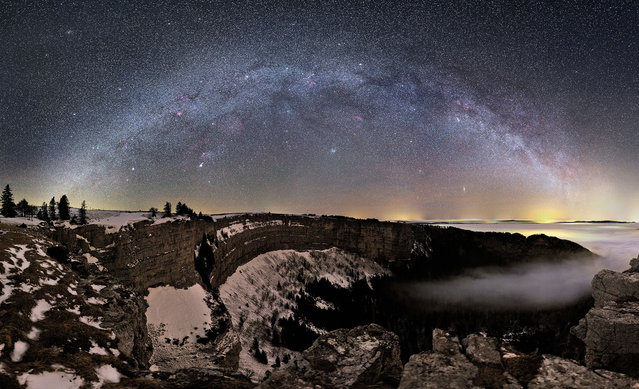
Milky Way over Switzerland

Milky Way over Switzerland

The Milky Way is the galaxy in which Earth is contained. This name derives from its appearance as a dim “milky” glowing band arching across the night sky, in which the naked eye cannot distinguish individual stars. The term “Milky Way” is a translation of the Classical Latin via lactea, from the Hellenistic Greek γαλαξίας κύκλος (pr. galaxías kýklos, “milky circle”). The Milky Way appears like a band because it is a disk-shaped structure being viewed from inside. The fact that this faint band of light is made up of stars was proven in 1610 when Galileo Galilei used his telescope to resolve it into individual stars. In the 1920s, observations by astronomer Edwin Hubble showed that the Milky Way is just one of many galaxies.


Details
20 Jun 2012 10:11:00
Wang Jia Yun (王嘉韻 or 왕지아인). (Photo by Wang Jia Yun)

Wang Jiayun, born June 18 1993. Wang’s height is 164cm, her weight 42kg. Wang Jiayun says she was born in Kowloon of Hong Kong Special Administrative Region, and presently lives in Shenzhen City of Guangdong province in China. Identity: High school student. Wang's large eyes, pale face, perfectly structured nose and extremely slim figure resemble a brand of human-sized blow-up doll popular with Korean men. This cute and s*xy barbie doll look a like is hot property. She recently became the No.1 searched name in the country's top search engine, Naver.com. Photo: Wang Jia Yun (王嘉韻 or 왕지아인). (Photo by Wang Jia Yun)
Details
06 Sep 2013 09:28:00
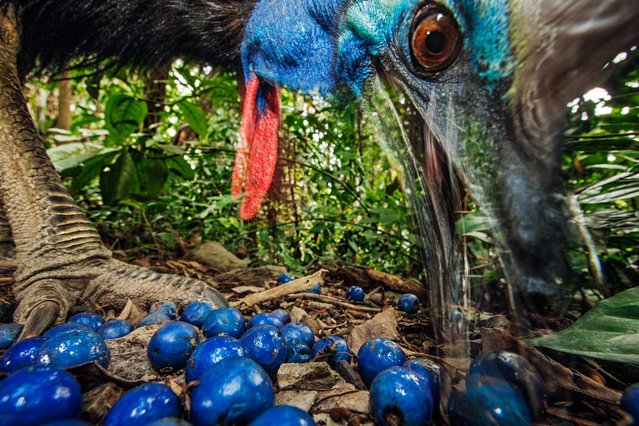
“Cassowaries are large, flightless birds related to emus and (more distantly) to ostriches, rheas, and kiwis”, writes Olivia Judson in the September issue of National Geographic magazine. (Photo by Christian Ziegler/National Geographic)

“Cassowaries are large, flightless birds related to emus and (more distantly) to ostriches, rheas, and kiwis”, writes Olivia Judson in the September issue of National Geographic magazine. How large? People-size: Adult males stand well over five foot five and top 110 pounds. Females are even taller, and can weigh more than 160 pounds. Dangerous when roused, they’re shy and peaceable when left alone. But even birds this big and tough are prey to habitat loss. The dense New Guinea and Australia rain forests where they live have dwindled. Today cassowaries might number 1,500 to 2,000. And because they help shape those same forests – by moving seeds from one place to another – “if they vanish”, Judson writes, “the structure of the forest would gradually change” too. (Photo by Christian Ziegler/National Geographic)
Details
06 Jan 2014 12:21:00
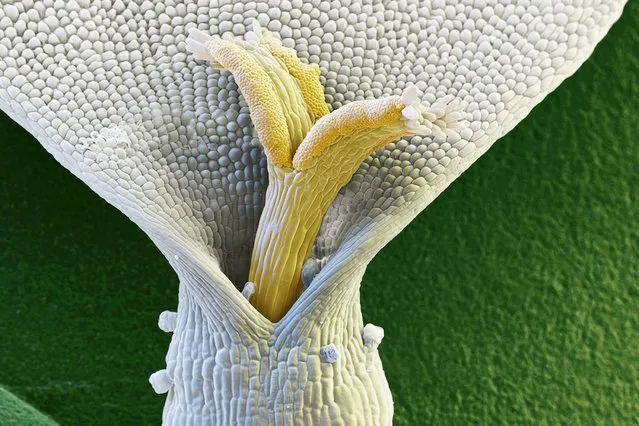
The floret of a Chamomile flower up close and personal. (Photo by Oliver Meckes/Barcroft Media)

These images have been created using a colour scanning electron microscope (SEM) by the award-winning Eye of Science, comprised of snapper Oliver Meckes and biologist Nicole Ottawa. For a decade the pair, based in Reutlingen in the south of Germany, worked with an old SEM they saved from the scrapheap, but for the last five years they have used a £250,000 FEI Quanta Series Field Emission SEM. Oliver said: “Flowers are beautiful in 'normal' view, but when you look closer, some parts get very bizarre and unexpected structures appear – flowers within flowers, worlds within worlds”. Photo: The floret of a Chamomile flower up close and personal. (Photo by Oliver Meckes/Barcroft Media)
Details
26 May 2014 13:51:00