Loading...
Done
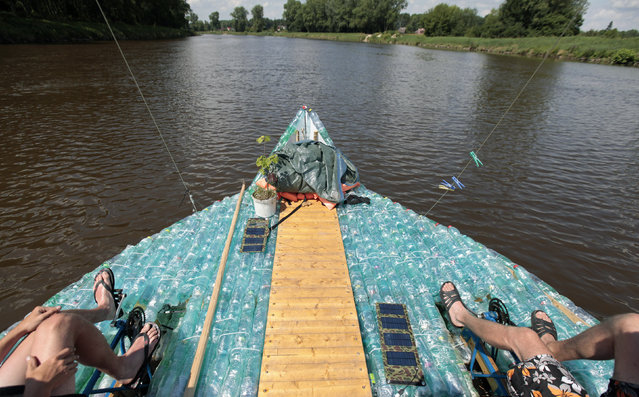
Jan Kara (R) and Jan Holan pedal their boat, made with plastic bottles, on the Elbe river near Kostelec nad Labem July 15, 2014. (Photo by David W. Cerny/Reuters)

Jan Kara (R) and Jan Holan pedal their boat, made with plastic bottles, on the Elbe river near Kostelec nad Labem July 15, 2014. Jan Kara, a 22-year-old student, and Jakub Bures, a 22-year-old car mechanic, built the 10-metre (32.8-feet) long boat from 5000 plastic bottles strapped to a wooden frame. (Photo by David W. Cerny/Reuters)
Details
22 Sep 2014 11:43:00
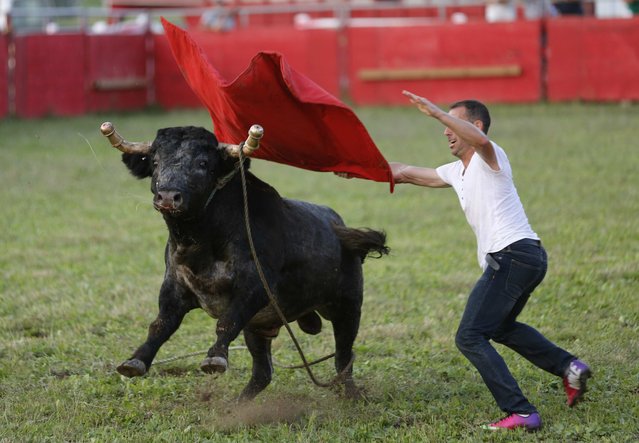
Matador Marco Espinola, who emigrated from the Azores two years ago, challenges a bull during an Azorean “tourada a corda” (bullfight by rope) in Brampton, Ontario August 15, 2015. (Photo by Chris Helgren/Reuters)

Matador Marco Espinola, who emigrated from the Azores two years ago, challenges a bull during an Azorean “tourada a corda” (bullfight by rope) in Brampton, Ontario August 15, 2015. Bulls in a tourada a corda are held by a rope controlled by a team of men to make sure the animal does not cause injury. Bulls are never killed, in contrast with bullfighting in Spain. The Portuguese population in Canada, numbering 429,000 in the 2011 census, mainly centers around Toronto with immigrants from the nine islands of the mid-Atlantic Azores archipelago. (Photo by Chris Helgren/Reuters)
Details
18 Aug 2015 13:39:00
Chicago: 35 photographs, 15 minutes. (Photo by Daniel Marker-Moors/Caters News)

A photographer is using a unique method to show the shift from day to night across famous cities in spectacular images. Daniel Marker-Moors' take on time-lapse photography – which he calls time slice – sees the photographer snap image after image, before combining them to create beautiful, vibrant works. His images usually focus on a point in the day with the most dramatic change in light, such as sunrise or sunset. Marker-Moors, from Los Angeles, begins by shooting hundreds and sometimes thousands of images from the same spot. Here: Chicago – 35 photographs, 15 minutes. (Photo by Daniel Marker-Moors/Caters News)
Details
21 Dec 2015 08:04:00
A couple wearing masks as a precaution against the spread of the new coronavirus walk on the Malecon seawall at sunset in Havana, Cuba, Monday, August 31, 2020. Cuban authorities will introduce new measures starting tomorrow Tuesday aimed at containing the spread of the coronavirus in Havana among others a curfew from 7 pm until 5 am and no one without special permission will be able to enter or leave the province. The new measures will last at least 15 days. (Photo by Ramon Espinosa/AP Photo)

A couple wearing masks as a precaution against the spread of the new coronavirus walk on the Malecon seawall at sunset in Havana, Cuba, Monday, August 31, 2020. Cuban authorities will introduce new measures starting tomorrow Tuesday aimed at containing the spread of the coronavirus in Havana among others a curfew from 7 pm until 5 am and no one without special permission will be able to enter or leave the province. The new measures will last at least 15 days. (Photo by Ramon Espinosa/AP Photo)
Details
22 Oct 2020 00:05:00
Men wear masks as they sit in the metro in Prague, Czech Republic, 17 March 2020. According to media reports, the Czech government decided to impose a two-week quarantine in the country on the evening of 15 March, and ban all international travel from 16 March 2020. Currently 383 cases of the coronavirus SARS-CoV-2, which causes the Covid-19 disease, have been officially confirmed in Czech Republic. (Photo by Martin Divisek/EPA/EFE)

Men wear masks as they sit in the metro in Prague, Czech Republic, 17 March 2020. According to media reports, the Czech government decided to impose a two-week quarantine in the country on the evening of 15 March, and ban all international travel from 16 March 2020. Currently 383 cases of the coronavirus SARS-CoV-2, which causes the Covid-19 disease, have been officially confirmed in Czech Republic. (Photo by Martin Divisek/EPA/EFE)
Details
19 Mar 2020 00:07:00
Adriana Barahona, known as " Madame Barocle," wearing clothing of the Victorian era, walks along a central avenue in San Jose, Costa Rica June 4, 2015. Barahona says she has been passionate about clothing from the era of Britain's Queen Victoria (1837-1901), and has been making and wearing them since the age of 15. REUTERS/Juan Carlos Ulate

Adriana Barahona, known as "Madame Barocle", wearing clothing of the Victorian era, walks along a central avenue in San Jose, Costa Rica June 4, 2015. Barahona says she has been passionate about clothing from the era of Britain's Queen Victoria (1837-1901), and has been making and wearing them since the age of 15. REUTERS/Juan Carlos Ulate
Details
17 Jun 2015 13:25:00


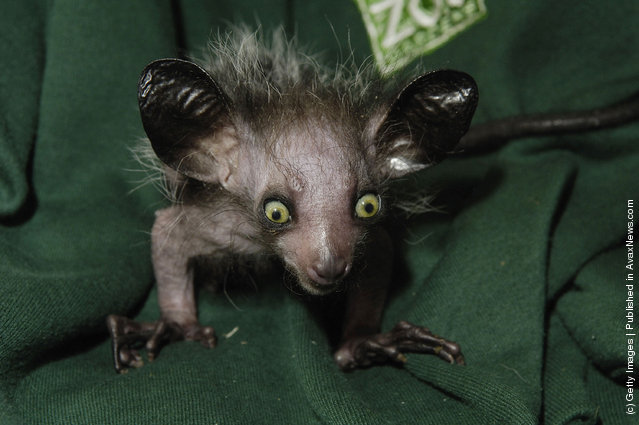
“The aye-aye (Daubentonia madagascariensis) is a lemur, a strepsirrhine primate native to Madagascar that combines rodent-like teeth and a special thin middle finger to fill the same ecological niche as a woodpecker. It is the world's largest nocturnal primate, and is characterized by its unusual method of finding food; it taps on trees to find grubs, then gnaws holes in the wood and inserts its narrow middle finger to pull the grubs out. The only other animal species known to find food in this way is the striped possum. From an ecological point of view the aye-aye fills the niche of a woodpecker as it is capable of penetrating wood to extract the invertebrates within”. – Wikipedia

Photo: In this handout image from Bristol Zoo is seen the first captive bred aye-aye in the UK named “Kintana” (meaning star in Malagasy) April 15, 2005 at Bristol Zoo Gardens, England. The zoo announced today only the second baby aye-aye to be hand-reared in the world (the first was in Jersey Zoo) and has now made his first public appearance since his birth on 11 February 2005. (Photo by Rob Cousins/Bristol Zoo via Getty Images)
Details
13 Apr 2011 13:33:00
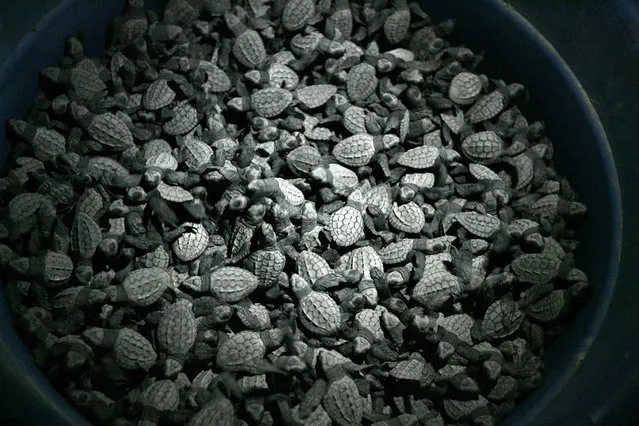
Olive Ridley turtle hatchlings (Lepidochelys olivacea) sit in baskets and trays at the turtle camp La Gloria, before their release into the ocean in Tomatlan November 15, 2013. (Photo by Alejandro Acosta/Reuters)

Olive Ridley turtle hatchlings (Lepidochelys olivacea) sit in baskets and trays at the turtle camp La Gloria, before their release into the ocean in Tomatlan November 15, 2013. Twenty years ago, Mexico's government implemented ecological plans to protect the sea turtles from being hunted for their leather and meat and established conservation areas and a pay system for local residents to protect turtle nests. Millions of baby turtles hatch on the shores in November and December, according to an environmental group. It is estimated that in 2012, there were 20 million newborns. Hatching season is still underway, but officials say they expect there will be even more turtles born this year. (Photo by Alejandro Acosta/Reuters)
Details
25 Nov 2013 08:54:00