Loading...
Done
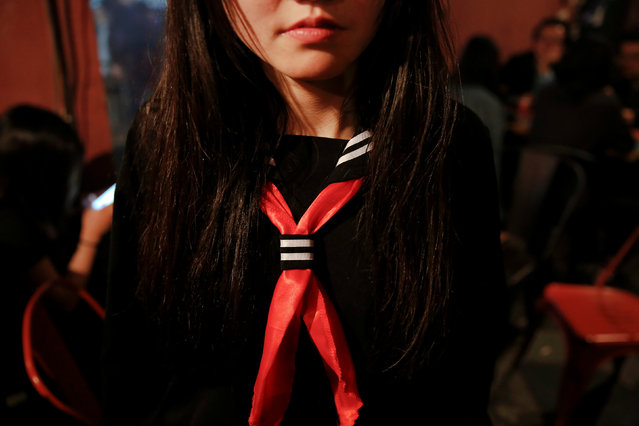
Yuanlei Liao, the singer of hardcore band called Thank Ray wears a read scarf after performing on the stage of Mao Live House during the club's last public concert night in central Beijing, China April 23, 2016. Mao Live House, a prominent live rock music venue in Beijing, shut its doors on the weekend, the latest closure to hit China's rock music scene. Owner Li Chi said the club, popular among fans of punk, metal and alternative rock since it opened nine years ago, was forced to close due to tighter rules on live performances. (Photo by Damir Sagolj/Reuters)

Yuanlei Liao, the singer of hardcore band called Thank Ray wears a read scarf after performing on the stage of Mao Live House during the club's last public concert night in central Beijing, China April 23, 2016. Mao Live House, a prominent live rock music venue in Beijing, shut its doors on the weekend, the latest closure to hit China's rock music scene. Owner Li Chi said the club, popular among fans of punk, metal and alternative rock since it opened nine years ago, was forced to close due to tighter rules on live performances. (Photo by Damir Sagolj/Reuters)
Details
04 May 2016 12:13:00
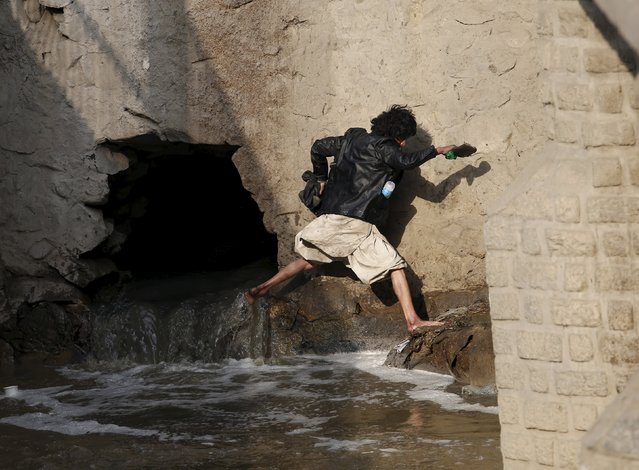
A man runs away during a police round up of suspected drug addicts in Kabul, Afghanistan December 27, 2015. Afghan officials have opened a new drug treatment centre in an abandoned NATO military base in Kabul, in the latest attempt to stamp out the country's massive problem of drug abuse. Camp Phoenix, a former training camp on the edges of Kabul set up by the U.S. army in 2003, will take in around 1,000 homeless drug addicts who will receive food, medical attention and treatment, said Public Health Minister Ferozuddin Feroz. (Photo by Ahmad Masood/Reuters)

A man runs away during a police round up of suspected drug addicts in Kabul, Afghanistan December 27, 2015. Afghan officials have opened a new drug treatment centre in an abandoned NATO military base in Kabul, in the latest attempt to stamp out the country's massive problem of drug abuse. Camp Phoenix, a former training camp on the edges of Kabul set up by the U.S. army in 2003, will take in around 1,000 homeless drug addicts who will receive food, medical attention and treatment, said Public Health Minister Ferozuddin Feroz. (Photo by Ahmad Masood/Reuters)
Details
11 Jan 2016 08:00:00
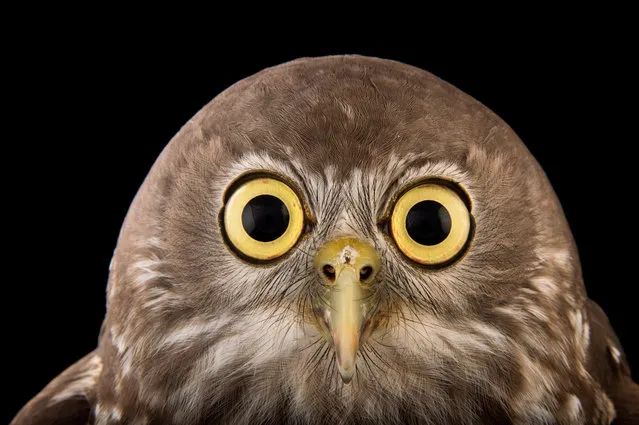
The National Geographic Photo Ark is a travelling exhibition of photographer Joel Sartore’s quest to create a photo archive of biodiversity around the world. So far, Sartore has captured studio portraits of more than 6,000 species – a number that he hopes to double. On 1 July, the ark will open at Melbourne zoo – the first time it has been exhibited in the southern hemisphere. More than 50 portraits will be on display, including many of Australian endangered animals being protected by programs at the zoo itself. These captions have been edited from text supplied by Melbourne zoo. Here: Barking owl. So-named because its call sounds like a barking dog, these birds are native to Australia, Indonesia and Papua New Guinea. In Victoria they are listed as an endangered species, and in 2003 there were estimated to be fewer than 50 breeding pairs. The main threat to the species in Victoria is loss of habitat, especially large trees with hollows in which they can nest and on which many of their prey depend. Apart from a bark, they may utter a chilling scream when they feel threatened. (Photo by Joel Sartore/National Geographic Photo Ark/The Guardian)

The National Geographic Photo Ark is a travelling exhibition of photographer Joel Sartore’s quest to create a photo archive of biodiversity around the world. So far, Sartore has captured studio portraits of more than 6,000 species – a number that he hopes to double. On 1 July, the ark will open at Melbourne zoo – the first time it has been exhibited in the southern hemisphere. More than 50 portraits will be on display, including many of Australian endangered animals being protected by programs at the zoo itself. These captions have been edited from text supplied by Melbourne zoo. Here: Barking owl. (Photo by Joel Sartore/National Geographic Photo Ark/The Guardian)
Details
01 Jul 2017 07:45:00
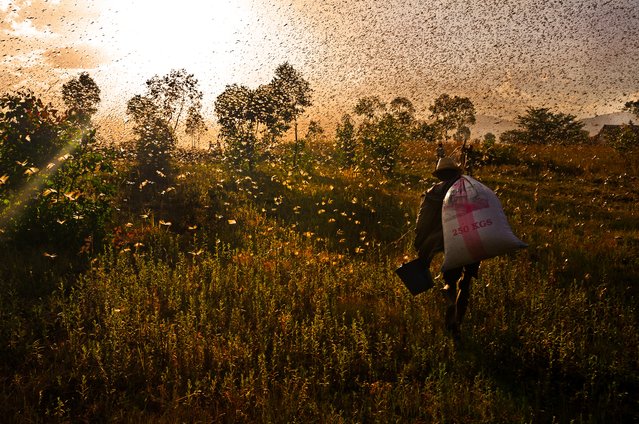
“Locusts & Men”. Oppression, interaction, collaboration. In the life cycle of nature nothing is lost, but the coexistence of different species is sometimes difficult. In Madagascar periodically returns the archaic antagonism between man and the migratory locust, in a circle of life where the two species are looking for space and food for their survival. Photo location: Madagascar, 2013. (Photo and caption by Michele Martinelli/National Geographic Photo Contest)

“Locusts & Men”. Oppression, interaction, collaboration. In the life cycle of nature nothing is lost, but the coexistence of different species is sometimes difficult. In Madagascar periodically returns the archaic antagonism between man and the migratory locust, in a circle of life where the two species are looking for space and food for their survival. At the end of the day a man walks home carrying on his shoulders the heavy bag which contains the locusts captured during the day. The insects provide nutritious meals for the man and his family. Photo location: Madagascar, 2013. (Photo and caption by Michele Martinelli/National Geographic Photo Contest)

ATTENTION! All pictures are presented in high resolution. To see Hi-Res images – just TWICE click on any picture. In other words, click small picture – opens the BIG picture. Click BIG picture – opens VERY BIG picture.
Details
03 Dec 2013 10:59:00
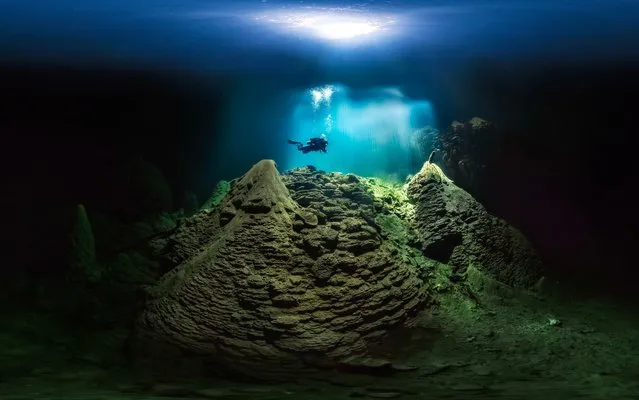
Cave Diver, Anhumas Abyss, Bonito, Brazil: The Anhumas Abyss is an underground cavern with a crystal-clear lake below, more than 260 feet (79 m) deep. A visitor must enter through a narrow opening at the top of the chamber and rappel into the cave. Snorkeling and scuba diving in the lake reveal amazing scenery. Distinctive, conical limestone stalagmites and stalactites occupy the lake and the surrounding area, some reaching 65 feet (20 m) high. “One must rappel about 235 feet (72 m) to get down into this deep lake. The photo was taken at a depth of 50 feet (15 m). It was a challenge to create the image because of the high contrast, plus the diver could not see into the darkness, making communication impossible”. (Photo by Marcio Cabral/Nature’s Best Photography Awards 2017)

Cave Diver, Anhumas Abyss, Bonito, Brazil: The Anhumas Abyss is an underground cavern with a crystal-clear lake below, more than 260 feet (79 m) deep. A visitor must enter through a narrow opening at the top of the chamber and rappel into the cave. Snorkeling and scuba diving in the lake reveal amazing scenery. Distinctive, conical limestone stalagmites and stalactites occupy the lake and the surrounding area, some reaching 65 feet (20 m) high. (Photo by Marcio Cabral/Nature’s Best Photography Awards 2017)
Details
26 Oct 2017 08:10:00
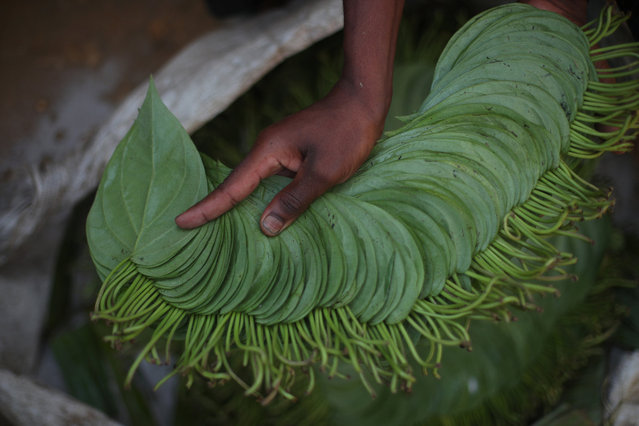
Faruk, 17, a Rohingya refugee trader holds betel leaves which are on sale at a stall in Palong Khali refugee camp near Cox's Bazar, Bangladesh, November 3, 2017. He left his village in Myanmar when the military opened fire towards the Rohingya. “I buy this betel leaf from Palong Khali market, in one bundle there are 160 pieces, I buy it for 80 taka and I sell it for 100 taka. Bangladeshi's and I sell for the same rate in the camp. Outside in the local market it is 80 taka per bundle. My problem is that I don't have money so I can't buy anything to eat, I can't buy fish to eat”, he said. (Photo by Hannah McKay/Reuters)

Faruk, 17, a Rohingya refugee trader holds betel leaves which are on sale at a stall in Palong Khali refugee camp near Cox's Bazar, Bangladesh, November 3, 2017. He left his village in Myanmar when the military opened fire towards the Rohingya. “I buy this betel leaf from Palong Khali market, in one bundle there are 160 pieces, I buy it for 80 taka and I sell it for 100 taka (1 Bangladeshi Taka = 0.012 US Dollar). Bangladeshi's and I sell for the same rate in the camp. Outside in the local market it is 80 taka per bundle. My problem is that I don't have money so I can't buy anything to eat, I can't buy fish to eat”, he said. (Photo by Hannah McKay/Reuters)
Details
27 Nov 2017 08:54:00
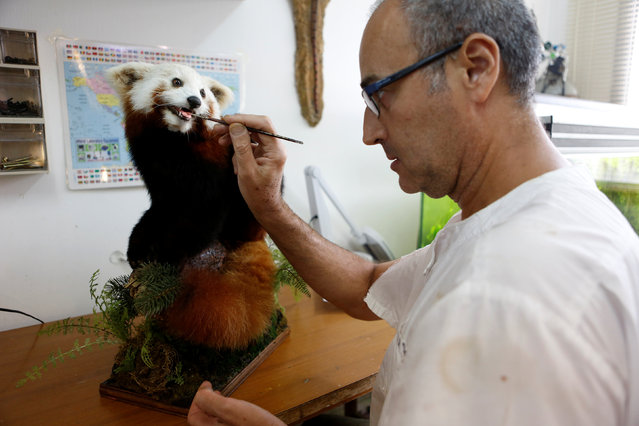
Igor Gavrilov, the main taxidermist of the Zoological centre at Tel Aviv University, works on a taxidermied animal, part of a collection which will be housed at the Steinhardt Museum of Natural History, a new Israeli natural history museum set to open next year in Tel Aviv, Israel June 8, 2016. Legions of insects, sea creatures and ancient fossils are lining up in a new museum shaped liked a giant Noah's Ark, telling the story of a crucial evolutionary byway across Israel. Experts say all humans and other animals had to pass through Israel on their first journey out of Africa into Europe and Asia. (Photo by Nir Elias/Reuters)

Igor Gavrilov, the main taxidermist of the Zoological centre at Tel Aviv University, works on a taxidermied animal, part of a collection which will be housed at the Steinhardt Museum of Natural History, a new Israeli natural history museum set to open next year in Tel Aviv, Israel June 8, 2016. Legions of insects, sea creatures and ancient fossils are lining up in a new museum shaped liked a giant Noah's Ark, telling the story of a crucial evolutionary byway across Israel. (Photo by Nir Elias/Reuters)
Details
25 Aug 2016 09:42:00
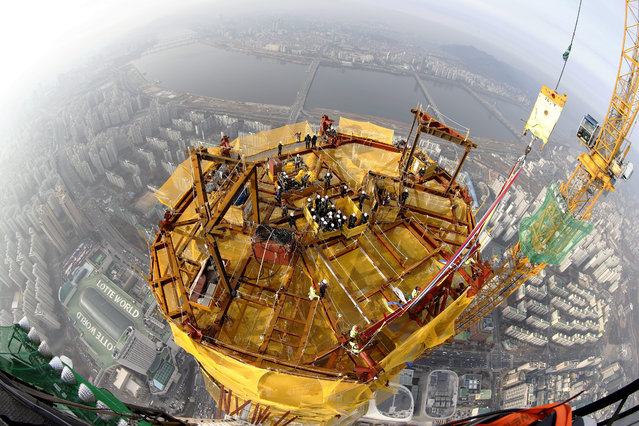
South Korean workers are seen from a crane as they work on the 123rd floor during the framing completion ceremony of the 'Lotte World Tower' in Seoul, South Kora, 22 December 2015. The building's exterior was completed in a final height of 550 meters, and 123 floors. The ceremony came five years and two months after the construction of the building began and its opening will likely take place at the end of next year when the interior work is set to be completed, the South Korean Yonhap news agency reported. (Photo by Jeon Heon-Kyun/EPA)

South Korean workers are seen from a crane as they work on the 123rd floor during the framing completion ceremony of the 'Lotte World Tower' in Seoul, South Kora, 22 December 2015. The building's exterior was completed in a final height of 550 meters, and 123 floors. The ceremony came five years and two months after the construction of the building began and its opening will likely take place at the end of next year when the interior work is set to be completed, the South Korean Yonhap news agency reported. The building is the highest in South Korea and the fifth highest in the world, according to Yonhap. (Photo by Jeon Heon-Kyun/EPA)
Details
23 Dec 2015 13:19:00