Loading...
Done
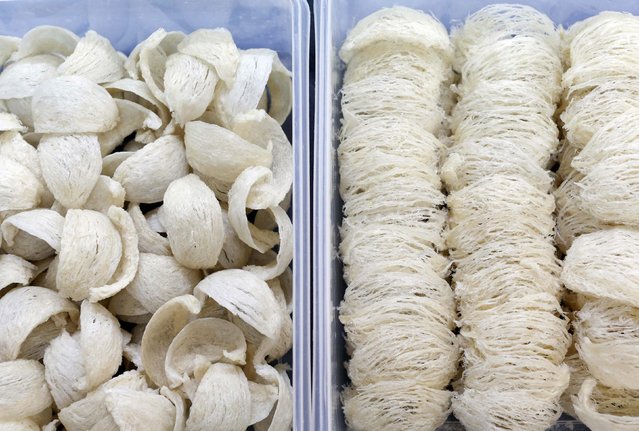
Two styles of cleaned bird's nest, Yan Zhan (L) and Su Zhan (R) await repacking at a processing plant in Kuala Lumpur, February 17, 2015. Prized in China for is alleged health benefits for hundreds of years, nests made from swiftlets' saliva are being mixed into coffee and cereal as the Southeast Asian producers of the delicacy seek to broaden its appeal, and their profit margins. (Photo by Olivia Harris/Reuters)

Two styles of cleaned bird's nest, Yan Zhan (L) and Su Zhan (R) await repacking at a processing plant in Kuala Lumpur, February 17, 2015. Prized in China for is alleged health benefits for hundreds of years, nests made from swiftlets' saliva are being mixed into coffee and cereal as the Southeast Asian producers of the delicacy seek to broaden its appeal, and their profit margins. The nests are among the world's most expensive foods, selling for up to $2,500 a kg and the swiftlets that weave them are indigenous to Indonesia, Malaysia, Thailand and Vietnam. (Photo by Olivia Harris/Reuters)
Details
24 Feb 2015 13:57:00
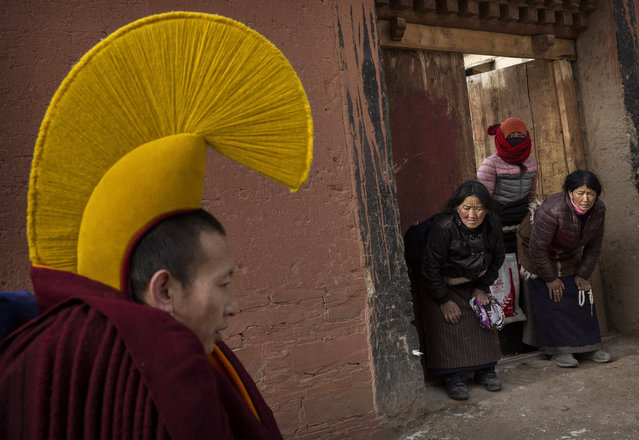
Devotees bow to a passingTibetan Buddhist monk on his way to take part in a special prayer during Monlam or the Great Prayer rituals on March 5, 2015 at the Labrang Monastery, Xiahe County, Amdo, Tibetan Autonomous Prefecture, Gansu Province, China. (Photo by Kevin Frayer/Getty Images)

Devotees bow to a passingTibetan Buddhist monk on his way to take part in a special prayer during Monlam or the Great Prayer rituals on March 5, 2015 at the Labrang Monastery, Xiahe County, Amdo, Tibetan Autonomous Prefecture, Gansu Province, China. Labrang Monastery is one of the six great monasteries of the Gelug school of Tibetan Buddhism and one of the largest outside of the Tibetan Autonomous Region. Monlam, the most important prayer event for many Tibetans was banned during the Cultural Revolution in China but once again in recent years it is celebrated in many areas. (Photo by Kevin Frayer/Getty Images)
Details
14 Mar 2015 14:37:00
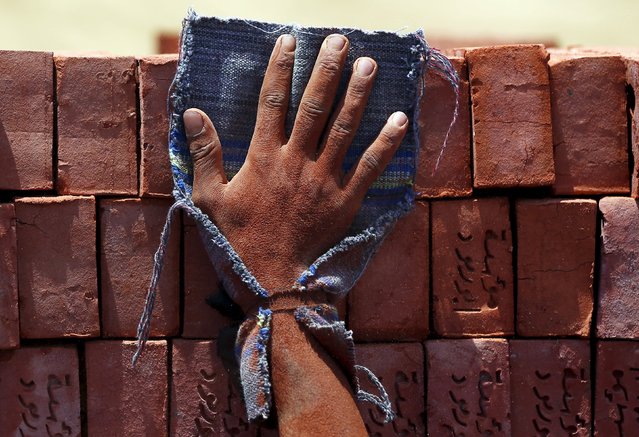
A hand of a labourer pushes bricks at a traditional brick factory in Arab Mesad district of Helwan, northeast of Cairo, May 14, 2015. (Photo by Amr Abdallah Dalsh/Reuters)

A hand of a labourer pushes bricks at a traditional brick factory in Arab Mesad district of Helwan, northeast of Cairo, May 14, 2015. About 45 labourers are employed at the brick factory and most work 10 hours a day. Adult workers earn a daily wage of 70 Egyptian pounds ($9) and child workers earn 40 Egyptian pounds ($5). The labourers, who are usually temporary or seasonally employed in Egypt's brick-making industry, experience unsafe work conditions, according to local media. (Photo by Amr Abdallah Dalsh/Reuters)
Details
19 May 2015 11:37:00
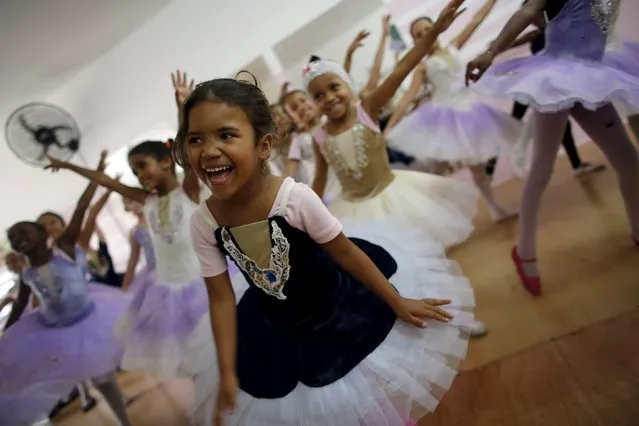
Young girls take ballet lessons at the New Dreams dance studio in the Luz neighborhood known to locals as Cracolandia (Crackland) in Sao Paulo, Brazil, August 14, 2015. (Photo by Nacho Doce/Reuters)

Young girls take ballet lessons at the New Dreams dance studio in the Luz neighborhood known to locals as Cracolandia (Crackland) in Sao Paulo, Brazil, August 14, 2015. For the young girls learning to jump and plie, the dance studio provides a way forward and out of the difficult environment they have grown up in. Brazil is one of the world's highest consuming countries of crack cocaine, and Cracolandia, or “Crack Land”, located in the outskirts of Sao Paulo, is one of the most intense and brutal hubs. (Photo by Nacho Doce/Reuters)
Details
18 Aug 2015 13:59:00
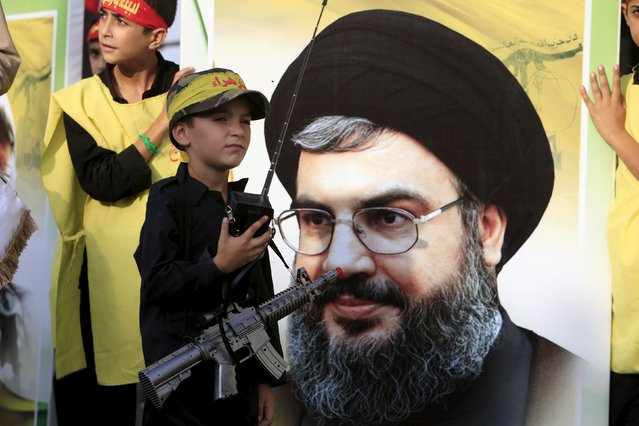
A Muslim Shi'ite boy carries a toy gun while standing next to a picture of Hezbollah leader Sayyed Hassan Nasrallah as he takes part in a march organised by Hezbollah during a re-enactment of the battle of Kerbala during a mourning process, ahead of the day of Ashura, in Saksakieh village, southern Lebanon, October 18, 2015. (Photo by Ali Hashisho/Reuters)

A Muslim Shi'ite boy carries a toy gun while standing next to a picture of Hezbollah leader Sayyed Hassan Nasrallah as he takes part in a march organised by Hezbollah during a re-enactment of the battle of Kerbala during a mourning process, ahead of the day of Ashura, in Saksakieh village, southern Lebanon, October 18, 2015. Ashoura, the most important day in the Shi'ite calendar, commemorates the death of Imam Hussein, grandson of the Prophet Mohammad, in the 7th century battle of Kerbala. (Photo by Ali Hashisho/Reuters)
Details
21 Oct 2015 08:00:00
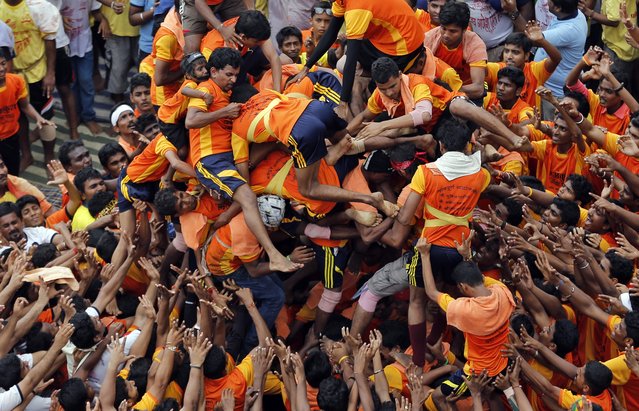
People fall down as they try to form a human pyramid to break the “Dahi handi”, an earthen pot filled with curd, an integral part of celebrations to mark Janmashtami in Mumbai, India, Monday, August 18, 2014. (Photo by Rafiq Maqbool/AP Photo)

People fall down as they try to form a human pyramid to break the “Dahi handi”, an earthen pot filled with curd, an integral part of celebrations to mark Janmashtami in Mumbai, India, Monday, August 18, 2014. Hindu devotees take part in the celebration in which an earthen pot is suspended high above the ground and groups of young men and children form a human pyramid to reach the pot and break it. The festival celebrates the birth of Hindu god Lord Krishna, one of the most popular gods in Hinduism. (Photo by Rafiq Maqbool/AP Photo)
Details
21 Aug 2014 09:38:00
James Swartz, director of World Against Toys Causing Harm Inc., holds up toy battle hammer at Children's Franciscan Hospital in Boston, Wednesday, November 19, 2014. The consumer watchdog group has released its annual list of what it considers to be the 10 most unsafe toys as the holiday season approaches. (Photo by Charles Krupa/AP Photo)

A light-up bow whose arrows are advertised as flying up to 145 feet and the “Catapencil” – a pencil with a miniature slingshot-style launcher on its end – are on an annual list of unsafe toys released Wednesday by a Massachusetts-based consumer watchdog group. World Against Toys Causing Harm, or W.A.T.C.H., issued the “10 Worst Toys” list to remind parents and consumers of the potential hazards in some toys as the holiday shopping season gets underway. (Photo by Charles Krupa/AP Photo)
Details
21 Nov 2014 12:41:00


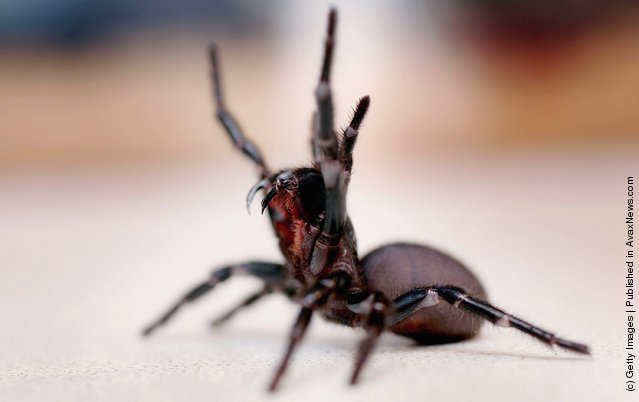
A Funnel Web spider is pictured at the Australian Reptile Park January 23, 2006 in Sydney, Australia. The Funnel Web is one of Australia's deadliest animals, with a venom that is packed with at least 40 different toxic proteins. A bite from a Funnel Web causes massive electrical over-load in the body's nervous system. Finally, fatalities occur from either heart attack or a pulmonary oedema, where the capillaries around the lungs begin to leak fluid and the patient effectively drowns. Death can come as quickly as two hours after a bite if no medical treatment is sought. Due to advances in anti-venom, there has been no death from a Funnel Web bite in Australia since 1980. Australia is home to some of the most deadly and poisonous animals on earth. (Photo by Ian Waldie/Getty Images)
Details
25 Apr 2011 07:49:00