Loading...
Done
Isabel Schmalenbach, an environmental scientist with the Helgoland Biological Institute (Biologische Anstalt Helgoland), part of the Alfred Wegener Institute for Polar and Marine Research, holds a one-year old baby European lobster (Homarus gammarus) raised at the institute on August 3, 2013 on Helgoland Island, Germany. (Photo by Sean Gallup/Getty Images)

Isabel Schmalenbach, an environmental scientist with the Helgoland Biological Institute (Biologische Anstalt Helgoland), part of the Alfred Wegener Institute for Polar and Marine Research, holds a one-year old baby European lobster (Homarus gammarus) raised at the institute on August 3, 2013 on Helgoland Island, Germany. Later in the day Schmalenbach and her colleagues released a total of 415 one-year old lobsters into the North Sea as part of an effort to repopulate the lobster population around Helgoland (also called Heligoland). In the 19th century local fishermen caught up to 80,000 lobsters a year in the surrounding waters, combined with the heavy allied bombing of the island during and after World War II, as well as other environmental factors, decimated the lobster population. (Photo by Sean Gallup)
Details
05 Aug 2013 08:39:00
World's Ugliest Dog

It's that time of year again when dogs with unusually large heads, hairless bodies and other oddities compete to be the World's Ugliest Dog. This year's winner? A 2-year-old mutt named Peanut, whose wild white and brown hair, bulging eyes and protruding teeth belie his sweet, energetic personality. Peanut's owner, Holly Chandler of Greenville, North Carolina, says he was seriously burned as a puppy and she wants to use her pet to raise awareness about animal abuse. She plans to use the $1,500 prize to pay for other animals' veterinary bills. The contest, held at the Sonoma-Marin Fairgrounds in Petaluma, California, is in its 26 year. The dogs are scored by a three-judge panel in several categories, including special or unusual attributes, personality and natural ugliness.
Details
24 Jun 2014 10:04:00
Female metro passengers hold flowers presented to them by metro workers, prior to International Women's Day in Kiev, Ukraine, 02 March 2016. (Photo by Sergey Dolzhenko/EPA)

Female metro passengers hold flowers presented to them by metro workers, prior to International Women's Day in Kiev, Ukraine, 02 March 2016. The hustle and bustle of the morning commute is broken up by an unexpected surprise. The first passengers to step on the train receive – a warm welcome and a pot of flowers. One woman says, “It's very nice. All the running around and then you're given a flower, it's not often. It's very nice. I'm going to take care of this flower”. International Women's Day first emerged from the activities of labour movements at the turn of the twentieth century, in North America and across Europe, it is celebrated on March 08 in many countries around the world. (Photo by Sergey Dolzhenko/EPA)
Details
03 Mar 2016 11:34:00


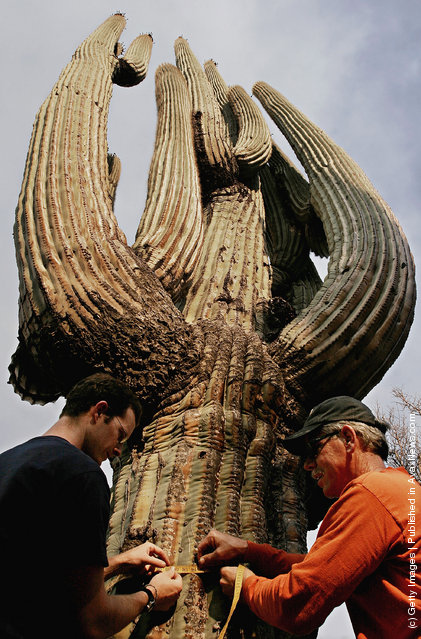
“The saguaro (scientific name Carnegiea gigantea) is a large, tree-sized cactus species in the monotypic genus Carnegiea. It is native to the Sonoran Desert in the U.S. state of Arizona, the Mexican state of Sonora, a small part of Baja California in the San Felipe Desert and an extremely small area of California, U.S. The saguaro blossom is the State Wildflower of Arizona”. – Wikipedia

Photo: Daniel Appel (L), a firefighter with Engine 84 from the Lassen National Forest in California and Mike Hallen, (R), Arizona representative of the National Register of Big Trees, measure the circumference of this Saguaro cactus called the "Grand One," in the Tonto National Forest on July 1, 2005 35 miles north of Phoenix, near Carefree, Arizona. The cactus, estimated to be more than 200 years old, measures a circumference of 7 feet, 10 inches (2.4 meters) and stands 46 feet high (14 meters). The cactus was burned in the Cave Creek Complex fire and may not survive. It was once the largest Saguaro in the world, two others have been found recently that have tied it's measurements. The fire has burned more than 214,000 acres of the Sonoran desert. (Photo by Jeff Topping/Getty Images)
Details
26 Jul 2011 12:27:00
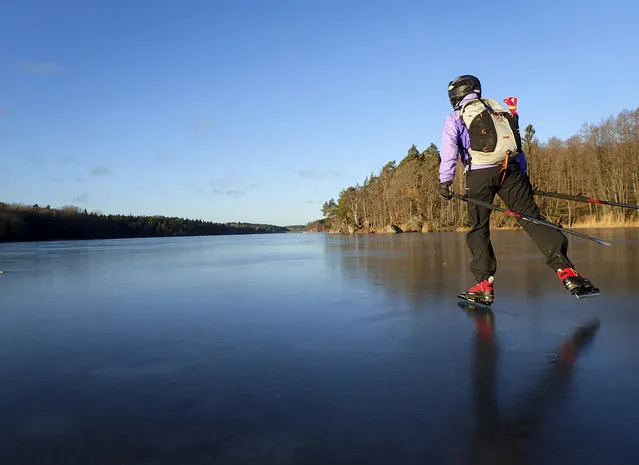
A woman tour skates on the frozen lake of Orlangen, south of Stockholm, Sweden, on December 23, 2016. Tour skating is recreational long distance ice skating on natural ice particularly popular in the Nordic countries. (Photo by Tobias Roestlund/AFP Photo/TT News Agency)

A woman tour skates on the frozen lake of Orlangen, south of Stockholm, Sweden, on December 23, 2016. Tour skating is recreational long distance ice skating on natural ice particularly popular in the Nordic countries. (Photo by Tobias Roestlund/AFP Photo/TT News Agency)
Details
24 Dec 2016 11:40:00
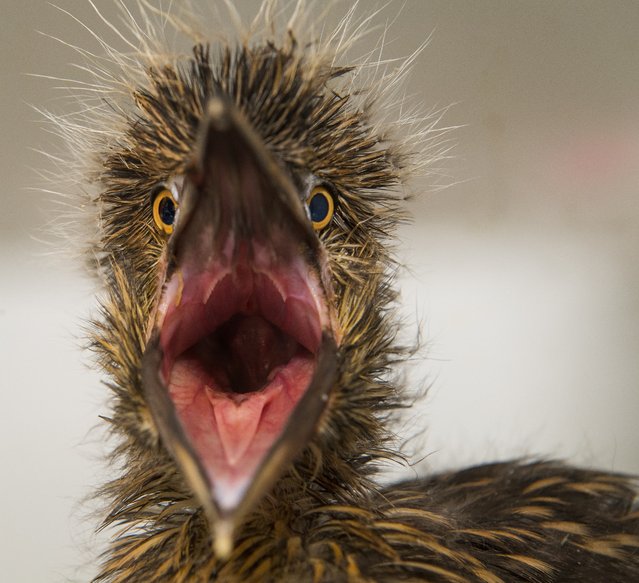
A baby Black-crowned Night Heron squawks in its incubator while being cared for at City Wildlife rescue and rehabilitation center in Washington, DC on May 31, 2017. The heron is one of several that have been brought to CW by the staff at The National Zoo over the past few years. The heron is a native bird and has made an established rookery inside the zoo grounds over a hundred years ago.  Every year at this time, some of the chicks get pushed or fall out of the nest and require human care.  Because the birds are native and not part of the Smithsonian collection, they partnered with CW to rehabilitate the herons for re-release back to the flock inside Zoo. They're reintroduced back to their flock so that they can migrate together in the Fall. The Black-crowned heron usually migrates from the DC area down to southeast North Carolina, some going as far as Jacksonville, FL in winter. The Black-crowned heron is the species of greatest conservation need in the District of Columbia because their numbers are in such rapid decline due to habitat loss. (Photo Linda Davidson/The Washington Post)

A baby Black-crowned Night Heron squawks in its incubator while being cared for at City Wildlife rescue and rehabilitation center in Washington, DC on May 31, 2017. The heron is one of several that have been brought to CW by the staff at The National Zoo over the past few years. (Photo Linda Davidson/The Washington Post)
Details
04 Jun 2017 08:04:00
Ranger trainees and trainee dogs simulate an ambush against rhino poachers at the Paramount Group Anti-Poaching training and K9 (canine) academy on November 26, 2014 in Magaliesberg, South Africa. One of the largest of its kind in Africa, the Academy will address the ever increasing need for training of Conservation Officers in anti poaching activities, wildlife contraband detection, specialist K9 solutions and Ranger K9 handler training – all of which have proven success rates in combatting and apprehending poachers and their activities. (Photo by Gianluigi Guercia/AFP Photo)

Ranger trainees and trainee dogs simulate an ambush against rhino poachers at the Paramount Group Anti-Poaching training and K9 (canine) academy on November 26, 2014 in Magaliesberg, South Africa. One of the largest of its kind in Africa, the Academy will address the ever increasing need for training of Conservation Officers in anti poaching activities, wildlife contraband detection, specialist K9 solutions and Ranger K9 handler training – all of which have proven success rates in combatting and apprehending poachers and their activities. (Photo by Gianluigi Guercia/AFP Photo)
Details
29 Nov 2014 13:06:00
A model poses at Checkpoint Charlie, a historic place in the German capital to promote the fashion magazine Sous on June 12, 2012

A model poses at Checkpoint Charlie, a historic place in the German capital to promote the fashion magazine “Sous” on June 12, 2012. (Photo by Maurizio Gambarini)
Details
19 Jun 2012 13:47:00