Loading...
Done
An art installation formed with milk churns, made by land art artist Gerard Benoit a la Guillaume, is seen at the Chenau de Mayen in the resort of Leysin, Switzerland August 7, 2015. More than 80 milk churns were placed between the Tour d'Ai and the Tour de Mayen summits at an altitude of 2,000 meters (6,561 feet) above sea level under the direction of the artist, to be photographed for his ongoing art project entitled “Milk churns without borders”. (Photo by Denis Balibouse/Reuters)

An art installation formed with milk churns, made by land art artist Gerard Benoit a la Guillaume, is seen at the Chenau de Mayen in the resort of Leysin, Switzerland August 7, 2015. More than 80 milk churns were placed between the Tour d'Ai and the Tour de Mayen summits at an altitude of 2,000 meters (6,561 feet) above sea level under the direction of the artist, to be photographed for his ongoing art project entitled “Milk churns without borders”. (Photo by Denis Balibouse/Reuters)
Details
08 Aug 2015 13:16:00
Disguised revellers parade on the occasion of the Cortege during the Carnival in Basel, Switzerland, February 17, 2016. (Photo by Georgios Kefalas/EPA)

Disguised revellers parade on the occasion of the Cortege during the Carnival in Basel, Switzerland, February 17, 2016. (Photo by Georgios Kefalas/EPA)
Details
18 Feb 2016 13:53:00
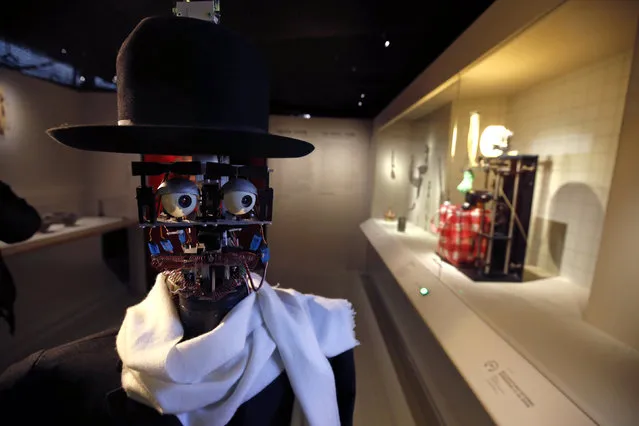
The Berenson robot strolls among visitors during the exhibition “Persona : Oddly Human” at the Quai Branly museum in Paris, France, February 23, 2016. The Berenson robot, developed in France in 2011, is the brainchild of anthropologist Denis Vidal and robotics engineer Philippe Gaussier. Its programming allows it to record reactions of museum visitors to certain pieces of art and then use the data to develop its own unique taste, which allows “Berenson” to judge whether or not it likes a certain work of art within an exhibition. (Photo by Philippe Wojazer/Reuters)

The Berenson robot strolls among visitors during the exhibition “Persona : Oddly Human” at the Quai Branly museum in Paris, France, February 23, 2016. The Berenson robot, developed in France in 2011, is the brainchild of anthropologist Denis Vidal and robotics engineer Philippe Gaussier. Its programming allows it to record reactions of museum visitors to certain pieces of art and then use the data to develop its own unique taste, which allows “Berenson” to judge whether or not it likes a certain work of art within an exhibition. (Photo by Philippe Wojazer/Reuters)
Details
25 Feb 2016 12:26:00
Emilia Pechinkova, a 24-years-old Bulgarian Pomak (Bulgarian speaking Muslims) bride poses for a photograph following the “gelina” or face painting ceremony carried out by female guests and relatives in preparation for her three-day wedding ceremony in the village of Draginovo, 100 kms southeast of Sofia on April 22, 2016. Bulgaria's Muslim population is one of the highest in the European Union. (Photo by Nikolay Doychinov/AFP Photo)

Emilia Pechinkova, a 24-years-old Bulgarian Pomak (Bulgarian speaking Muslims) bride poses for a photograph following the “gelina” or face painting ceremony carried out by female guests and relatives in preparation for her three-day wedding ceremony in the village of Draginovo, 100 kms southeast of Sofia on April 22, 2016. Bulgaria's Muslim population is one of the highest in the European Union. During the Communist regime religious rituals were not tolerated, and Muslims were forced to abandon wearing their traditional wedding outfits. Recently, more young Pomak women want to include traditional wedding customs that were forbidden during the regime, regardless of their secular lifestyles and the high cost of such a wedding. (Photo by Nikolay Doychinov/AFP Photo)
Details
25 Apr 2016 09:55:00
A student activist is detained during a silent protest after Thailand's election commission filed charges against a group for posting “foul and strong” comments online criticising a military-backed draft constitution, in Bangkok, Thailand April 27, 2016. (Photo by Jorge Silva/Reuters)

A student activist is detained during a silent protest after Thailand's election commission filed charges against a group for posting “foul and strong” comments online criticising a military-backed draft constitution, in Bangkok, Thailand April 27, 2016. (Photo by Jorge Silva/Reuters)
Details
28 Apr 2016 12:39:00
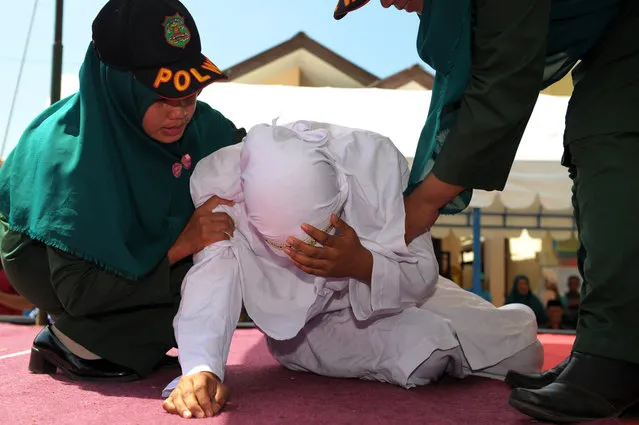
An Indonesian woman known as Linda (C) is helped by two Sharia officials after being caned for spending time in close proximity with a man who is not her husband, which is against Sharia law, in Banda Aceh on February 2, 2017. Aceh is the only province in the world's most populous Muslim-majority country that imposes sharia law. People can face floggings for a range of offences – from gambling, to drinking alcohol, to gay s*x. (Photo by Chaideer Mahyuddin/AFP Photo)

An Indonesian woman known as Linda (C) is helped by two Sharia officials after being caned for spending time in close proximity with a man who is not her husband, which is against Sharia law, in Banda Aceh on February 2, 2017. Aceh is the only province in the world's most populous Muslim-majority country that imposes sharia law. People can face floggings for a range of offences – from gambling, to drinking alcohol, to gay sеx. (Photo by Chaideer Mahyuddin/AFP Photo)
Details
03 Feb 2017 10:45:00
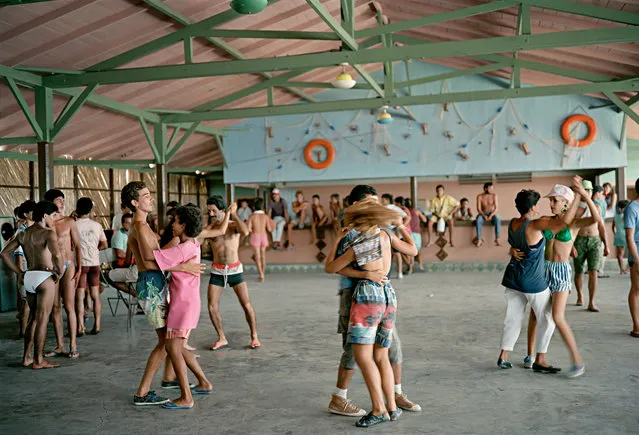
Giovan set out to capture the people’s resilience, during what Fidel Castro, with typical hyperbole, called the “special period”. (Photo by Tria Giovan/The Guardian)

As an American in 1990s Cuba, Tria Giovan risked being branded a traitor. But the photographer continued to visit and, from the dance hall to the hair salon, she captured the resilient spirit of the Cuban people. The 120 images in Tria Giovan’s “The Cuba Archive” are from the period in the 90s when, as an American, travel to Cuba could have seen her branded a traitor, as the country was subject to a US trade embargo. Her trip required lots of planning – and patience. (Photo by Tria Giovan/The Guardian)
Details
21 Sep 2017 09:04:00
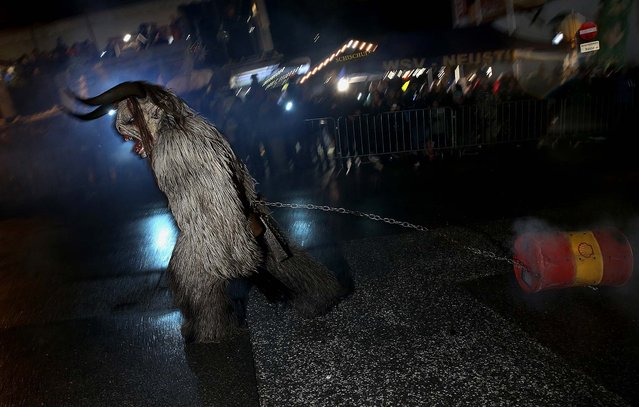
A participant dressed as the Krampus creature pulls a barrel of fire past onlookers during his search for delinquent children in Neustift im Stubaital. (Photo by Sean Gallup)

“Krampus is a beast-like creature from the folklore of Alpine countries thought to punish children during the Yule season who had misbehaved, in contrast with Saint Nicholas, who rewards well-behaved ones with gifts. Krampus is said to capture particularly naughty children in his sack and carry them away to his lair”. – Wikipedia. Photo: A participant dressed as the Krampus creature pulls a barrel of fire past onlookers during his search for delinquent children in Neustift im Stubaital. (Photo by Sean Gallup)
Details
05 Dec 2013 08:29:00