Loading...
Done
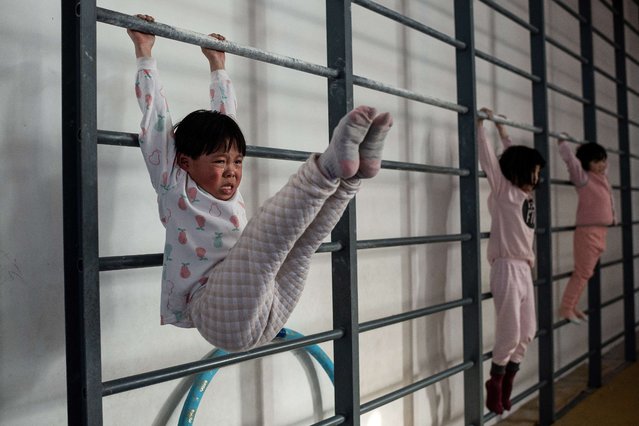
In this picture taken on January 11, 2021, young gymnasts train at the Li Xiaoshuang Gymnastics School in Xiantao, Hubei province. (Photo by Nicolas Asfouri/AFP Photo)

In this picture taken on January 11, 2021, young gymnasts train at the Li Xiaoshuang Gymnastics School in Xiantao, Hubei province. This summer's delayed Tokyo Olympics, which are now due to start on July 23, 2021, will be the defining moment for Chinese gymnasts who have trained relentlessly since as young as age four in the pursuit of gold. (Photo by Nicolas Asfouri/AFP Photo)
Details
23 Apr 2021 09:29:00
A migrant holds a placard which reads “No Forced Deportations” as he rides his bicycle at the makeshift camp called “The New Jungle” in Calais, France, September 18, 2015. (Photo by Regis Duvignau/Reuters)

A migrant holds a placard which reads “No Forced Deportations” as he rides his bicycle at the makeshift camp called “The New Jungle” in Calais, France, September 18, 2015. Around 3,500 migrants and refugees are camped in Calais, fleeing war and poverty in the Middle East, Africa and Asia and now living in the jungle. Most of them are hoping to make the crossing to England. (Photo by Regis Duvignau/Reuters)
Details
25 Sep 2015 08:00:00
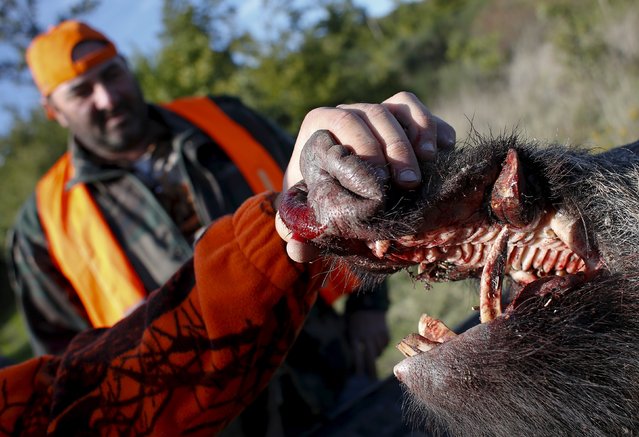
A dead wild boar is seen during a hunt in Castell'Azzara, Tuscany, central Italy, October 23, 2015. (Photo by Max Rossi/Reuters)

A dead wild boar is seen during a hunt in Castell'Azzara, Tuscany, central Italy, October 23, 2015. Extinct across much of the country by the end of the 1800s, the number of wild boar in Italy has almost doubled over the past decade and there are now about a million roaming the country, environmental and agricultural associations say. (Photo by Max Rossi/Reuters)
Details
08 Nov 2015 08:04:00
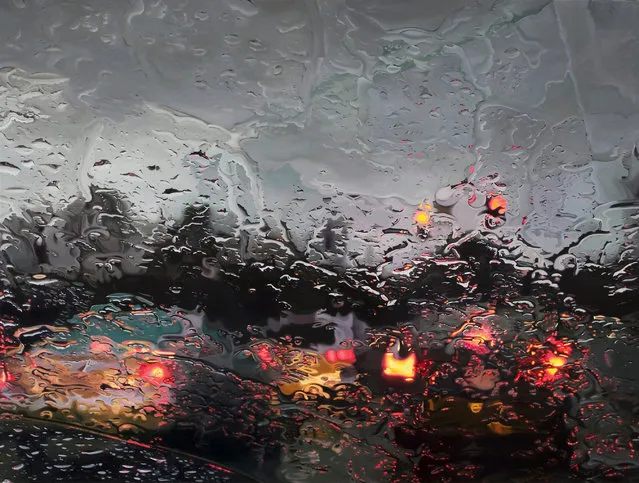
“Complete Stop”. (Painting by Gregory Thielker)

When he's driving, New York-based painter Gregory Thielker takes in the views that change from moment to moment: the road, the sky, other cars. “Inside the car it's easy to forget the outside temperature, humidity, the noise of the road”, he says. “But something happens when rain interrupts the view: the lens through which we are seeing is revealed. Water both obscures and highlights the landscape”. Gregory Thielker's exhibition “Between here and now” will be at Castor Gallery in lower Manhattan from early March. Here: “Complete Stop”. (Painting by Gregory Thielker)
Details
18 Jan 2016 08:02:00
Some women doing yoga pose on the hammocks during the Anti-Gravity yoga class at Svarga e-Motion Sanctuary at Dharmawangsa Square, Jakarta, Saturday, April 18, 2015. (Photo by Jurnasyanto Sukarno/JG Photo)

Some women doing yoga pose on the hammocks during the Anti-Gravity yoga class at Svarga e-Motion Sanctuary at Dharmawangsa Square, Jakarta, Saturday, April 18, 2015. Anti-Gravity Yoga or “aerial yoga”, is a new type of yoga, originating in New York but now being practised in several countries, which combines the traditional yoga poses, pilates and dance with the use of a hammock. (Photo by Jurnasyanto Sukarno/JG Photo)
Details
21 Apr 2015 10:39:00
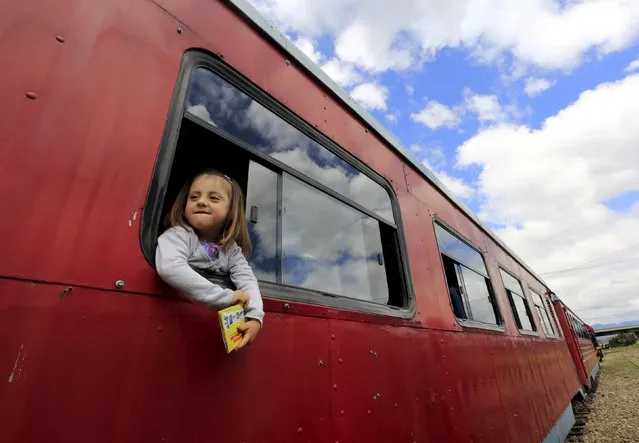
A girl looks out from the window of a “La Sabana” tourist train in La Caro March 1, 2015. (Photo by Jose Miguel Gomez/Reuters)

A girl looks out from the window of a “La Sabana” tourist train in La Caro March 1, 2015. The “La Sabana” tourist train that runs through the capital was founded by Eduardo Rodriguez, a railway engineer. Rodriguez has worked on Colombia's railway system his whole life and now, with an air of nostalgia, transports thousands of tourists in renovated steam locomotives that he fixes in Bogota's Central Station which dates back to 1913. (Photo by Jose Miguel Gomez/Reuters)
Details
23 Apr 2015 11:30:00
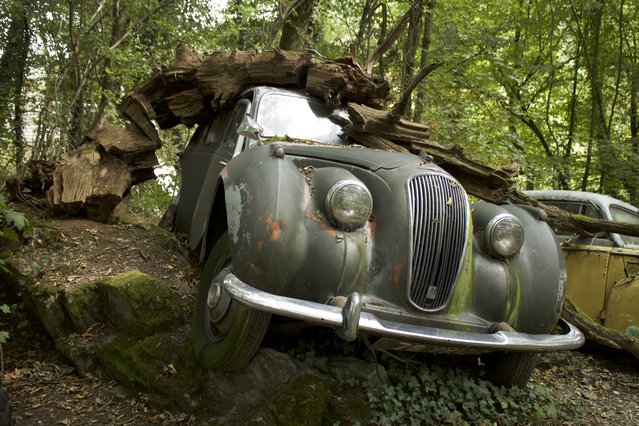
Michael Fröhlich's Jowett Javelin rotting car in his forest sculpture park in Neandertal Germany, September 11, 2016. An eccentric artist has collected fifty vintage cars and left them to rot in a forest – and now they're worth over $1 million. Former racing driver Michael Fröhlich, from Dusseldorf, Germany, has purposely crashed the cars into trees, buried them in mud and parked them on cliff faces in his estate's garden in the middle of the German Neanderthal. His collections includes a Jaguar XK120 worth $170,000, a Porsche 356 racer and a Buick worth $17,000. Perhaps his most interesting collectable is a Rolls Royce, with a purposefully misspelt “Buckingham Palace” – replacing the B with an F – emblazoned on the side with a replica of the Queen Elizabeth at the wheel. (Photo by Christoph Hagen/Barcroft Images)

Michael Fröhlich's Jowett Javelin rotting car in his forest sculpture park in Neandertal Germany, September 11, 2016. An eccentric artist has collected fifty vintage cars and left them to rot in a forest – and now they're worth over $1 million. Former racing driver Michael Fröhlich, from Dusseldorf, Germany, has purposely crashed the cars into trees, buried them in mud and parked them on cliff faces in his estate's garden in the middle of the German Neanderthal. His collections includes a Jaguar XK120 worth $170,000, a Porsche 356 racer and a Buick worth $17,000. (Photo by Christoph Hagen/Barcroft Images)
Details
24 Sep 2016 10:56:00
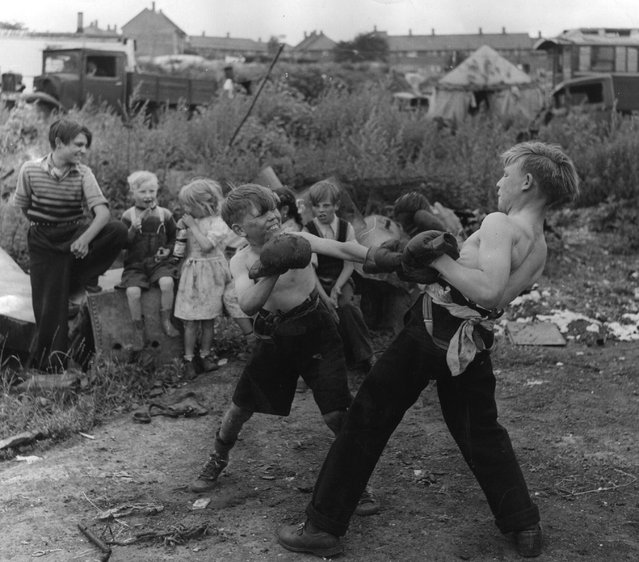
The unromantic gypsies. Children boxing in a gypsy camp in Kent, England on July 1, 1951. Like all boys these gypsy lads like to try their hand at boxing. Encouraged by their friends they fight it out on Corke's Meadow. Few Romanies now live a life of wandering romance. Most are like the three hundred squatters of Corke's Meadow, Kent, which is part of a “gypsy problem” that involves about 100,000 today. Of those about 25,000 can be rightly called gypsies, the rest are Mumpers and Posh-rats and Hobos. Corke's Meadow has both kinds. “Picture Post” cameraman Bert Hardy photographs the Corke's Meadow gypsies in their encampment. (Photo by Hulton-Deutsch Collection/Corbis via Getty Images)

The unromantic gypsies. Children boxing in a gypsy camp in Kent, England on July 1, 1951. Like all boys these gypsy lads like to try their hand at boxing. Encouraged by their friends they fight it out on Corke's Meadow. Few Romanies now live a life of wandering romance. Most are like the three hundred squatters of Corke's Meadow, Kent, which is part of a “gypsy problem” that involves about 100,000 today. Of those about 25,000 can be rightly called gypsies, the rest are Mumpers and Posh-rats and Hobos. Corke's Meadow has both kinds. “Picture Post” cameraman Bert Hardy photographs the Corke's Meadow gypsies in their encampment. (Photo by Hulton-Deutsch Collection/Corbis via Getty Images)
Details
12 Mar 2017 00:01:00