Loading...
Done
A bus goes through a flooded street in Wuhan, Hubei province, China July 6, 2016. (Photo by Reuters/China Daily)

A bus goes through a flooded street in Wuhan, Hubei province, China July 6, 2016. (Photo by Reuters/China Daily)
Details
11 Jul 2016 12:29:00
An environmental activist adjusts his mask while taking part in “The Dead Sea Swim Challenge”, swimming from the Jordanian to Israeli shore, to draw attention to the ecological threats facing the Dead Sea, in Kibbutz Ein Gedi, Israel November 15, 2016. (Photo by Nir Elias/Reuters)

An environmental activist adjusts his mask while taking part in “The Dead Sea Swim Challenge”, swimming from the Jordanian to Israeli shore, to draw attention to the ecological threats facing the Dead Sea, in Kibbutz Ein Gedi, Israel November 15, 2016. Swimmers from around the world plunged into the salty waters of the Dead Sea on Tuesday to attempt a seven-hour swim across the fabled lake in a bid to draw attention to its environmental degradation. Wearing protective masks and snorkels, 25 swimmers paddled through the muddy water to attempt the 9-mile (15-kilometer) swim from Jordan to Israel. (Photo by Nir Elias/Reuters)
Details
16 Nov 2016 10:59:00
Patients from Rady Children's Hospital hug a bottlenose dolphin after being invited to swim and interact with dolphins at Sea World in San Diego, California  August 27, 2015. (Photo by Mike Blake/Reuters)

Patients from Rady Children's Hospital hug a bottlenose dolphin after being invited to swim and interact with dolphins at Sea World in San Diego, California August 27, 2015. Sea World has hosted Dolphin Interaction Program for seven years. It was started by dolphin trainer Joy Soto who battled and overcame non-Hodgkin’s lymphoma. (Photo by Mike Blake/Reuters)
Details
28 Aug 2015 12:19:00
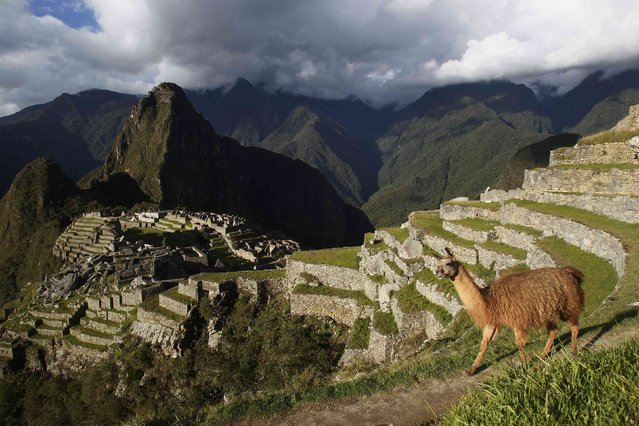
An alpaca is seen near the Inca citadel of Machu Picchu in Cusco December 2, 2014. Machu Picchu, a UNESCO World Heritage Site, is Peru's top tourist attraction, with the government limiting tourists to 2,500 per day due to safety reasons and concerns over the preservation of the ruins. (Photo by Enrique Castro-Mendivil/Reuters)

An alpaca is seen near the Inca citadel of Machu Picchu in Cusco December 2, 2014. Machu Picchu, a UNESCO World Heritage Site, is Peru's top tourist attraction, with the government limiting tourists to 2,500 per day due to safety reasons and concerns over the preservation of the ruins. (Photo by Enrique Castro-Mendivil/Reuters)
Details
04 Dec 2014 11:24:00
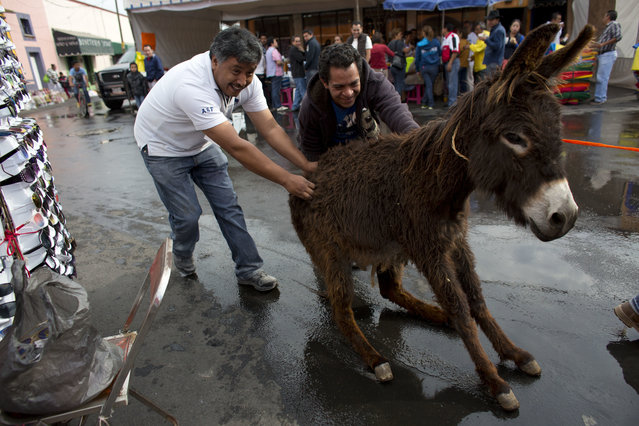
In this May 1, 2016 photo, a reluctant donkey is alternately pushed and pulled and enticed with carrots toward town hall in order to be dressed for the costume competition at the annual donkey festival in Otumba, Mexico state, Mexico. Otumba was an important donkey market during Spanish colonial times, standing at the crossroads of major roads leading to Mexico City, where the beasts pulled heavy loads and carried travelers. Today, however, farmers use tractors and pickup trucks, and the donkey population is in decline. (Photo by Rebecca Blackwell/AP Photo)


In this May 1, 2016 photo, a reluctant donkey is alternately pushed and pulled and enticed with carrots toward town hall in order to be dressed for the costume competition at the annual donkey festival in Otumba, Mexico state, Mexico. Otumba was an important donkey market during Spanish colonial times, standing at the crossroads of major roads leading to Mexico City, where the beasts pulled heavy loads and carried travelers. Today, however, farmers use tractors and pickup trucks, and the donkey population is in decline. (Photo by Rebecca Blackwell/AP Photo)

Details
04 May 2016 11:55:00
Artists from the Beijing Dance Academy perform to celebrate the Chinese Lunar New Year in Budapest, capital of Hungary, February 6, 2019. (Photo by Attila Volgyi/Xinhua News Agency/Barcroft Media)

Artists from the Beijing Dance Academy perform to celebrate the Chinese Lunar New Year in Budapest, capital of Hungary, February 6, 2019. (Photo by Attila Volgyi/Xinhua News Agency/Barcroft Media)
Details
08 Feb 2019 06:23:00
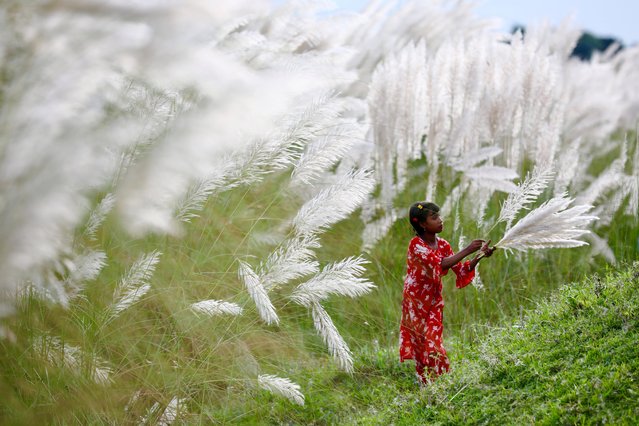
A girl picks catkins at a field amid the COVID-19 pandemic in Sarighat, on the outskirts of Dhaka, Bangladesh, October 2, 2020. (Photo by Mohammad Ponir Hossain/Reuters)

A girl picks catkins at a field amid the COVID-19 pandemic in Sarighat, on the outskirts of Dhaka, Bangladesh, October 2, 2020. (Photo by Mohammad Ponir Hossain/Reuters)
Details
16 Oct 2020 00:05:00
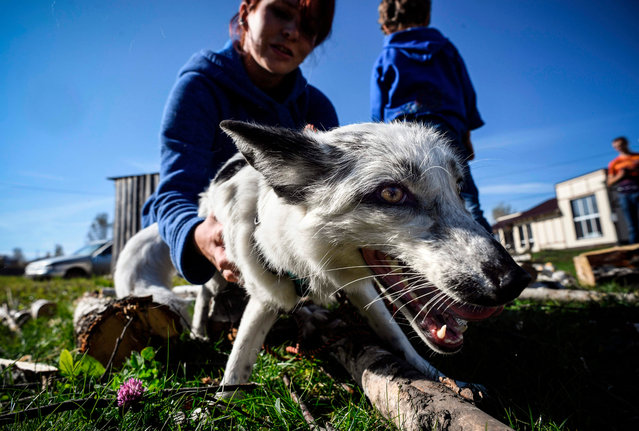
Tatyana Abramova, 33, plays with her home fox Plombir at her countryside house outside Siberian city of Novosibirsk on September 12, 2020. The official start of the Soviet experiment to better understand the domestication of animals by humans began in 1959, and was initiated by geneticists Dmitri Beliaiev and Lioudmila Trout on a farm in Akademgorodok, the scientific center of excellence in Siberia. Their primary objective was to domesticate foxes, to understand how the ancestor of wolves, another canine, evolved into a loyal and loving dog. And understand what this domestication tells us about the genetic evolution of species. (Photo by Alexander Nemenov/AFP Photo)

Tatyana Abramova, 33, plays with her home fox Plombir at her countryside house outside Siberian city of Novosibirsk on September 12, 2020. The official start of the Soviet experiment to better understand the domestication of animals by humans began in 1959, and was initiated by geneticists Dmitri Beliaiev and Lioudmila Trout on a farm in Akademgorodok, the scientific center of excellence in Siberia. Their primary objective was to domesticate foxes, to understand how the ancestor of wolves, another canine, evolved into a loyal and loving dog. And understand what this domestication tells us about the genetic evolution of species. (Photo by Alexander Nemenov/AFP Photo)
Details
25 Oct 2020 00:05:00