Loading...
Done
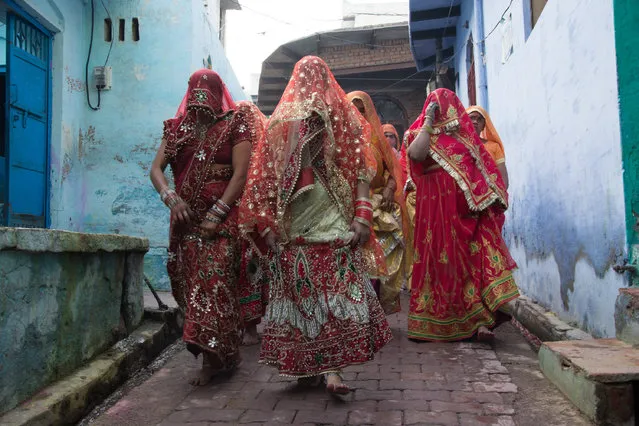
Indian women beat men with stick (Lathi) during celebration of Lathmar Holi in Nandgaon village of Mathura district in Uttar Pradesh, India on February 25, 2018. (Photo by Javed Sultan/Anadolu Agency/Getty Images)

Indian women beat men with stick (Lathi) during celebration of Lathmar Holi in Nandgaon village of Mathura district in Uttar Pradesh, India on February 25, 2018. Holi is observed in India at the end of the winter season on the last full moon of the lunar month. (Photo by Javed Sultan/Anadolu Agency/Getty Images)
Details
28 Feb 2018 00:05:00
Student Rabindra Bharati University celebrates the Holi festival, Color Festival on February 26, 2018 in Kolkata, India. (Photo by Debajyoti Chakraborty/NurPhoto via Getty Images)

Student Rabindra Bharati University celebrates the Holi festival, Color Festival on February 26, 2018 in Kolkata, India. Holi, the popular Hindu spring festival of colours is observed in India at the end of the winter season on the last full moon of the lunar month, and will be celebrated on March 1 this year. (Photo by Debajyoti Chakraborty/NurPhoto via Getty Images)
Details
03 Mar 2018 00:05:00
A boy carries a dog as he stands after a Peruvian police operation to destroy illegal gold mining camps in a zone known as Mega 14, in the southern Amazon region of Madre de Dios July 14, 2015. Peruvian police razed dozens of illegal gold mining camps at the edge of an Amazonian nature reserve this week, part of a renewed bid to halt the spread of wildcatting in a remote rainforest region. (Photo by Janine Costa/Reuters)

A boy carries a dog as he stands after a Peruvian police operation to destroy illegal gold mining camps in a zone known as Mega 14, in the southern Amazon region of Madre de Dios July 14, 2015. Peruvian police razed dozens of illegal gold mining camps at the edge of an Amazonian nature reserve this week, part of a renewed bid to halt the spread of wildcatting in a remote rainforest region. (Photo by Janine Costa/Reuters)
Details
18 Jul 2015 12:29:00
Respect, Kronotsky nature reserve, Russia. The photographer’s cat, Ryska – her name means little lynx in Russian – stands outside their cabin and with aggressive posturing warns off a fox. In winter, foxes would regularly visit the cabin searching for food. If one peered in at the window, possible when the snow was deep, Ryska would sit on the other side, fur raised, and growl. When outside, she would hold her ground. The foxes were not always frightened and so encounters could be a sort of dance. (Photo by Igor Shpilenok/Unforgettable Behaviour/NHM)

Respect, Kronotsky nature reserve, Russia. The photographer’s cat, Ryska – her name means little lynx in Russian – stands outside their cabin and with aggressive posturing warns off a fox. In winter, foxes would regularly visit the cabin searching for food. If one peered in at the window, possible when the snow was deep, Ryska would sit on the other side, fur raised, and growl. When outside, she would hold her ground. The foxes were not always frightened and so encounters could be a sort of dance. (Photo by Igor Shpilenok/Unforgettable Behaviour/NHM)
Details
08 Apr 2017 09:14:00
Image from Camille Seamans new book, “Melting Away”. (Photo by Camille Seaman/Barcroft Media)

Documenting the effects of climate change first hand over the past eight years, Camille Seaman fears we may be on the road to the last iceberg. Photographing the enormous frozen floats at both poles for the past eight years, the Californian adventurer has seen the receding ice shelves and experienced the changing warmer weather. Feeling that her intimate and emotional work documents a snapshot of history, Camille presents her series “The Last Iceberg” as a study of what she sees as the personality of each huge iceberg. Drawing parallels with the famous novel, “The Last of the Mohicans”, Camille, 42, wonders whether these unique, almost alien natural features will become a thing of the past or part of nature's renewal process. (Photo by Camille Seaman/Barcroft Media)
Details
02 Dec 2014 12:10:00
These snaps capture true winter wonderlands – as Mother Nature's icy grip takes hold of America's National Parks. From snow-capped mountains in Yosemite to an icy still Glacier Bay, the incredible images show their beauty is year round. In other breath-taking shots crisp frost lines the paths through Great Smokey Mountains and Crater Lake has had more than a dusting of snow. (Photo by U.S. Department of the Interior/Cater News)

These snaps capture true winter wonderlands – as Mother Nature's icy grip takes hold of America's National Parks. From snow-capped mountains in Yosemite to an icy still Glacier Bay, the incredible images show their beauty is year round. In other breath-taking shots crisp frost lines the paths through Great Smokey Mountains and Crater Lake has had more than a dusting of snow. Here: Apostle Island National Lakeshore Park in Wisconsin. (Photo by U.S. Department of the Interior/Cater News)
Details
22 Dec 2014 13:20:00
A picture taken on June 3, 2022 shows a unique albinos Galapagos giant tortoise baby, born on May 1, at the Tropicarium of Servion, western Switzerland. Albinos Galapagos tortoises have never been observed in captivity or in the nature. The Galapagos giant tortoises are strictly protected and are among the most endangered species among CITES-listed animals. (Photo by Fabrice Coffrini/AFP Photo)

A picture taken on June 3, 2022 shows a unique albinos Galapagos giant tortoise baby, born on May 1, at the Tropicarium of Servion, western Switzerland. Albinos Galapagos tortoises have never been observed in captivity or in the nature. The Galapagos giant tortoises are strictly protected and are among the most endangered species among CITES-listed animals. (Photo by Fabrice Coffrini/AFP Photo)
Details
19 Jun 2022 04:00:00
An orphaned giraffe nuzzling a wildlife keeper at Sarara camp in Kenya, one of 70 pictures being sold by Prints for Nature (printsfornature.com) to raise money for work by the Conservation International charity. This giraffe was rehabilitated and returned to the wild, as a number of others have done before him. Right now, giraffe are undergoing what has been referred to as a silent extinction. Current estimates are that giraffe populations across Africa have dropped 40 percent in three decades, plummeting from approximately 155,000 in the late 1980s to under 100,000 today. (Photo by Ami Vitale/National Geographic)

An orphaned giraffe nuzzling a wildlife keeper at Sarara camp in Kenya, one of 70 pictures being sold by Prints for Nature (printsfornature.com) to raise money for work by the Conservation International charity. This giraffe was rehabilitated and returned to the wild, as a number of others have done before him. Right now, giraffe are undergoing what has been referred to as a silent extinction. Current estimates are that giraffe populations across Africa have dropped 40 percent in three decades, plummeting from approximately 155,000 in the late 1980s to under 100,000 today. (Photo by Ami Vitale/National Geographic)
Details
22 Nov 2020 00:03:00