Loading...
Done
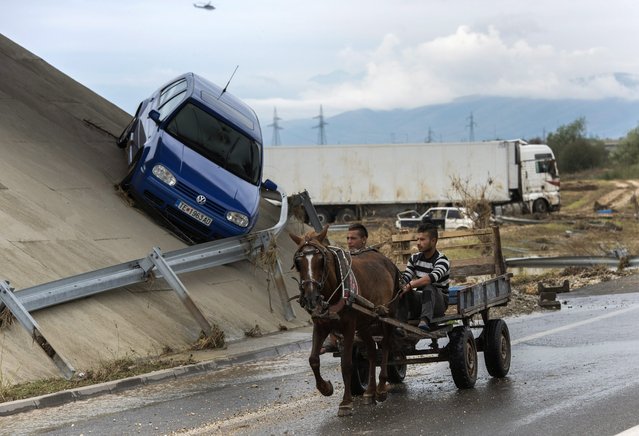
A damaged vehicle is seen next to the ring road, around Skopje, near the village of Stajkovci, Skopje, The Former Yugoslav Republic of Macedonia, 08 August 2016. At least 21 people have died and more than 100 are injured in the heavy rain storm that hit the Macedonian capital Skopje late Saturday night causing severe damage to the roads and house infrastructure. More than 80 vehicles were hit by landslides at Skopje's ring road. The highway remains closed. The government announced a 15-day state of emergency in the Skopje and Tetovo region. (Photo by Georgi Licovski/EPA)

A damaged vehicle is seen next to the ring road, around Skopje, near the village of Stajkovci, Skopje, The Former Yugoslav Republic of Macedonia, 08 August 2016. At least 21 people have died and more than 100 are injured in the heavy rain storm that hit the Macedonian capital Skopje late Saturday night causing severe damage to the roads and house infrastructure. More than 80 vehicles were hit by landslides at Skopje's ring road. The highway remains closed. The government announced a 15-day state of emergency in the Skopje and Tetovo region. (Photo by Georgi Licovski/EPA)
Details
09 Aug 2016 13:00:00
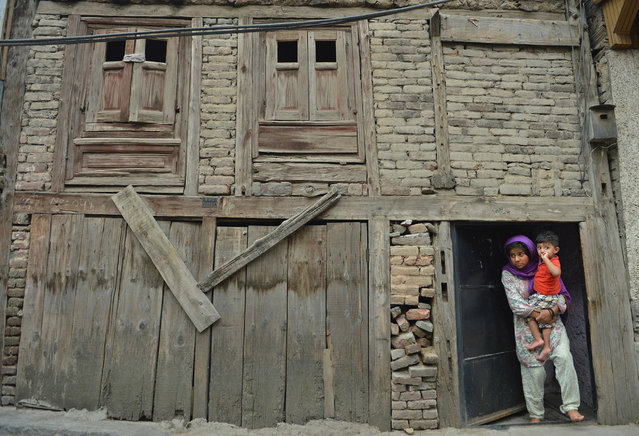
A Kashmiri girl holds her brother in the doorway of their home while watching protesters shout pro-freedom and anti-Indian slogans during  mourning and protests held in downtown Srinagar on August 22, 2016, following the killing of teenager Irfan Ahmed by security forces. Teenager Irfan Ahmed was killed after he was hit in the chest by a teargas canister fired by Indian security forces to quell pro-freedom protests in the Kashmiri capital on August 21. More than 60 civilians have been killed in clashes between protesters and security forces, and thousands more injured in the worst violence to hit the Himalayan region since 201. Indian-administered Kashmir has been in the grip of almost daily anti-India protests and rolling curfews sparked by the killing on July 8 of a popular rebel leader, Burhan Wani, in a gunfight with government forces. (Photo by Tauseef Mustafa/AFP Photo)

A Kashmiri girl holds her brother in the doorway of their home while watching protesters shout pro-freedom and anti-Indian slogans during mourning and protests held in downtown Srinagar on August 22, 2016, following the killing of teenager Irfan Ahmed by security forces. Teenager Irfan Ahmed was killed after he was hit in the chest by a teargas canister fired by Indian security forces to quell pro-freedom protests in the Kashmiri capital on August 21. More than 60 civilians have been killed in clashes between protesters and security forces, and thousands more injured in the worst violence to hit the Himalayan region since 201. Indian-administered Kashmir has been in the grip of almost daily anti-India protests and rolling curfews sparked by the killing on July 8 of a popular rebel leader, Burhan Wani, in a gunfight with government forces. (Photo by Tauseef Mustafa/AFP Photo)
Details
25 Aug 2016 09:48:00
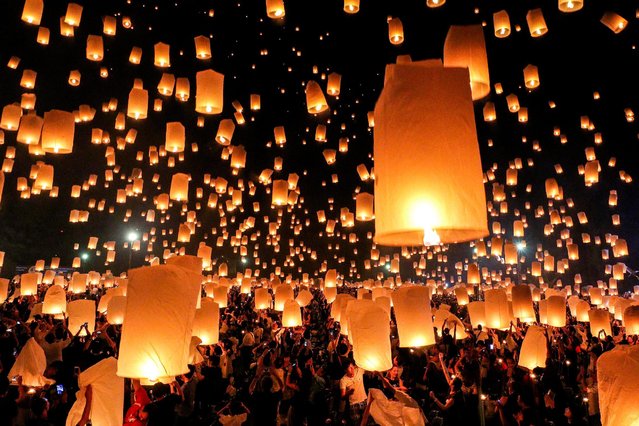
People release floating lanterns during the festival of Yee Peng in the northern capital of Chiang Mai, Thailand November 14, 2016. Yi Peng refers to the full moon day in the second month according to the Lanna lunar calendar (the twelfth month according to the Thai lunar calendar). Swarms of Lanna-style sky lanterns are launched into the air where they resemble large shoals of giant fluorescent jellyfish gracefully floating through the sky. The festival is meant as a time for tham bun, to make merit. Khom loi are made from a thin fabric, such as rice paper, stretched over a bamboo or wire frame, to which a candle or fuel cell is attached. When the fuel cell is lit, the resulting hot air is trapped inside the lantern and creates enough lift for the khom loi to float up into the sky. (Photo by Athit Perawongmetha/Reuters)

People release floating lanterns during the festival of Yee Peng in the northern capital of Chiang Mai, Thailand November 14, 2016. Yi Peng refers to the full moon day in the second month according to the Lanna lunar calendar (the twelfth month according to the Thai lunar calendar). Swarms of Lanna-style sky lanterns are launched into the air where they resemble large shoals of giant fluorescent jellyfish gracefully floating through the sky. The festival is meant as a time for tham bun, to make merit. Khom loi are made from a thin fabric, such as rice paper, stretched over a bamboo or wire frame, to which a candle or fuel cell is attached. When the fuel cell is lit, the resulting hot air is trapped inside the lantern and creates enough lift for the khom loi to float up into the sky. (Photo by Athit Perawongmetha/Reuters)
Details
15 Nov 2016 11:54:00
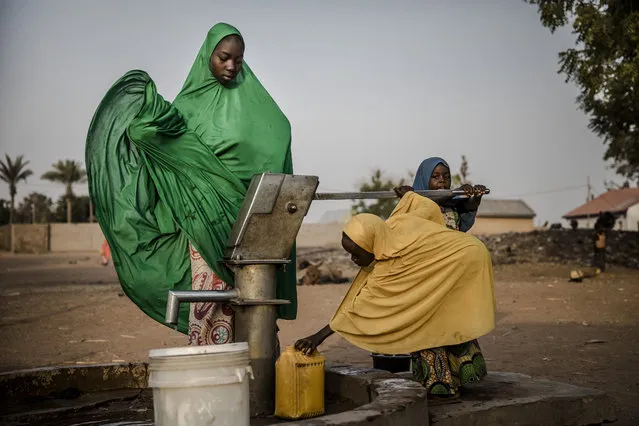
Camp dwellers pump water from a well at Malkohi refugee camp in Jimeta, Adamawa State, Nigeria on February 19, 2019, four days ahead of the country's General elections set for February 23 after a last-minute rescheduling. Malkohi is a camp for internal displaced who fled their homes as Boko Haram insurgents advanced across north-eastern Nigeria. From their homes on the outskirts of Yola, capital of presidential candidate Atiku Abubakar's home state Adamawa, Malkohi residents say they feel forgotten. (Photo by Luis Tato/AFP Photo)

Camp dwellers pump water from a well at Malkohi refugee camp in Jimeta, Adamawa State, Nigeria on February 19, 2019, four days ahead of the country's General elections set for February 23 after a last-minute rescheduling. Malkohi is a camp for internal displaced who fled their homes as Boko Haram insurgents advanced across north-eastern Nigeria. From their homes on the outskirts of Yola, capital of presidential candidate Atiku Abubakar's home state Adamawa, Malkohi residents say they feel forgotten. (Photo by Luis Tato/AFP Photo)
Details
02 Mar 2019 00:05:00
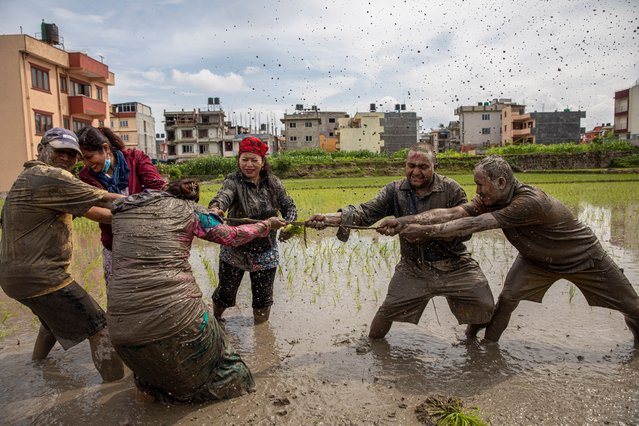
Farmers play tug of war in a paddy field on National Paddy Day in Tokha village, on the outskirt of capital Kathmandu, Nepal, 29 June 2021. Nepal is celebrating National Paddy Day with various events on 29 June. On this day, known as Asar Pandra, farmers begin the annual rice planting season and mark the day with various festivities such as preparing rice meals with muddy water, mud being a symbol for a prosperous season. Sixty percent of Nepal's agriculture industry relies on monsoon rain while 40 percent is carried out through irrigation. Agriculture is a major contributor to the country's GDP. (Photo by Narendra Shrestha/EPA/EFE)

Farmers play tug of war in a paddy field on National Paddy Day in Tokha village, on the outskirt of capital Kathmandu, Nepal, 29 June 2021. Nepal is celebrating National Paddy Day with various events on 29 June. On this day, known as Asar Pandra, farmers begin the annual rice planting season and mark the day with various festivities such as preparing rice meals with muddy water, mud being a symbol for a prosperous season. Sixty percent of Nepal's agriculture industry relies on monsoon rain while 40 percent is carried out through irrigation. Agriculture is a major contributor to the country's GDP. (Photo by Narendra Shrestha/EPA/EFE)
Details
26 Feb 2022 04:53:00
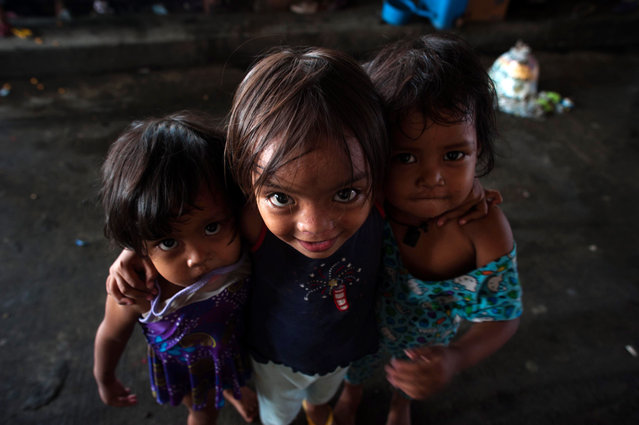
Children beg for alms in a street on August 11, 2014 in Manila, Philippines. The Philippines has one of the fastest growing populations in Southeast Asia with around 100 million people. (Photo by Dondi Tawatao/Getty Images)

Children beg for alms in a street on August 11, 2014 in Manila, Philippines. The Philippines has one of the fastest growing populations in Southeast Asia with around 100 million people. At least 12 million people live in the capital city of Manila alone, making it one of the most densely populated and largest cities in the world. Lack of space and economic opportunities has pushed around four million people to live informally along waterways, bridges and even cemeteries further straining the already weak infrastructure and straining the resources of the city. (Photo by Dondi Tawatao/Getty Images)
Details
12 Aug 2014 12:21:00
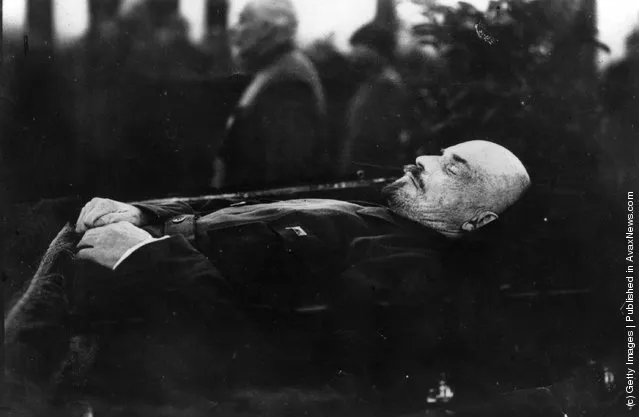
1924:  Vladimir Ilyich Lenin lying in state in the Kremlin

Photo: Vladimir Ilyich Lenin (1870 – 1924) lying in state in the Kremlin. (Photo by Hulton Archive/Getty Images). 1924

Important! For the same article in Russian language click here.

Something quite intriguing is happening within Russian-speaking internet during the last few – should you type a fully academic inquiry (at least, according to Russian academic requirements) in national search engines for "Lenin's mausoleum" – the first thing you get (even in top 10 searches) is website pages talking about black magic and occult. Website authors view this construction differently, but unconditionally agree on one thing: the mausoleum of the "leader of the world proletariat” – the essence of a magical artifact, a sort of “energy vampire”. It was built with a certain purpose: to drain the energy out of miserable Soviet citizens on one hand; and to poison the anthroposphere of one-sixth part of the earth with its vibes (the exact territory that was occupied by the former Soviet Union), depriving the Russian people of will to resist on the other hand. Complete nonsense? No doubt. Nevertheless, an intriguing one. Well, probably because some oddities do exist in mausoleum's history. These oddities are the thing we are going to discuss this time. First, let me refresh you memory on the subject.
Details
16 Oct 2011 11:27:00
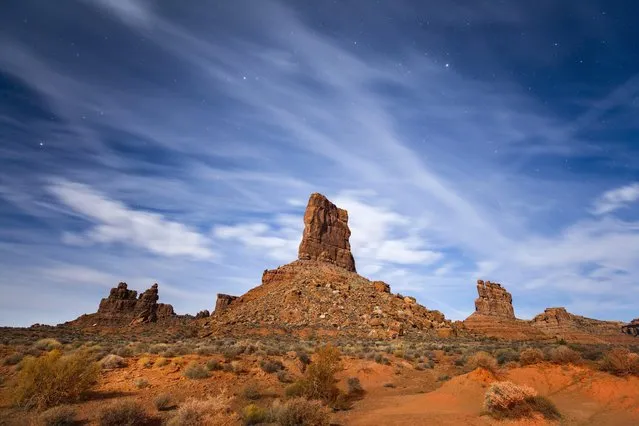
Moonlight illuminates sandstone buttes in the Valley of the Gods in the proposed Bear Ears National Monument near Mexican Hat, Utah, USA, 12 November 2016. (Photo by Jim Lo Scalzo/EPA)

Moonlight illuminates sandstone buttes in the Valley of the Gods in the proposed Bear Ears National Monument near Mexican Hat, Utah, USA, 12 November 2016. In October 2015, a coalition of five Indian nations, including the Hopi, Ute, and Navajo, formally proposed the monument, attempting to preserve the parcel's 100,000 archeological sites from ongoing looting and grave robbing. Less than two months before handing over the White House to President Elect Trump, President Obama must decide if it's worth the political capital to designate Bear Ears a national monument. (Photo by Jim Lo Scalzo/EPA)
Details
07 Dec 2016 11:53:00