Loading...
Done
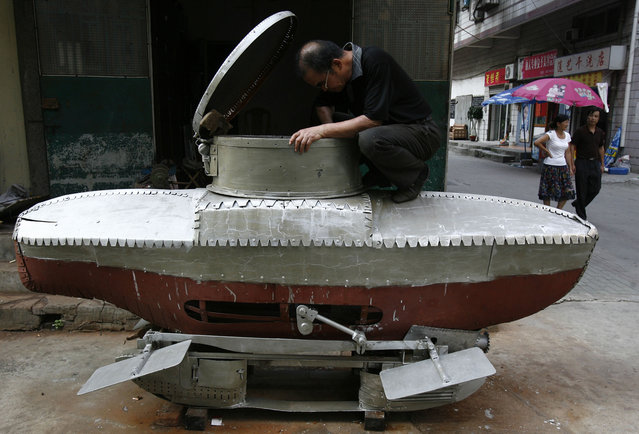
Li Yuming, a local farmer who is interested in scientific invention, works on his unfinished miniature submarine “Xiaguang V” on the outskirts of Wuhan, capital of central China's Hubei province August 24, 2007. “Xiaguang V”, which is 3-metre long, 1.2-metre in height, has a maximum diving depth of 20 metres, and can hold two adults and one child at the same time. The submarine will be used for tour after safety test, local media said. (Photo by Reuters/Stringer)

Li Yuming, a local farmer who is interested in scientific invention, works on his unfinished miniature submarine “Xiaguang V” on the outskirts of Wuhan, capital of central China's Hubei province August 24, 2007. “Xiaguang V”, which is 3-metre long, 1.2-metre in height, has a maximum diving depth of 20 metres, and can hold two adults and one child at the same time. The submarine will be used for tour after safety test, local media said. (Photo by Reuters/Stringer)
Details
09 Sep 2013 10:44:00
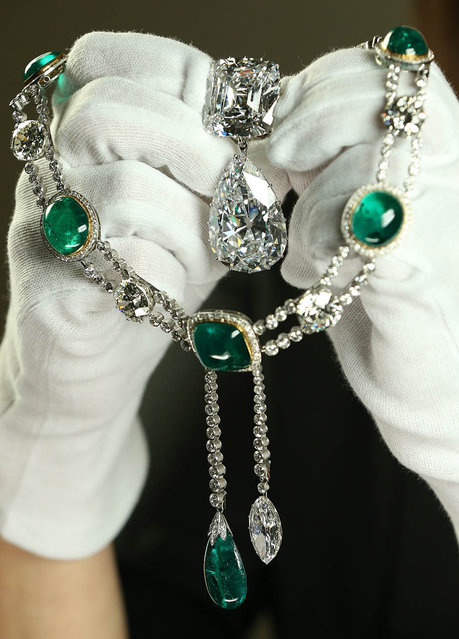
Caroline de Guitaut, Curator of Royal Collections, holds the Cullinan III and IV Broach and the Cullinan VII Delhi Durbar Necklace and Cullinan Pendant at The Queen's Gallery, Buckingham Palace

“A dazzling exhibition featuring jewelry made with the world’s largest diamond will be part of the celebrations marking the 60th anniversary of Queen Elizabeth II’s reign. The jewelry was made with a 3,106-carat diamond discovered in 1905 at the Cullinan Diamond Mine near Pretoria, the capital of South Africa. The diamond was so large that miners initially thought it was a worthless crystal and almost threw it away”... – Vidya Kauri via News.nationalpost.com

Photo: Caroline de Guitaut, Curator of Royal Collections, holds the Cullinan III and IV Broach and the Cullinan VII Delhi Durbar Necklace and Cullinan Pendant at The Queen's Gallery, Buckingham Palace on May 15, 2012 in London, England. (Photo by Peter Macdiarmid)
Details
17 May 2012 10:59:00
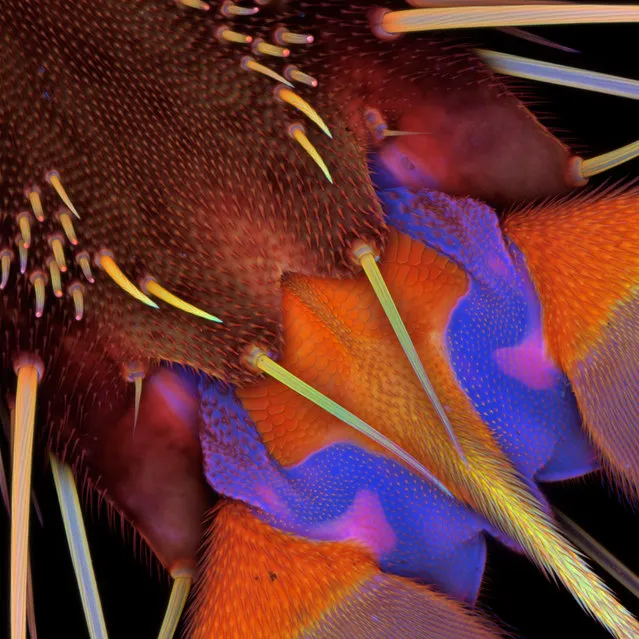
Pretarsus of the third leg of a female drone fly (Eristalis tenax), ventral view, by Dr. Jan Michels, Institute of Zoology, Christian-Albrechts-University of Kiel, Germany. (Photo by Olympus BioScapes)

“Microscope images forge an extraordinary bond between science and art, said Hidenao Tsuchiya, Olympus America's Vice President and General Manager for the Scientific Equipment Group. We founded this competition to focus on the fascinating stories coming out of today's life science research laboratories. The thousands of images that people have shared with the competition over the years reflect some of the most exciting work going on in research today – work that can help shed light on the living universe and ultimately save lives. We look at BioScapes and these beautiful images as sources of education and inspiration to us and the world”. – OlympusBioScapes

Photo: Pretarsus of the third leg of a female drone fly (Eristalis tenax), ventral view, by Dr. Jan Michels, Institute of Zoology, Christian-Albrechts-University of Kiel, Germany. (Photo by Olympus BioScapes)
Details
29 Jul 2012 09:20:00
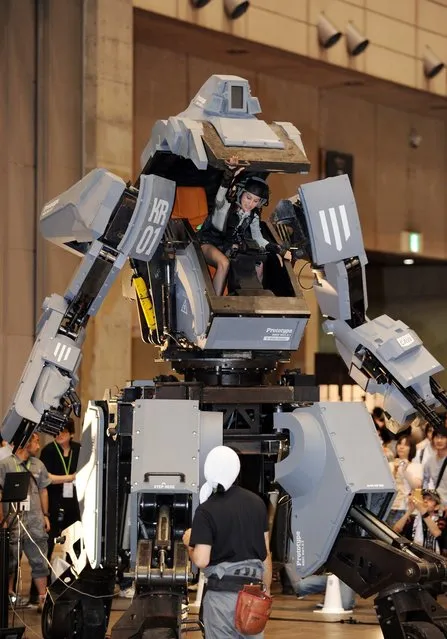
Female “pilot” Anna (C) climbs out the cockpit of Japanese electronics company Suidobashi Heavy Industry's newly unveiled robot “Kuratas” at the Wonder Festival in Chiba, suburban Tokyo on July 29, 2012. The Kuratas robot, which will go on sale with a price tag of one million USD, measures four meters in height, weighs four tons and has four wheeled legs that can either be controlled remotely through the 3G network or by a human seated within the cockpit.

Female pilot Anna climbs out the cockpit of Japanese electronics company Suidobashi Heavy Industry's newly unveiled robot “Kuratas” at the Wonder Festival in Chiba, suburban Tokyo on July 29, 2012. The “Kuratas” robot, which will go on sale with a price tag of one million USD, measures four meters in height, weighs four tons and has four wheeled legs that can either be controlled remotely through the 3G network or by a human seated within the cockpit. (Photo by Yoshikazu Tsuno/AFP Photo)
Details
30 Jul 2012 09:26:00
A christmas teddy bear is wheeled along on a trolley at the Steiff stuffed toy factory on November 23, 2012 in Giengen an der Brenz, Germany. Founded by seamstress Margarethe Steiff in 1880, Steiff has been making stuffed teddy bears since the early 20th century ever since her nephew Richard Steiff exhibited the first commercially produced teddy bear in Europe in 1903. Teddy bears are among the most popular children's toys and the company is hoping for a strong Christmas season. (Photo by Thomas Niedermueller)

A christmas teddy bear is wheeled along on a trolley at the Steiff stuffed toy factory on November 23, 2012 in Giengen an der Brenz, Germany. Founded by seamstress Margarethe Steiff in 1880, Steiff has been making stuffed teddy bears since the early 20th century ever since her nephew Richard Steiff exhibited the first commercially produced teddy bear in Europe in 1903. Teddy bears are among the most popular children's toys and the company is hoping for a strong Christmas season. (Photo by Thomas Niedermueller)
Details
27 Nov 2012 11:21:00
Members of Brazil's Movimento dos Sem-Teto (Roofless Movement) stand in the hallway of one of the 11 empty buildings that the movement took over recently, in the centre of Sao Paulo, November 6, 2012. According to City Hall, there are some 400,000 people in need of stable housing, including the 4,000 families of the Roofless Movement who are squatting in abandoned or vacant buildings that range from apartment blocks to hotels, in Sao Paulo, the largest city in South America. Picture taken November 6, 2012

Members of Brazil's Movimento dos Sem-Teto (Roofless Movement) stand in the hallway of one of the 11 empty buildings that the movement took over recently, in the centre of Sao Paulo, November 6, 2012. According to City Hall, there are some 400,000 people in need of stable housing, including the 4,000 families of the Roofless Movement who are squatting in abandoned or vacant buildings that range from apartment blocks to hotels, in Sao Paulo, the largest city in South America. (Photo by Nacho Doce/Reuters)
Details
18 Dec 2012 09:40:00
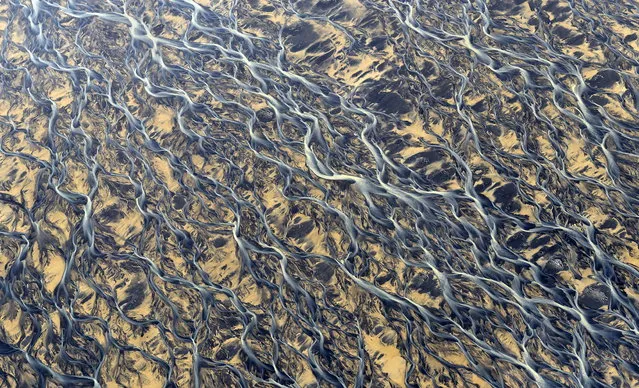
These pictures look like an artist has painted abstract patterns on canvas – but in fact they are natural rivers captured on camera. The spectacular rivers in Iceland's central highlands and southern parts originate from glaciers, which is why the water is a milky colour. (Photo by Andrey Ermolaev/Solent News)

These picture look like an artist has painted abstract patterns on canvas – but in fact they are natural rivers captured on camera. The spectacular rivers in Iceland's central highlands and southern parts originate from glaciers, which is why the water is a milky colour. They are shallow rivers and the water spreads quickly over a flat and sandy surface, creating random and beautiful patterns. Photographer Andrey Ermolaev from Moscow, Russia, flew 500ft above the unique sight in a small plane. (Photo by Andrey Ermolaev/Solent News)
Details
05 May 2014 10:57:00
A miner holds an amalgam of mercury and gold he mined after working a 28-hour shift at an illegal gold mining process in La Pampa, in Peru's Madre de Dios region. (Photo by Rodrigo Abd/AP Photo)

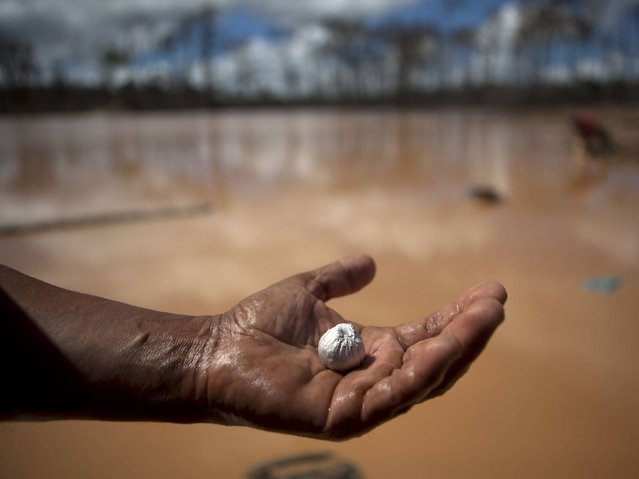
In this May 4, 2014 photo, a miner holds an amalgam of mercury and gold he mined after working a 28-hour shift at an illegal gold mining process, in La Pampa, in Peru's Madre de Dios region. Thousands of artisanal gold miners sweat through the long shifts and endure, for a few grams of gold, the perils of collapsing earth, limb-crushing machinery and the toxic mercury used to bind gold flecks. (Photo by Rodrigo Abd/AP Photo)
Details
14 May 2014 10:05:00