Loading...
Done
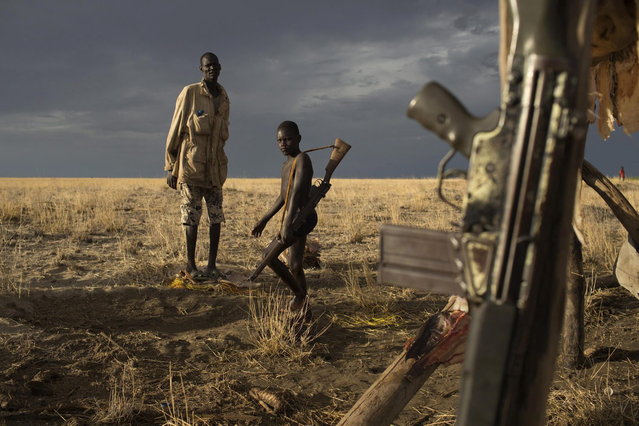
A Turkana man and a boy carrying a gun look on as a G3 battle rifle hangs from a structure used to dry fish at a fishing camp on the shores of Lake Turkana, some kilometres from Todonyang near the Kenya-Ethiopia border in northwestern Kenya October 12, 2013. (Photo by Siegfried Modola/Reuters)

A Turkana man and a boy carrying a gun look on as a G3 battle rifle hangs from a structure used to dry fish at a fishing camp on the shores of Lake Turkana, some kilometres from Todonyang near the Kenya-Ethiopia border in northwestern Kenya October 12, 2013The Turkana are traditionally nomadic pastoralists, but they have seen the pasture that they need to feed their herds suffer from recurring droughts and many have turned to fishing. However, Lake Turkana is overfished, and scarcity of food and pastureland is fuelling long-standing conflict with Ethiopian indigenous Dhaasanac, who have seen grazing grounds squeezed by large-scale government agricultural schemes in southern Ethiopia. The Dhaasanac now venture ever deeper into Kenyan territory in search of fish and grass, clashing with neighbours. Fighting between the communities has a long history, but the conflict has become ever more fatal as automatic weapons from other regional conflicts seep into the area. While the Turkana region is short of basics like grass and ground-water, it contains other resources including oil reserves and massive, newly discovered underground aquifers. (Photo by Siegfried Modola/Reuters)
Details
05 Dec 2013 12:08:00
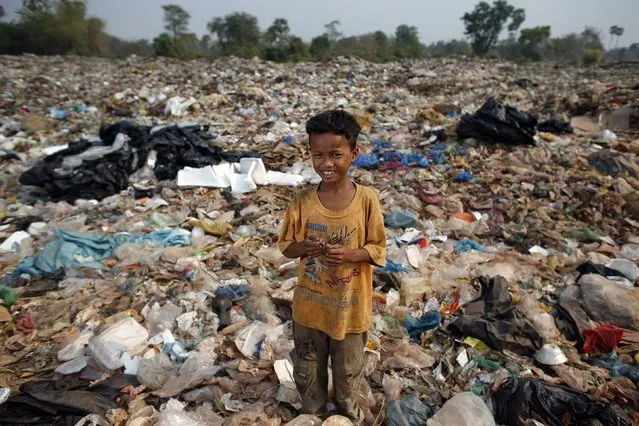
Ty, a 15-year-old boy, poses for a picture while collecting usable items at a landfill dumpsite outside Siem Reap March 19, 2015. Ty, who finished  six-grade primary school, said he makes 5 USD per month working at the dumpsite. (Photo by Athit Perawongmetha/Reuters)

Ty, a 15-year-old boy, poses for a picture while collecting usable items at a landfill dumpsite outside Siem Reap March 19, 2015. Ty, who finished six-grade primary school, said he makes 5 USD per month working at the dumpsite. (Photo by Athit Perawongmetha/Reuters)
Details
22 Mar 2015 11:13:00
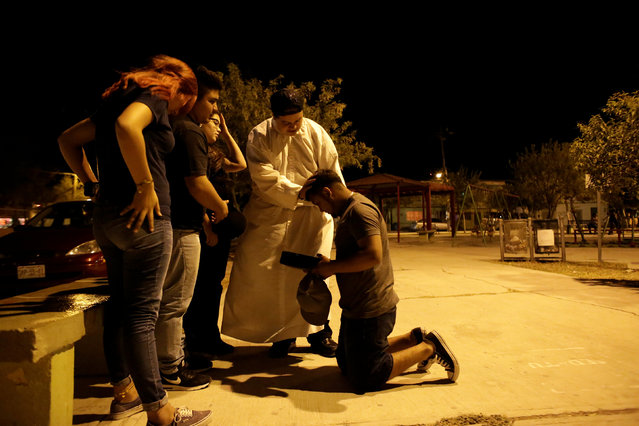
An aspiring Catholic priest Jose Luis Guerra, a member of Raza Nueva in Christ, a project of the archdiocese of Monterrey, and other missionaries hand out a Bible to Angel Castillo, who wants to become a missionary with Raza Nueva, in the municipality of Garcia, outskirts of Monterrey, Mexico, July 12, 2016. (Photo by Daniel Becerril/Reuters)

An aspiring Catholic priest Jose Luis Guerra, a member of Raza Nueva in Christ, a project of the archdiocese of Monterrey, and other missionaries hand out a Bible to Angel Castillo, who wants to become a missionary with Raza Nueva, in the municipality of Garcia, outskirts of Monterrey, Mexico, July 12, 2016. In the troubled fringes of the northern Mexican city of Monterrey, an aspiring priest is using his faith to reach out to young gang members and at-risk youth, and bring them into his “Gang of Christ”. (Photo by Daniel Becerril/Reuters)
Details
28 Jul 2016 13:22:00
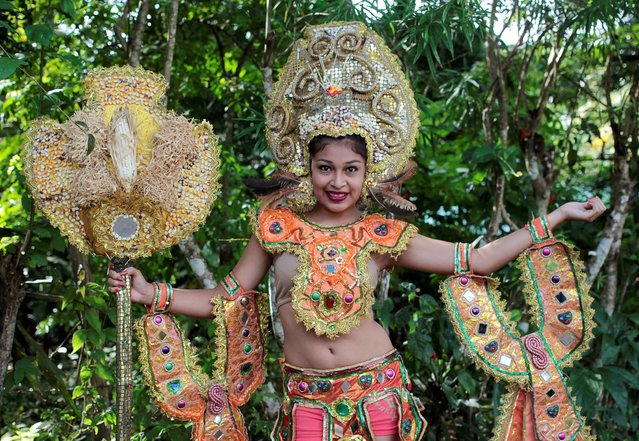
An Indigenous schoolchild dressed in traditional attire takes part in a rally to commemorate Indigenous Resistance Day in Catarina town, Nicaragua October 12, 2016. (Photo by Oswaldo Rivas/Reuters)

An Indigenous schoolchild dressed in traditional attire takes part in a rally to commemorate Indigenous Resistance Day in Catarina town, Nicaragua October 12, 2016. This holiday coincides with Columbus Day which commemorates Christopher Columbus landing in America in 1492. But rather than celebrating the discovery of the Americas, the Nicaraguans observe Indigenous Resistance Day to celebrate the bravery of the indigenous population in the fight against the Spanish conquistadors. (Photo by Oswaldo Rivas/Reuters)
Details
14 Oct 2016 12:04:00
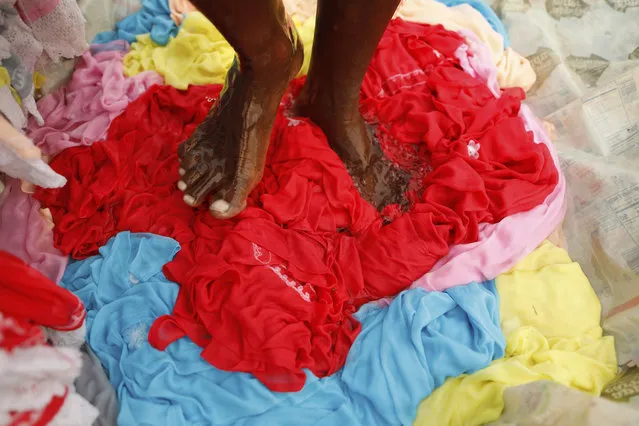
A dhobi, or a washerman washes cloths on the banks of the River Gomti in Lucknow, India, Saturday, September 12, 2020. Dhobis are traditional laundry workers who wash clothes by hand and dry them in the sun, an occupation which has been in existence for generations. Most cities in India have a Dhobi Ghat, or washermen's area, where the city's pile of clothes is laundered. This practice is still popular in India, despite of modern technology. Around 1,000 families work in Lucknow's Dhobi Ghat. However, in light of the novel coronavirus, their wages have decreased drastically. With each family earning around US$100-200 per month. (Photo by Rajesh Kumar Singh/AP Photo)

A dhobi, or a washerman washes cloths on the banks of the River Gomti in Lucknow, India, Saturday, September 12, 2020. Dhobis are traditional laundry workers who wash clothes by hand and dry them in the sun, an occupation which has been in existence for generations. Most cities in India have a Dhobi Ghat, or washermen's area, where the city's pile of clothes is laundered. This practice is still popular in India, despite of modern technology. Around 1,000 families work in Lucknow's Dhobi Ghat. However, in light of the novel coronavirus, their wages have decreased drastically. With each family earning around US$100-200 per month. (Photo by Rajesh Kumar Singh/AP Photo)
Details
25 Sep 2020 00:03:00
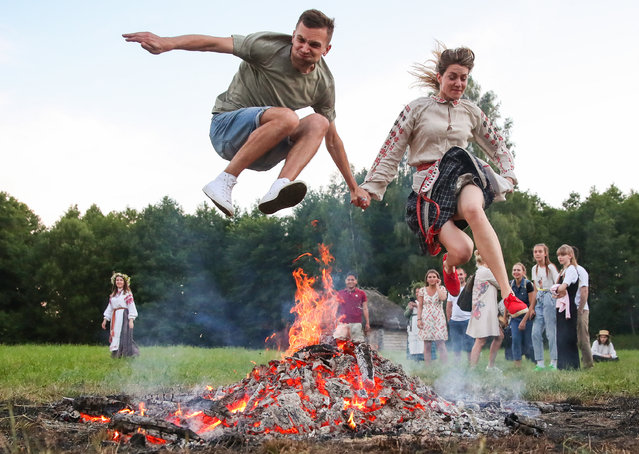
A man and a woman jump over a bonfire during Ivan Kupala Day celebrations held by the Belarusian State Museum of Folk Architecture and Rural Lifestyle in the village of Ozertso near Minsk, Belarus on July 4, 2020. Ivan Kupala Day, also known as Ivana-Kupala or Kupala Night, is a traditional pagan holiday celebrated in eastern Slavic cultures. Various rituals are traditionally performed on Kupala Night, including making flower wreaths, fortune-telling, jumping over bonfires, and burning a wheel-like effigy symbolizing the sun. (Photo by Natalia Fedosenko/TASS)

A man and a woman jump over a bonfire during Ivan Kupala Day celebrations held by the Belarusian State Museum of Folk Architecture and Rural Lifestyle in the village of Ozertso near Minsk, Belarus on July 4, 2020. Ivan Kupala Day, also known as Ivana-Kupala or Kupala Night, is a traditional pagan holiday celebrated in eastern Slavic cultures. Various rituals are traditionally performed on Kupala Night, including making flower wreaths, fortune-telling, jumping over bonfires, and burning a wheel-like effigy symbolizing the sun. (Photo by Natalia Fedosenko/TASS)
Details
23 Jan 2021 09:53:00
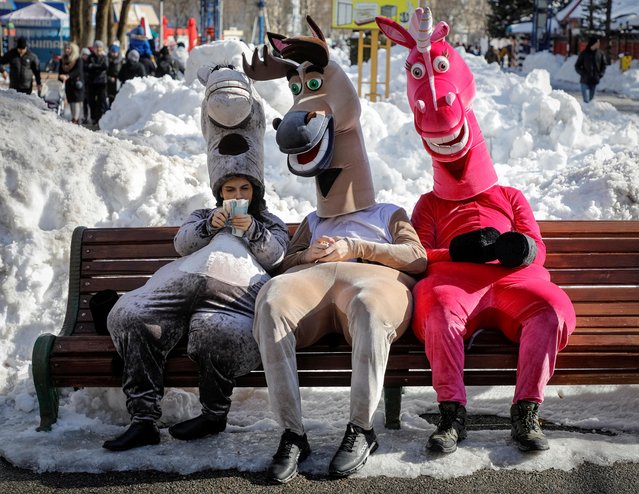
Street animators wearing fancy costumes take a break on a bench in a park in Stavropol, Russia on March 14, 2021. (Photo by Eduard Korniyenko/Reuters)

Street animators wearing fancy costumes take a break on a bench in a park in Stavropol, Russia on March 14, 2021. (Photo by Eduard Korniyenko/Reuters)
Details
21 Mar 2021 08:45:00
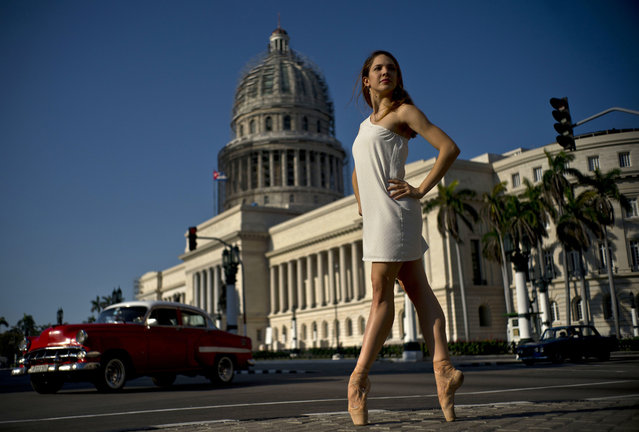
In this April 14, 2018 photo, National Ballet of Cuba dancer Daniela Gomez Perez stands on point as she poses outside the Capitol in Havana, Cuba. Gomez, who says Cubans love dancing, trusts the next generation of leaders will continue such traditions and that art will continue to be the engine of Cuban society. Gomez said she is proud to represent Cuba during a dance trip in May to Washington, Tampa and Chicago, and that the Cuban state has always supported dance. (Photo by Ramon Espinosa/AP Photo)

In this April 14, 2018 photo, National Ballet of Cuba dancer Daniela Gomez Perez stands on point as she poses outside the Capitol in Havana, Cuba. Gomez, who says Cubans love dancing, trusts the next generation of leaders will continue such traditions and that art will continue to be the engine of Cuban society. Gomez said she is proud to represent Cuba during a dance trip in May to Washington, Tampa and Chicago, and that the Cuban state has always supported dance. (Photo by Ramon Espinosa/AP Photo)
Details
01 May 2018 00:05:00