Loading...
Done
Iraqis run for cover as they flee Mosul's Al-Tayaran neighbourhood on February 28, 2017, during an offensive by Iraqi forces to retake the area from Islamic State (IS) group fighters. Hundreds of civilians fled through the desert to escape fighting and privation in Mosul, joining thousands of others who left their homes as conditions worsen in the city's west. (Photo by Ahmad Al-Rubaye/AFP Photo)

Iraqis run for cover as they flee Mosul's Al-Tayaran neighbourhood on February 28, 2017, during an offensive by Iraqi forces to retake the area from Islamic State (IS) group fighters. Hundreds of civilians fled through the desert to escape fighting and privation in Mosul, joining thousands of others who left their homes as conditions worsen in the city's west. (Photo by Ahmad Al-Rubaye/AFP Photo)
Details
02 Mar 2017 00:01:00
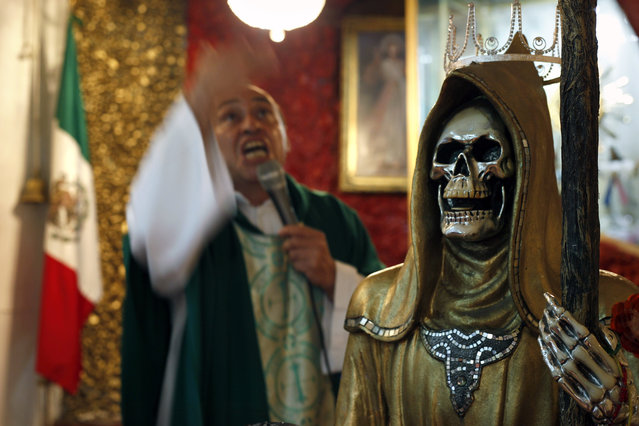
In this February 19, 2017 photo, a statue of the Death Saint stands inside Mercy Church as Juan Carlos Avila Mercado gives a service, on the edge of Mexico City's Tepito neighborhood. “She chooses them and has always been with us”, said Avila, who says he is a Catholic priest, but who is not listed among the archdiocese's priests. “We are born and we die with death”. (Photo by Marco Ugarte/AP Photo)

In this February 19, 2017 photo, a statue of the Death Saint stands inside Mercy Church as Juan Carlos Avila Mercado gives a service, on the edge of Mexico City's Tepito neighborhood. “She chooses them and has always been with us”, said Avila, who says he is a Catholic priest, but who is not listed among the archdiocese's priests. “We are born and we die with death”. (Photo by Marco Ugarte/AP Photo)
Details
14 Mar 2017 00:01:00
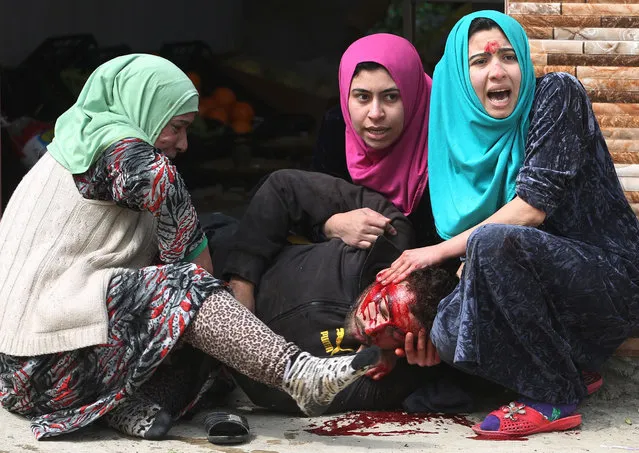
Iraqi women cry over their brother's body, who was killed by a mortar shell fired by Islamic State (IS) group jihadists on civilians who were gathered to receive aid, in Al-Risala neighbourhood on March 22, 2017, as an ongoing offensive by Iraqi forces to retake the city from the group continues. Iraqi forces launched a major operation to recapture west Mosul – the most-populated urban area still held by IS – on February 19, and have retaken a series of neighbourhoods from the jihadists. (Photo by Ahmad Al-Rubaye/AFP Photo)

Iraqi women cry over their brother's body, who was killed by a mortar shell fired by Islamic State (IS) group jihadists on civilians who were gathered to receive aid, in Al-Risala neighbourhood on March 22, 2017, as an ongoing offensive by Iraqi forces to retake the city from the group continues. Iraqi forces launched a major operation to recapture west Mosul – the most-populated urban area still held by IS – on February 19, and have retaken a series of neighbourhoods from the jihadists. (Photo by Ahmad Al-Rubaye/AFP Photo)
Details
27 Mar 2017 08:30:00
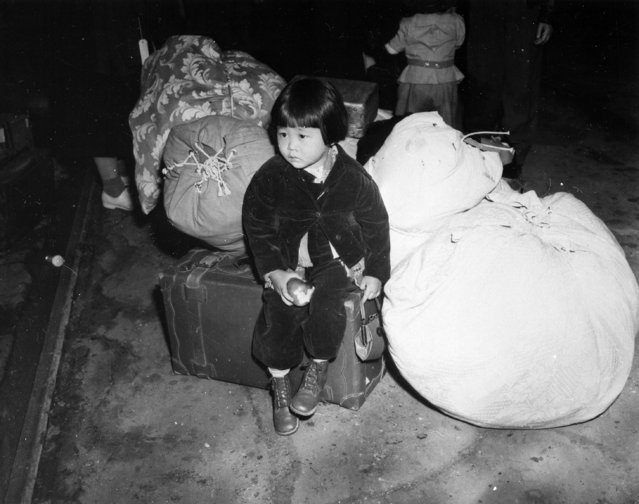
A young evacuee of Japanese ancestry waits with the family baggage before leaving by bus for an assembly center in California, in this April 1942 handout photo. (Photo by Courtesy Clem Albers/Department of the Interior/War Relocation Authority/National Archives/Reuters)

A young evacuee of Japanese ancestry waits with the family baggage before leaving by bus for an assembly center in California, in this April 1942 handout photo. February 19, 2017 marks the 75th anniversary of FDR signing executive order 9066, authorizing the internment of Japanese Americans during World War Two. (Photo by Courtesy Clem Albers/Department of the Interior/War Relocation Authority/National Archives/Reuters)
Details
19 Feb 2017 00:02:00
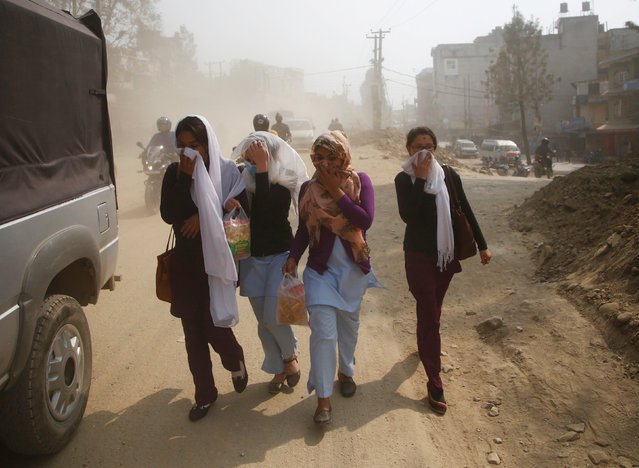
Pedestrians cover their face as they walk along the dusty road in Kathmandu, Nepal February 27, 2017. Nepal has forced 2,500 old vehicles off roads in its capital city of Kathmandu, part of a fight against alarming air pollution levels that have hit nine times World Health Organisation (WHO) limits. Air pollution has been a chronic problem in rapidly growing Kathmandu, which sits in a Himalayan valley and is home to more than 3mn people. Rising public anger with the smog is turning into a headache for a beleaguered government headed by former Maoist rebels. Dust from road works, exhaust from old, poorly maintained vehicles and smoke from coal-burning brick kilns blend in a murky haze that hangs over the ancient city, raising the risk of cancer, stroke, asthma and high blood pressure, experts say. Officials hope the ban on vehicles more than 20 years old will be a step towards a cleaner future. (Photo by Navesh Chitrakar/Reuters)

Pedestrians cover their face as they walk along the dusty road in Kathmandu, Nepal February 27, 2017. Nepal has forced 2,500 old vehicles off roads in its capital city of Kathmandu, part of a fight against alarming air pollution levels that have hit nine times World Health Organisation (WHO) limits. Air pollution has been a chronic problem in rapidly growing Kathmandu, which sits in a Himalayan valley and is home to more than 3mn people. (Photo by Navesh Chitrakar/Reuters)
Details
04 Mar 2017 00:04:00
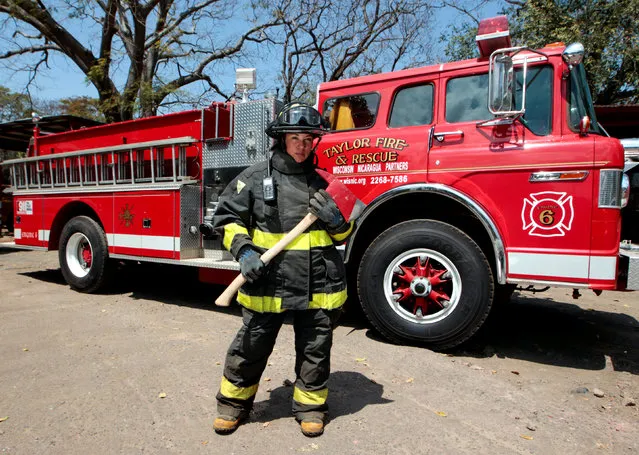
Yolaina Chavez Talavera, 31, a firefighter, poses for a photograph in front of a truck at a fire station in Managua, Nicaragua, February 22, 2017. “In my early days as a female firefighter, men, my team mates, thought that I would not last long in the organisation due to the hard training. However, in practice I showed them that I am able to take on tasks at the same level as men. I think women must fight to break through in all areas, in the midst of the machismo that still persists in Nicaragua and in Hispanic countries”, Talavera said. (Photo by Oswaldo Rivas/Reuters)

Wednesday March 8 marks International Women's Day, with festivals, concerts and exhibitions among the numerous events planned around the world to celebrate the achievements of women in society. The annual event has been held since the early 1900s and traditionally promotes a different theme each year, with this year's edition calling on people to #BeBoldForChange and push for a more gender-inclusive working world. Reuters photographers have been speaking with women in a range of professions around the world about their experiences of gender inequality. Here: Yolaina Chavez Talavera, 31, a firefighter, poses for a photograph in front of a truck at a fire station in Managua, Nicaragua, February 22, 2017. (Photo by Oswaldo Rivas/Reuters)
Details
04 Mar 2017 00:06:00
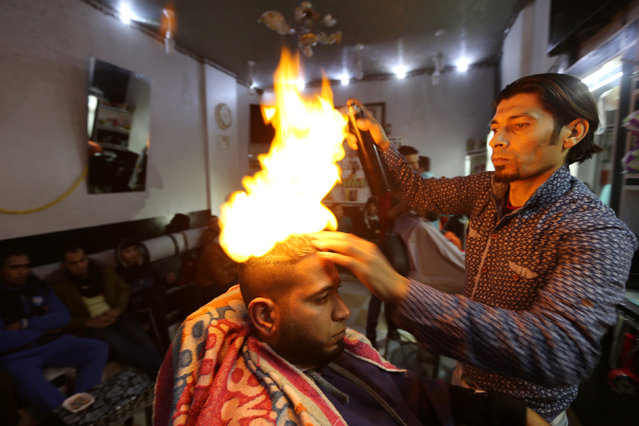
Palestinian barber Ramadan Odwan styles and straightens the hair of a customer with fire at his salon in Rafah, in the southern Gaza Strip February 2, 2017. In Ramadan Odwan's barbershop in Gaza, hair isn't just blow-dried, it's blowtorch-dried. “People have gone crazy about it, many people are curious to go through the experience and they are not afraid”, he told Reuters. “People here love adventures”. Odwan, 37, is not the first stylist in the world to use flame to straighten hair, but his craft is unique in the Gaza Strip. In his salon in the southern Gaza town of Rafah, Odwan applied what he described as a protective liquid coating to a customer's hair – he declined to disclose its contents – before aiming for the head and pressing the button on a small blowtorch. “I control how long I apply fire, I keep it on and off for 10 seconds or 15 seconds. It is completely safe and I have not encountered any accident since I started it two months ago”, Odwan added. Odwan charges 20 shekels ($5.20) for a haircut and fire-straightening. A barber for the past 18 years, he said part of the reason he uses the technique is to show that Palestinian barbers are as “professional as those out there around the world”. (Photo by Ibraheem Abu Mustafa/Reuters)

Palestinian barber Ramadan Odwan styles and straightens the hair of a customer with fire at his salon in Rafah, in the southern Gaza Strip February 2, 2017. In Ramadan Odwan's barbershop in Gaza, hair isn't just blow-dried, it's blowtorch-dried. “People have gone crazy about it, many people are curious to go through the experience and they are not afraid”, he told Reuters. “People here love adventures”. (Photo by Ibraheem Abu Mustafa/Reuters)
Details
11 Feb 2017 00:05:00
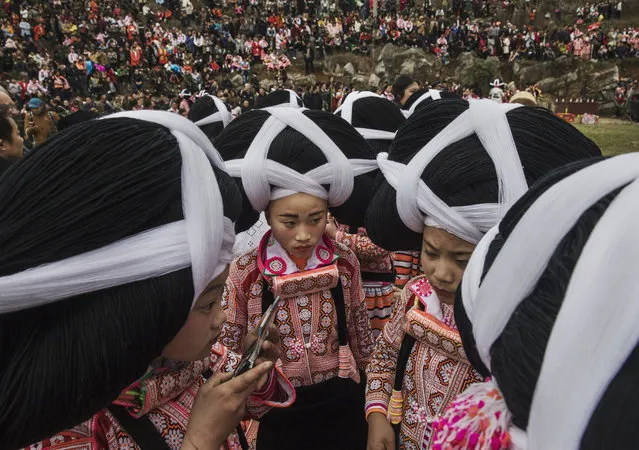
Girls of the Long Horn Miao ethnic minority group wear headdresses as they prepare gather for Tiaohua or Flower Festival as part of the Lunar New Year on February 6, 2017 in Longga village, Guizhou province, southern China. The Long Horn Miao are recognized for their declining practice of wrapping a blend of linen, wool, and the hair of their ancestors around animal horns or a wooden clip to make headdresses. Many young women say they now wear the headdresses only for special occasions and festivals, as the ornaments, which are attached by the horns to their real hair, have proved impractical for modern daily life in a fast changing world. China officially recognizes 56 different ethnic minorities, and statistics show over 7 million Chinese identifying themselves as Miao. But the small Long Horn Miao community counts only around 5000 people living in 12 villages, whose age-old traditions, language, and culture are fading. It is increasingly difficult in a modernizing China, as young people are drawn from remote rural villages to opportunities in bigger cities amongst wide-scale urbanization. Farming and labour remain the mainstays of life for the Long Horn Miao, leaving the area relatively poor in comparison with many parts of China. The government has invested significant amounts into local infrastructure and the tourism industry to try to bolster the local economy. (Photo by Kevin Frayer/Getty Images)

Girls of the Long Horn Miao ethnic minority group wear headdresses as they prepare gather for Tiaohua or Flower Festival as part of the Lunar New Year on February 6, 2017 in Longga village, Guizhou province, southern China. (Photo by Kevin Frayer/Getty Images)
Details
13 Feb 2017 00:01:00