Loading...
Done
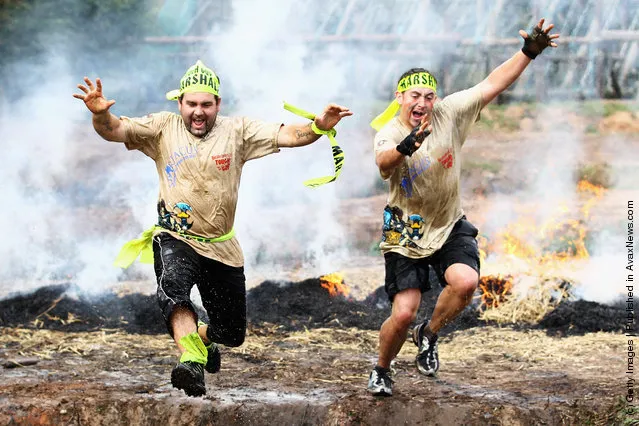
2011 Spartacus Challenge

Participants run through the flames in the 2011 Spartacus Challenge on October 2, 2011 in Wolverhamton, England. (Photo by Dean Mouhtaropoulos/Getty Images)
Details
04 Oct 2011 10:33:00
21st International Tattoo Convention

A customer grimaces in pain as she gets a tattoo on her arm at the 21st International Tattoo Convention Berlin on December 3, 2011 in Berlin, Germany. The annual tattoo trade fair runs from December 2–4, 2011. (Photo by Adam Berry/Getty Images)
Details
04 Dec 2011 12:32:00
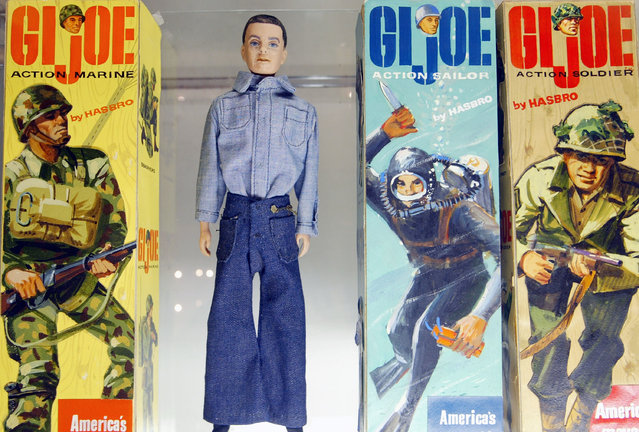
Vintage G.I. Joe figurers are on display at the 2003 Hasbro International G.I. Joe Collectors' Convention June 27, 2003 in Burlingame, California. Hundreds of G.I. Joe fans from around the country are attending the convention to buy, sell and trade G.I. Joe and military action figures. (Photo by Justin Sullivan/Getty Images)

“G.I. Joe is a line of action figures produced by the toy company Hasbro. The term G.I. stands, in popular usage, for Government Issued and after the First World War became a generic term for U.S. soldiers. The origin of the term dates to World War I, when much of the equipment issued to U.S. soldiers was stamped “G.I.”, meaning that it was made from galvanized iron. The development of G.I. Joe led to the coining of the term “action figure”. G.I. Joe's appeal to children has made it an American icon among toys”. – Wikipedia. Photo: Vintage G.I. Joe figurers are on display at the 2003 Hasbro International G.I. Joe Collectors' Convention June 27, 2003 in Burlingame, California. (Photo by Justin Sullivan/Getty Images)
Details
27 Mar 2014 07:46:00
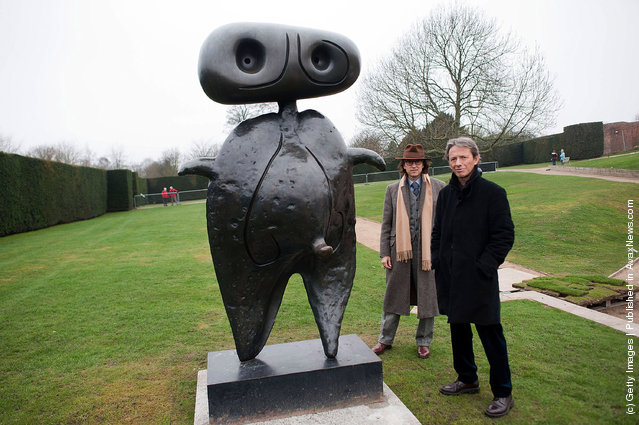
Joan Miro's, grandsons, Emilio Fernandez Miro and Joan Punyet Miro pose beside Personnage (1970) in the Yorkshire Sculpture park

“Joan Miro i Ferra (April 20, 1893 – December 25, 1983) was a Spanish Catalan painter, sculptor, and ceramicist born in Barcelona. Earning international acclaim, his work has been interpreted as Surrealism, a sandbox for the subconscious mind, a re-creation of the childlike, and a manifestation of Catalan pride. In numerous interviews dating from the 1930s onwards, Miro expressed contempt for conventional painting methods as a way of supporting bourgeois society, and famously declared an “assassination of painting” in favour of upsetting the visual elements of established painting”. – Wikipedia

Photo: Joan Miro's, grandsons, Emilio Fernandez Miro and Joan Punyet Miro pose beside Personnage (1970) in the Yorkshire Sculpture park on March 14, 2012 in Wakefield, England. Yorkshire Sculpture Park stages the first major UK survey of sculpture by Spanish artist Joan Miro. (Photo by Bethany Clarke/Getty Images)
Details
15 Mar 2012 13:47:00


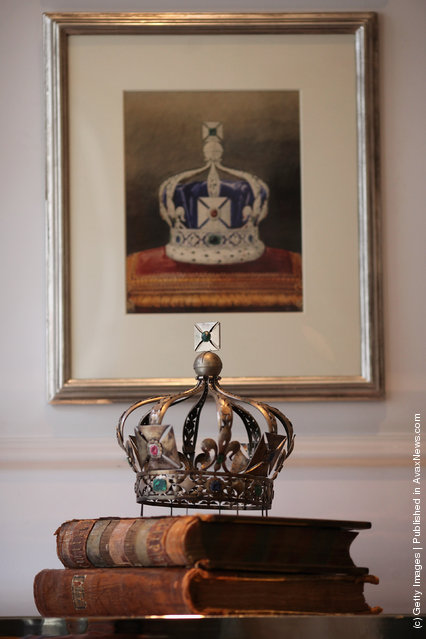
A preparatory model of the Imperial State Crown of India worn in 1911 by King George V stands next to original ledgers dating from 1735 in Garrard's flagship store in Mayfair on April 6, 2011 in London, England. Garrard is the world's oldest jewellers having been founded by George Wickes in 1735 and soon after appointed as goldsmith to the Prince of Wales. For over 160 years Garrard held the title of Crown Jeweller, bestowed by Queen Victoria in 1843, Garrard have served six successive monarchs. They have produced several royal crowns as well as the engagement ring presented to Kate Middleton by Prince William and formerly Princess Diana's engagement ring. (Photo by Oli Scarff/Getty Images)
Details
17 Apr 2011 10:22:00


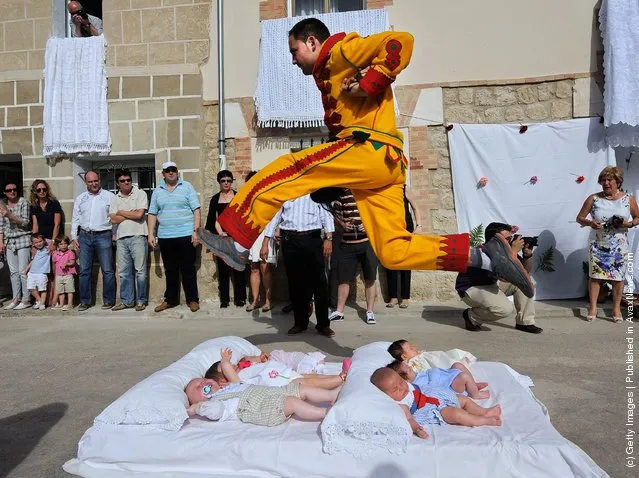
“Baby jumping (El Colacho) is a traditional Spanish practice dating back to 1620 that takes place annually to celebrate the Catholic feast of Corpus Christi in the village of Castrillo de Murcia near Burgos. During the act – known as El Salto del Colacho (the devil's jump) or simply El Colacho – men dressed as the Devil (known as the Colacho) jump over babies born during the previous twelve months of the year who lie on mattresses in the street. ... The festival has been rated as one of the most dangerous in the world”. – Wikipedia

Photo: A man representing the devil leaps over babies during the festival of El Colacho on June 26, 2011 in Castrillo de Murcia near Burgos, Spain. The festival, held on the first Sunday after Corpus Cristi, represents the devil taking away original sin from the newly born babies by leaping over them. (Photo by Denis Doyle/Getty Images)
Details
27 Jun 2011 09:20:00
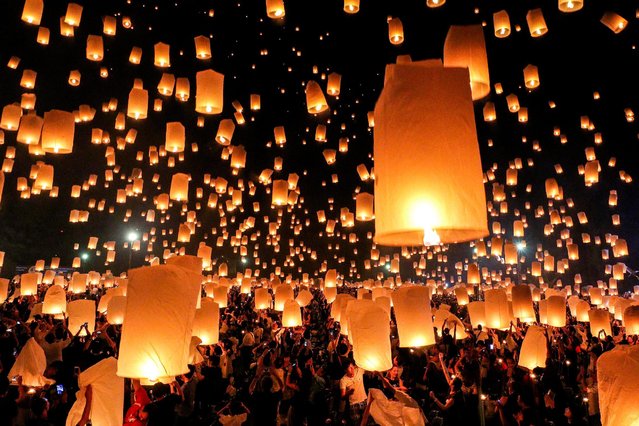
People release floating lanterns during the festival of Yee Peng in the northern capital of Chiang Mai, Thailand November 14, 2016. Yi Peng refers to the full moon day in the second month according to the Lanna lunar calendar (the twelfth month according to the Thai lunar calendar). Swarms of Lanna-style sky lanterns are launched into the air where they resemble large shoals of giant fluorescent jellyfish gracefully floating through the sky. The festival is meant as a time for tham bun, to make merit. Khom loi are made from a thin fabric, such as rice paper, stretched over a bamboo or wire frame, to which a candle or fuel cell is attached. When the fuel cell is lit, the resulting hot air is trapped inside the lantern and creates enough lift for the khom loi to float up into the sky. (Photo by Athit Perawongmetha/Reuters)

People release floating lanterns during the festival of Yee Peng in the northern capital of Chiang Mai, Thailand November 14, 2016. Yi Peng refers to the full moon day in the second month according to the Lanna lunar calendar (the twelfth month according to the Thai lunar calendar). Swarms of Lanna-style sky lanterns are launched into the air where they resemble large shoals of giant fluorescent jellyfish gracefully floating through the sky. The festival is meant as a time for tham bun, to make merit. Khom loi are made from a thin fabric, such as rice paper, stretched over a bamboo or wire frame, to which a candle or fuel cell is attached. When the fuel cell is lit, the resulting hot air is trapped inside the lantern and creates enough lift for the khom loi to float up into the sky. (Photo by Athit Perawongmetha/Reuters)
Details
15 Nov 2016 11:54:00
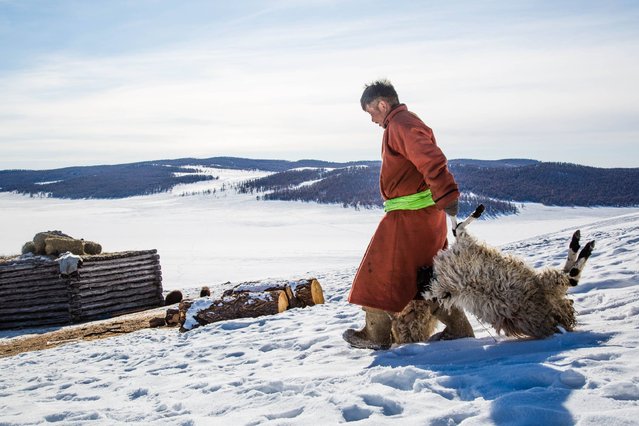
This handout photo taken on February 12, 2017 and released on February 16 by the International Federation of Red Cross and Red Crescent Societies (IFRC) shows Mongolian herder Munkhbat Bazarragchaa (C) dragging two sheep – which recently died due to the weather - to a pile of dead animals behind his “ger” in Khuvsgul province, northern Mongolia. Thousands of Mongolian herders face disastrous livestock losses from dreaded severe weather  known as the “dzud”, the Red Cross said on February 16, 2017 in launching an international emergency aid appeal. (Photo by Mirva Helenius/AFP Photo/IFRC)

This handout photo taken on February 12, 2017 and released on February 16 by the International Federation of Red Cross and Red Crescent Societies (IFRC) shows Mongolian herder Munkhbat Bazarragchaa (C) dragging two sheep – which recently died due to the weather - to a pile of dead animals behind his “ger” in Khuvsgul province, northern Mongolia. Thousands of Mongolian herders face disastrous livestock losses from dreaded severe weather known as the “dzud”, the Red Cross said on February 16, 2017 in launching an international emergency aid appeal. (Photo by Mirva Helenius/AFP Photo/IFRC)
Details
17 Feb 2017 11:40:00